

Systems
Your Team Could Be Crushing It
A few years ago, a client of mine lost his best account manager.
She was sharp -- strong client relationships, high output, someone you build around. She left for a smaller company with less upside. Her reason: "I spend more time trying to find information and status for my clients than actually helping my clients."
She wasn't wrong. Every client request started with a 20-minute scavenger hunt through three inboxes, an unmaintained shared drive, and multiple Slack threads. By the time she had what she needed, the energy to actually help the client was gone. She was doing that multiple times per day.
He lost a key person over information structure. Or rather, the absence of one.
That story comes back to me whenever an operator tells me they need their team to move faster. Most business owners are not clear about the source of the problems that trip their teams up.
[Case Study] His business runs without him now. Here's how.
This founder ran a med spa opening its second location. But he was the bottleneck in his own business, every question ran through him, and he couldn't step away without things slowing down.
We built him a CompanyOS in Notion that put his entire operation in one place, and now his team runs without him. The result: at least 10 hours a week back, and a business that doesn't need him to function.
Watch The Full Story On Youtube
Why This Matters Now
Gartner surveyed digital workers in 2023 and found that 47% of them struggle to find the information they need to do their jobs. Nearly half of every team are operating under capacity -- not from lack of effort or intelligence, but because the information they need lives somewhere hard to find and often unreliable.
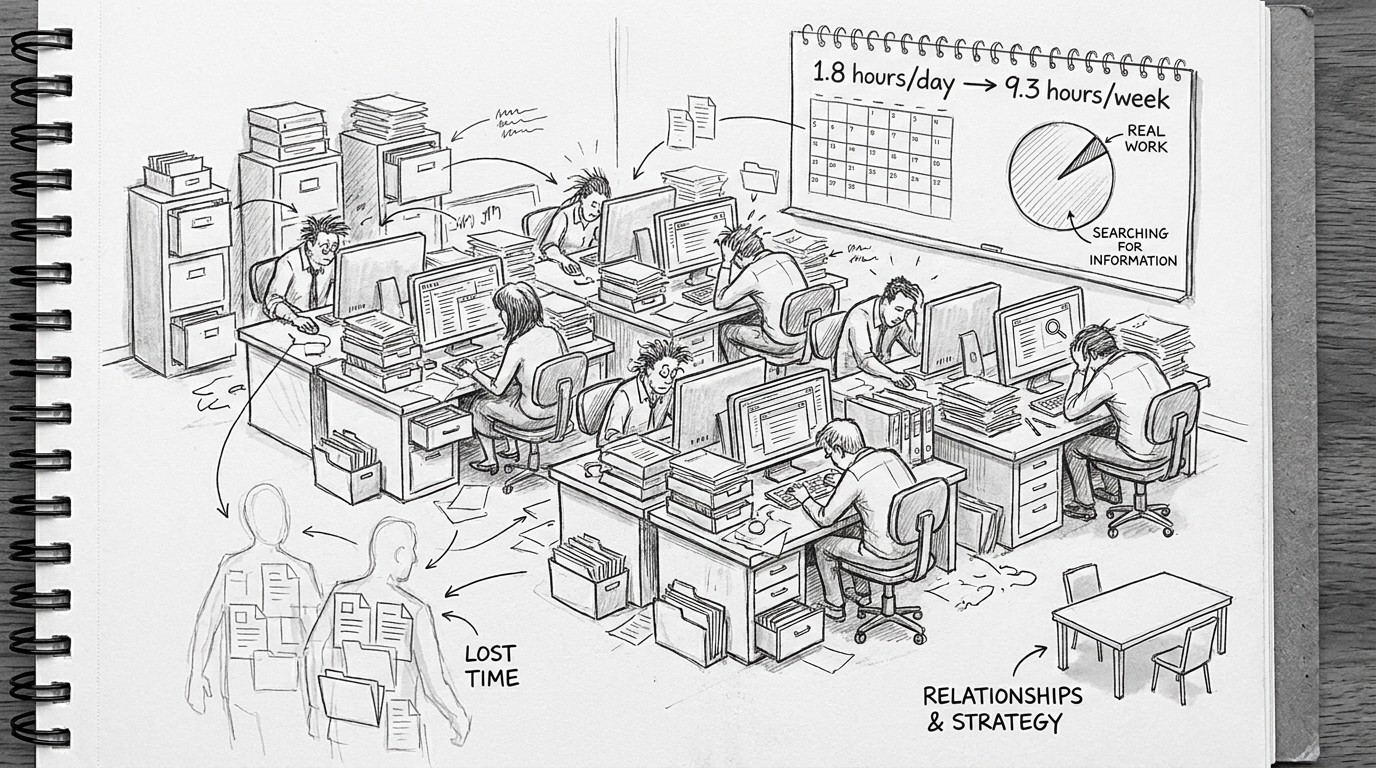
McKinsey put a number on the time cost: the average knowledge worker spends 1.8 hours every day -- 9.3 hours per week -- searching and gathering information before doing a minute of actual work.
If you have ten people on your team, that's roughly two full-time employees whose entire workweek goes to hunting for answers. Two people. Not building relationships. Not thinking ahead. But simply looking for documents!
You hired them to help grow the business. The system is making them file clerks instead.
McKinsey also found that when organizations centralize knowledge into one accessible system, employees can cut information-search time by up to 35% (This is much higher in our experience having used a central OS in our own and client’s businesses for 8+ years). That time goes somewhere. The question is where you point it.
The Bigger Unlock…
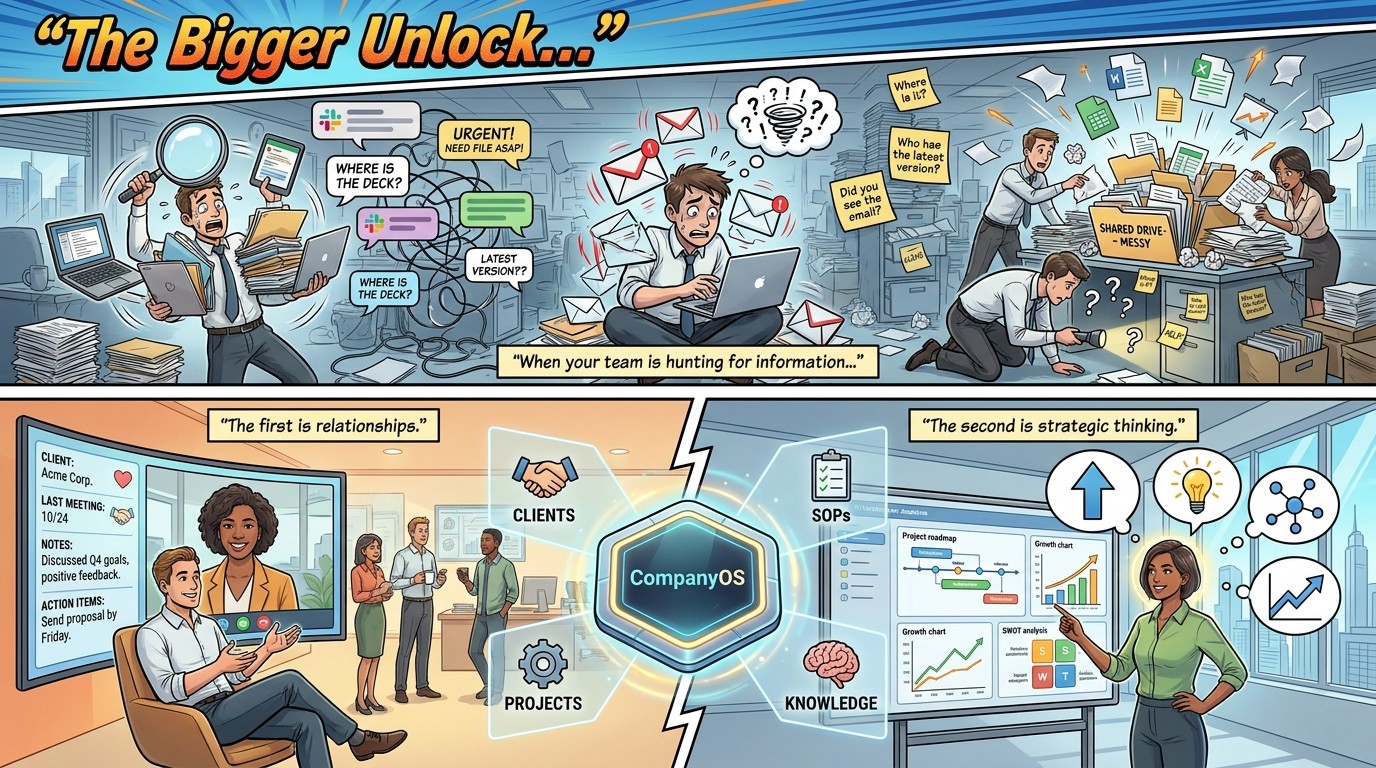
A system like Modern Operator’s CompanyOS has much bigger unlocks than just more productivity or efficiency. When your team stops hunting for information, two specific things start happening -- things that don't happen any other way.
The first is relationships.
Client deepening, vendor negotiations, affiliate conversations, potential partner outreach -- all of it runs on sustained human attention. You can't compress relationship-building into 15-minute windows between task switches. It requires presence, follow-through, and the mental bandwidth to actually listen.
When your team is heads-down in logistics -- tracking down contract versions, figuring out what was promised to which client, cross-referencing notes from last month -- they're not present. They can't be. Relationships that could develop into something real quietly stall. Not because anyone dropped the ball. Because no one had the attention to hold it.
Having one place where company answers lives doesn't just save time... It returns attention back to your staff. And attention is what allows relationships to grow.
The second is strategic thinking.
There's a story many founders tell themselves: "I'm the only one thinking strategically because I'm the only one with the full picture."
That's a systems failure, not a leadership trait.
When information is fragmented, reactive mode is rational. You can't plan around what you can't see. You can't propose a better approach to a process you're still trying to understand. So everyone defaults to putting out the fire in front of them -- because that's the only move available.
The shift from firefighting to proactive thinking doesn't come from a culture change, a management retreat, or a new hire. It comes from giving your team a shared operational foundation -- one place where context, history, and current state live -- so they can think from it instead of around it.
And when that foundation exists, something worth watching happens: strategic thinking stops being a founder only function. The account manager starts noticing patterns across clients and raising them before they become problems. Your ops lead starts flagging issues a week before they surface. Your junior hire starts asking the kinds of questions you used to only hear from senior people.
You didn't train them differently. You removed the friction that was suppressing the capability they already had.
That's the real story that enables leveraged and exponential growth. Not raw hustle. Not headcount. A system that lets your people do the work they were hired to do.
How to Apply This (This Week)
You don't need a full operational overhaul to start moving in this direction. Start here:
Ask your team one question. "What's the one piece of information you waste the most time trying to find?" Their answers will show you exactly where the system is leaking.
Pick one information type and centralize it. Client notes. SOPs. Project status. Whatever surfaces most. One place, one version, and it's not negotiable.
Eliminate the "who has it?" question. If your team regularly has to ask another person for something that should live in a system, that's a gap. Map it. Fill it.
Give your team protected time for non-reactive work -- but only after you've removed at least one information-hunting bottleneck. Space without context doesn't produce strategic thinking. Neither does context with no space to use it.
Watch where the attention goes. After centralizing one information type, track whether team behavior shifts. Are relationship conversations happening more? Are problems getting raised earlier? That's the signal you're looking for -- not an efficiency dashboard, but where people are actually spending their energy.
Final Thoughts
The question worth asking isn't how to get your team to move faster.
It's what they're doing instead of the work that matters.
In most businesses I've worked with, the answer is the same: they're hunting. Tracking down information that should already be accessible. Staying reactive because the system gives them no other option.
Fix the system. The speed follows.
-- Damon
How to get unstuck fast
Subscribe to our free newsletter that helps businesses go from working in the business to on the business.






Stay Updated with Us
Join the free weekly newsletter to see how smart founders operate modern companies.

Frameworks
Operational Models
Alignment


No Spam, Unsubscribe Any TIme