

Thought Leadership
The World Has Changed. Your Operations Hasn't.
Over the last 23 years of building and scaling companies, I've watched markets shift, lived through recessions, navigated the early days of the internet, mobile, social media, and cloud computing. Each wave brought disruption. Each wave rewarded the companies who adapted quickly and punished the ones who waited.
But what we're living through right now? This is different.
The pace of change has fundamentally broken the old model of business leadership. And the founders and operators who don't adapt fast are going to find themselves playing a game they don't recognize anymore.
In this newsletter, we’re going to take a look at the radically new landscape of Ops..
Why This Matters Now
Here's what's changed. And it's not subtle.
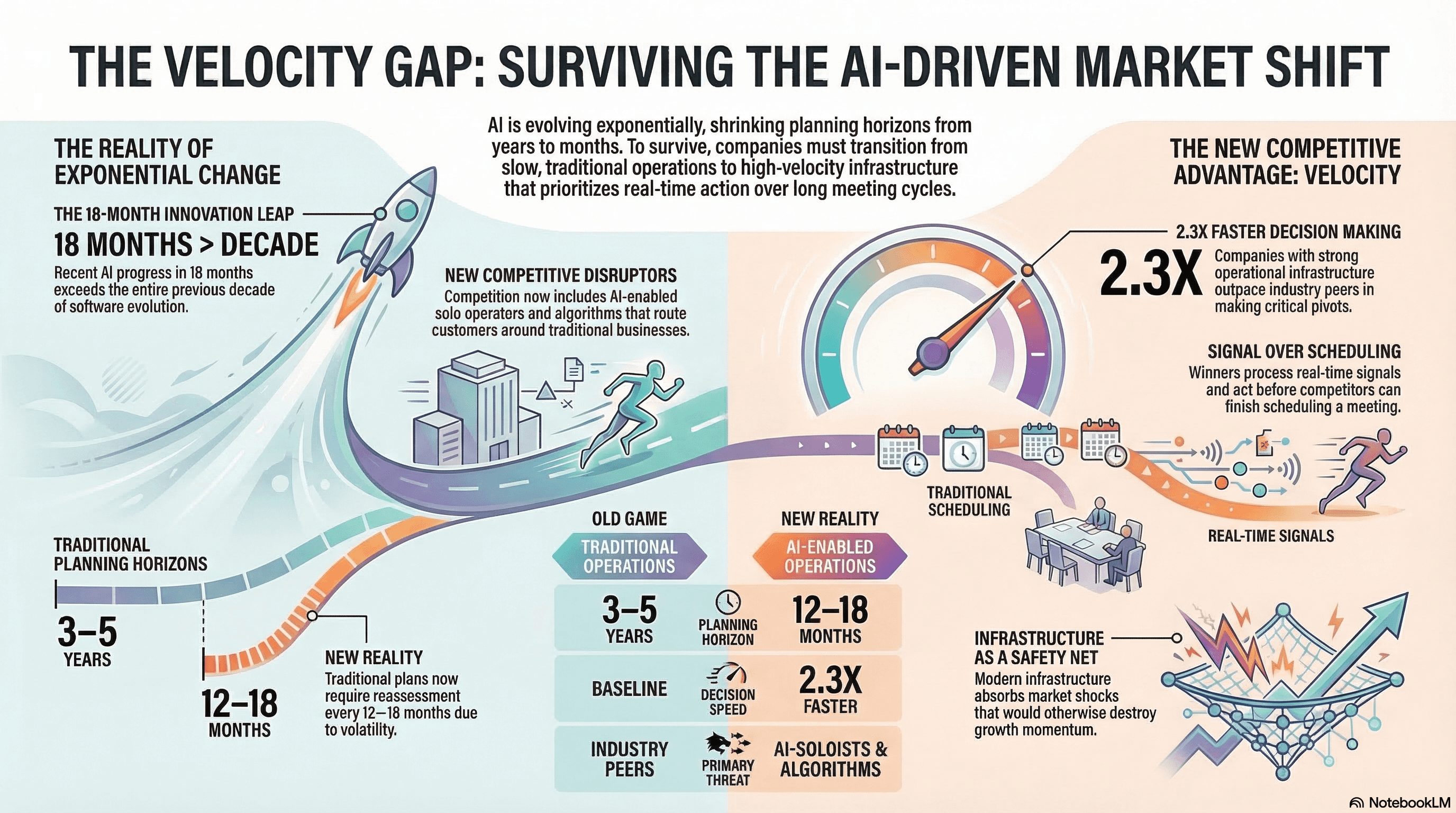
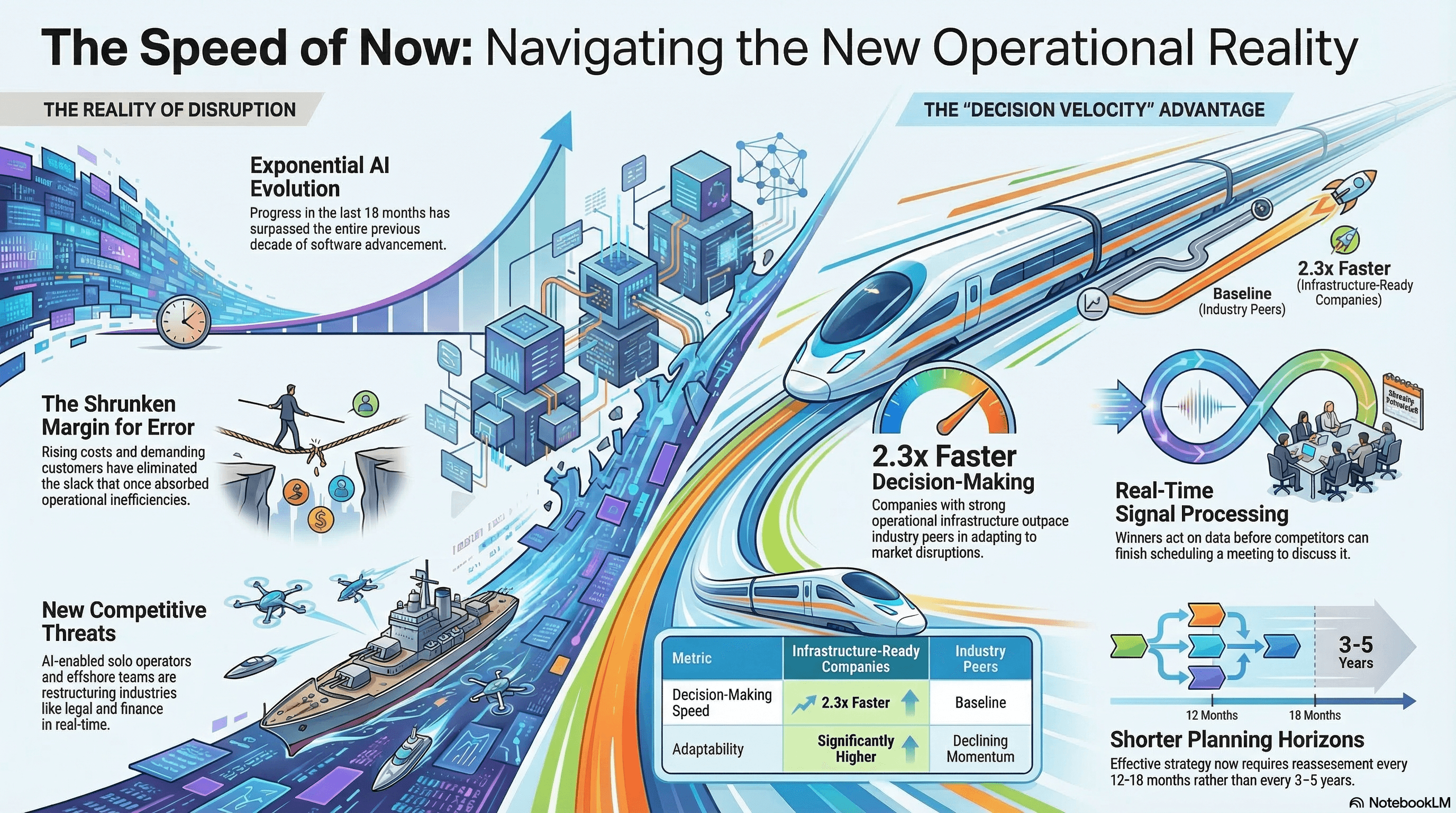
AI is evolving faster than any technology in human history. Not slightly faster. Exponentially faster. The gap between what was cutting-edge 18 months ago and what's available today is wider than the entire previous decade of software progress. And it's not slowing down. Every quarter, new capabilities are unlocked that change what's possible for a small team and every quarter, the companies who haven't built the infrastructure to leverage more capable tools fall further and further behind.
Markets are being disrupted at unprecedented speed. Industries that seemed immune (legal, finance, healthcare, creative services) are being restructured in real time. Your competitors aren't just other companies anymore. They're AI-enabled solo operators, offshore teams with world-class tools, and platform algorithms that can route customers around you before you even know there's a problem.
The "do more with less" pressure is relentless. Costs are up. Customers are more informed, more demanding, and quicker to switch. The margin for operational inefficiency… the slack that used to absorb founder mistakes and system gaps… has shrunk dramatically.
Uncertainty is the new normal. Supply chains. Interest rates. Regulatory shifts. Geopolitical volatility. The planning horizons that used to stretch 3–5 years now realistically extend maybe 12–18 months before requiring a serious reassessment.
Decision velocity is now a competitive advantage. The companies winning right now aren't always the ones with the best product or the most funding. They're the ones that can gather real-time signal, process it quickly, and act on it before their competitors even finish scheduling a meeting to discuss the same information.
According to McKinsey (2024), companies with strong operational infrastructure make decisions 2.3x faster than their industry peers and are significantly more likely to adapt to market disruptions without losing growth momentum.
Here's what all of this adds up to:
The old version of operations… the one most companies are still running… was built for a game that is no longer being played.
Let me prove it.
Take a founder I'll call Chris. He runs a $2.4M professional services firm. Sharp guy. Great at what he does. In 2022, his model was working. Then a wave of AI-enabled competitors entered his market, offering comparable output at 30% lower prices. His response time? Months. By the time he identified the threat, mapped a response, and got alignment from his team… he'd already lost three major accounts.
That's not a strategy problem. That's an operations problem. Because the business wasn't built to move fast.
In 2026, slow is the same as broken.
The Speed Test That May Signal Your Business Is Failing Right Now
Ask yourself these questions honestly:
If a new market opportunity appeared tomorrow, how fast could your team realistically move on it?
If you took a two-week vacation with no phone, would your business run smoothly… or start quietly unraveling?
If your best employee left on Friday, how much institutional knowledge would walk out the door with them?
If a competitor released a product that directly undercut your core offering, how quickly could you respond with a credible counter?
If a key vendor raised prices by 30% overnight, how fast could you model the impact and make a decision?
Most founder-led businesses can't answer these questions with confidence. Not because they lack talent or ambition, but because they were built for a slower world. A world where information moved in weekly reports, decisions could marinate for a few days, and operational inefficiency had enough margin to hide.
That world is gone. And it's not coming back.
Ops Used to Live in the Back. Now It Runs Everything.
Let me paint you a picture. If you've been in business for a while, some of this might be uncomfortably familiar.
Old-school operations was, to put it charitably, a support function. A cost center. The place where things went to slow down, get approved, and eventually…someday happen.
It lived in a silo. It had its own office… usually near the back, close to the filing cabinets and the ancient printer that only Gerald knew how to unclog. It reacted to problems. It cleaned up messes. It processed paperwork. It maintained compliance. It was the last team in the room and the first to get cut when budgets tightened.
Operations, in the old model, was essentially the adult in the room who made sure nothing actually caught fire. Metaphorically. Mostly.
And in fairness… that model worked. In a world where change was slow, customers were patient, and your competitive moat could hold for a decade on the strength of a single good product. Back-office operations was entirely reasonable.
But here's where it got problematic for founder-led businesses.
As companies scaled from $500K to $2M to $5M and beyond, the founder became the de facto operations department. Approvals, decisions, tribal knowledge, institutional memory, process guidance… it all lived in one person's head. And that person was you.
The founder became the operating system.
That worked fine… until it didn't.
Because here's the MAJOR PROBLEM about being the operating system for your own business: You Don't Scale!
You have 24 hours a day just like everyone else. You get tired, you go on vacation, you have kids who get sick, you have ideas that need your full attention. And every hour you spend being the answer-machine for your team is an hour you're not spending on the things only you can do: vision, strategy, relationships, growth.
The old model of operations created a ceiling. And most founders don't even realize they've hit it until they're staring at a revenue number that hasn't budged in 18 months and can't figure out why.
The 12 Responsibilities of Modern Operations
Modern Operations is not your grandfather's ops department. It is not a back-office function. It is not a cost center. It is not a team of people who exist to say "no" and process purchase orders.
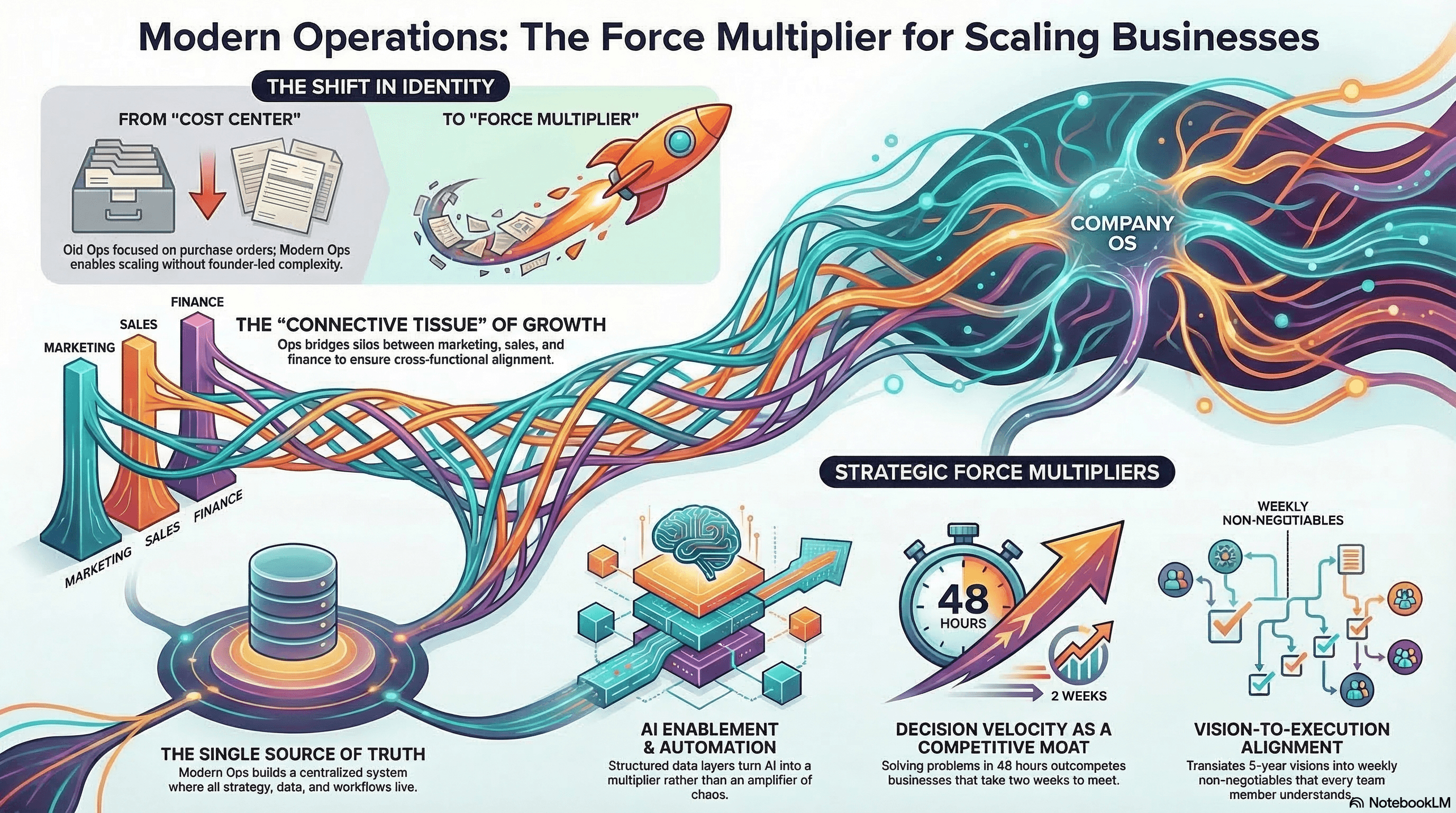
Modern Operations is now the connective tissue of your entire business.
It's the intelligence layer that makes every other function faster, smarter, and more aligned. It doesn't just support the business. It enables the business to scale without the founder as the operating system.
Here's the simplest way I can say it:
Old Operations was a department. Modern Operations is a force multiplier for your entire company.
Here's what Modern Operations is responsible for in a high-growth company:
🔹 Vision-to-Execution Alignment: Ops translates your 3–5 year vision into annual priorities, quarterly goals, and weekly non-negotiables. Every team member knows not just what to do, but why it matters and exactly how it connects to the bigger picture. This sounds simple. It is extraordinarily rare. Most companies have a vision… it lives in a deck that got presented at the annual offsite two years ago. Nobody refers to it. Nobody connects their daily work to it. Modern Ops closes that gap permanently.
🔹 Single Source of Truth: Modern Ops owns the centralized operating system where strategy, data, knowledge, and workflows live in one place. It eliminates the "where's that doc?" Slack message and makes the entire company searchable, queryable, and accessible. This is the Company OS, and it is the foundation that everything else is built on.
🔹 Cross-Functional Connective Tissue: Ops bridges marketing, sales, product, fulfillment, and finance. It surfaces what each team needs from the others, flags misalignments before they become fires, and keeps everyone moving in the same direction. Without this, every team optimizes for itself. Everyone is busy. Nobody is aligned.
🔹 Decision Velocity: Modern Ops installs the dashboards, rhythms, and data structures that allow leaders to make fast, confident decisions based on real-time signal, not gut feel, delayed reports, or a founder who holds all the context. Speed of decision is now a moat. The companies that can identify a problem and respond in 48 hours will outcompete the ones that take two weeks to schedule a meeting about it. Every single time.
🔹 Feedback Loops at Every Level: From weekly team check-ins to monthly metric reviews to quarterly resets, Ops designs the cadences that let the business learn fast, course-correct early, and compound improvements over time. Without feedback loops, your business is flying blind. You find out you have a problem when it's already a crisis. Modern Ops turns that into: you find out you have a problem when it's still a blip.
🔹 Knowledge Capture and Distribution: Modern Ops converts tribal knowledge into documented, living systems. SOPs, checklists, role clarity, and institutional memory are built into the OS, not trapped in people's heads or buried in Drive folders nobody can find. Every new hire that joins without a knowledge management system spends their first 90 days asking questions that have already been answered a hundred times. That's not onboarding. That's an expensive, demoralizing scavenger hunt.
🔹 Onboarding and Scale Readiness: The next hire doesn't add chaos. Ops ensures the company can absorb growth (new people, new markets, new revenue) without the founder having to rebuild the foundation each time. Scaling should bring efficiency, not exponentially more complexity.
🔹 AI Enablement and Automation Infrastructure: This is the one that separates 2026's winners from the ones who are going to be confused about why they're falling behind. Modern Ops creates the clean, structured data layer that makes AI actually useful. Here's the critical insight most business owners miss: AI without structure just amplifies chaos. If your processes are inconsistent, your data is scattered, and your knowledge lives in 14 different places, AI will not save you. It will just help you make a mess faster. But when Modern Ops has built a clean foundation? AI becomes a multiplier. Tasks that took hours take minutes. The business gets smarter as it scales, not more complicated.
🔹 Accountability Architecture: Ops defines who owns what, sets clear success criteria for every role, and installs performance rhythms so accountability is built into the system, not managed through micromanagement or founder pressure. The goal is a company where people are accountable to the system, not to the founder's mood on any given Tuesday.
🔹 Strategic Planning Engine: Modern Ops runs the annual debrief, the quarterly planning sprints, the mid-year resets. It's not just execution… it's the function that keeps the entire leadership team pointed at the right targets with the right data at the right intervals. Planning isn't a once-a-year event anymore. It's an ongoing process.
🔹 Risk and Resilience Management: Ops spots bottlenecks, single points of failure, and key-person dependencies before they become crises. It builds redundancy into the business so it can withstand disruption without breaking. In the current environment (where disruption can come from any direction at any time), the companies that get blindsided are the ones with fragile systems. The ones that absorb disruption and keep moving are the ones with Modern Ops installed.
🔹 Culture and Momentum Infrastructure: Through operating rhythms, clear priorities, and visible progress, Modern Ops creates the conditions where high-performers thrive, teams stay aligned, and momentum compounds naturally. Culture isn't just perks and values statements. Culture is what actually happens when nobody is watching. And what happens when nobody is watching is a direct reflection of your operating system.
Final Thoughts
The world is not slowing down to wait for your operations to catch up.
AI is moving fast. Markets are moving fast. The founders who win in this environment aren't the ones with the best ideas… they're the ones who've built a business that can execute those ideas quickly, consistently, and without the founder in every room.
Modern Operations is your growth engine. And right now, in 2026, it might be the most important competitive advantage you're not fully using yet.
🧠 Build the machine. Then let the machine run.
Next week, we're going to get specific… we'll dive into the operational trends that fast-growing companies are using right now to pull ahead. You won't want to miss it.
This is Issue 41 of Modern Operators. We help founder-led businesses scale smarter by turning clarity into their ultimate growth lever.
How to get unstuck fast
Subscribe to our free newsletter that helps businesses go from working in the business to on the business.






Stay Updated with Us
Join the free weekly newsletter to see how smart founders operate modern companies.

Frameworks
Operational Models
Alignment


No Spam, Unsubscribe Any TIme