

Identity
Your Brand’s Growth Hinges on an Operational Engine
You've been building this thing for years. And you've checked a lot of boxes.
Product or service? Check. Marketing strategy that actually generates leads? Check. A sales process that closes deals? Check. Staff on payroll. Vendors you can count on. Customers who buy. A website that doesn't embarrass you. A pitch deck. A logo. The whole thing.
Piece by piece, through sheer will and hustle, you've assembled something real. Something that didn't exist before you willed it into existence.
And yet…
There's this low-grade stress you can't quite shake. A sense that you're getting pulled in too many directions at once and can't get ahead of it. Growth has slowed. Maybe stalled. And you're not totally sure why, or where the business goes from here. Your staff aren't stepping up the way you thought they would when you hired them. You're still the one making calls you assumed someone else would own by now.
The market is shifting. AI is changing everything faster than anyone planned for. Trade. Tariffs. Economic uncertainty. And if you're being honest… you're kind of just hoping you can hold it all together through whatever comes next.
You built something real. All those pieces are there. But something is missing from the foundation.
The hard truth: the pieces you've assembled are no longer enough on their own. What fuels your business in rapidly changing times is your operational engine. And most founders never build one.
Let's dive in.
Why This Matters Now
The old model of "building a company" was designed for a slower, more predictable world.
Logo. Product. Website. Marketing funnel. Hire some staff. Run some ads. That linear sequence made sense when markets moved slowly, competition was local, and your team could just… follow the founder's lead.
That world is gone.
According to McKinsey (2025), companies with strong operational alignment are 2.4x more likely to outperform competitors during periods of disruption. Not companies with better logos. Not companies with more ad spend.
Companies with stronger internal alignment and faster decision loops.
The founders who are winning right now aren't the ones with the most polished brand. They're the ones whose teams can move without waiting. Whose AI tools have real context to work from. Whose business can absorb a market shift and adapt in real time.
Consider a founder we'll call Sarah. Eight-figure e-commerce brand. Beautiful visual identity. A brand kit any designer would envy. But when trade disruptions hit and shipping costs doubled overnight, Sarah's team froze. Nobody knew how to evaluate the change. Nobody had the context to act. The team looked to Sarah for every call, every pivot, every response. She worked 85-hour weeks for two months straight.
The brand looked great. The business nearly broke.
What would have helped Sarah and her team to adapt and keep moving?
An Operational Engine.
What Your Old Foundation Can't Handle
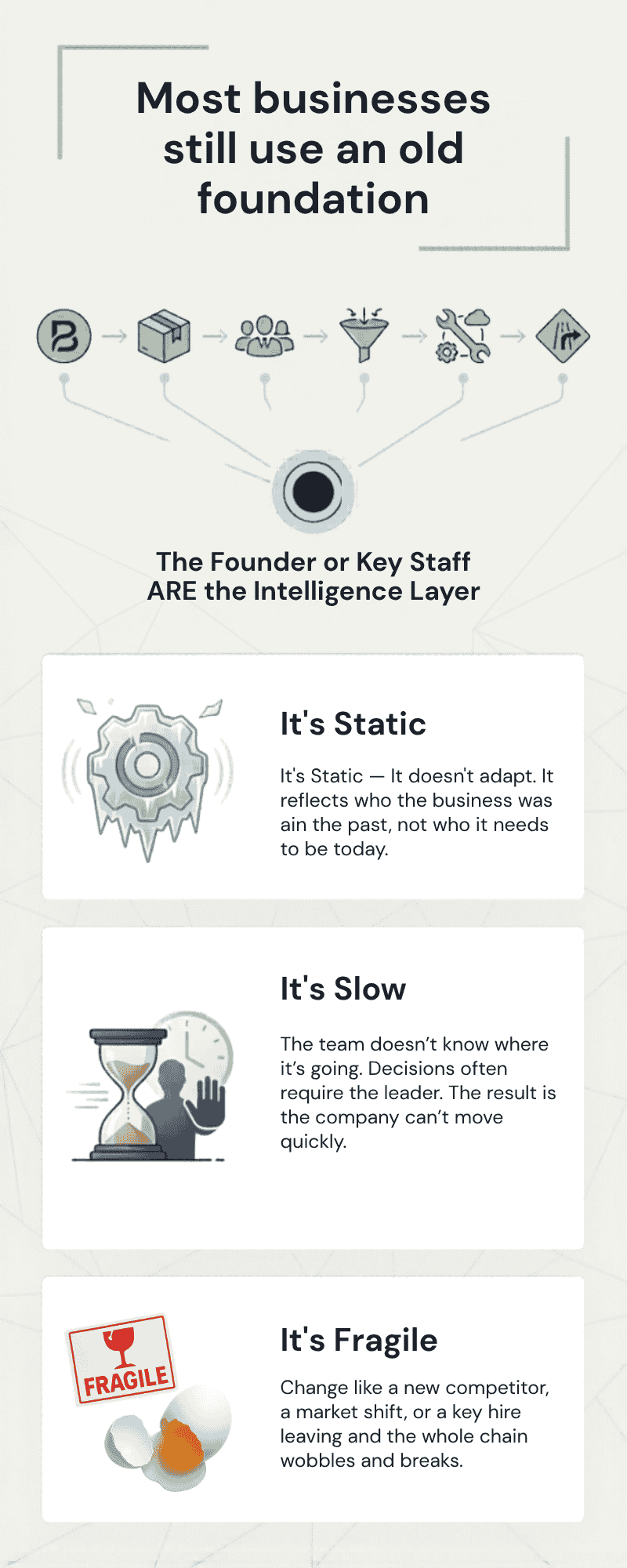
Most founders built their business on what we'd call an old "linear foundation."
It’s flat. Logo…Product. Then staff…funnel… tools… traffic. And the whole thing depends on the founder (or key staff) to be the intelligence layer that connects it all.
🔹 It's static. The linear foundation doesn't adapt. It reflects who the business was at launch or months…maybe years ago, not who it needs to be today.
🔹 It's slow. The founder or leadership team might know where to go…but nobody else does. Every decision that doesn’t fit in a nice neat box requires someone to ask the leader. Every new hire starts from scratch, because the context lives in someone’s head.
🔹 It's fragile. Change one domino… a new competitor, a market shift, a key hire leaving… and the whole chain wobbles and breaks.
🧠 Think of it this way. The linear foundation is like a highway with no GPS. You know roughly where you're going. But when there's construction, an accident, or a new road you didn't know about… everyone has to pull over and wait for the founder to navigate.
The operational engine is the GPS. It knows your destination, tracks conditions in real time, and helps the team re-route based on changing conditions.
The Operational Engine: What's Actually Inside
So what does an operational engine actually contain?
This is where it gets specific. Because the engine isn't a vague idea. It's a set of clearly defined parts that your team and your AI leverages every single day.
The Context Layer
This is the live intelligence your team and AI need to act without you.
🔹 Vision: Where the business is going. Specific and documented, not floating in the founder's head.
🔹 Brand Avatar: Who your customer is, what they want, what they fear, and what makes them buy.
🔹 Signal: What the market is telling you right now. Trends, shifts, patterns.
🔹 Job Roles: Who owns what outcomes. Not tasks. Outcomes.
🔹 SOPs: How the work actually gets done. Documented, repeatable, improvable.
🔹 Prospect and Customer Feedback: The real-time voice of your market flowing back into your system.
This is who your business is at its core.
🔹 The Cause: Why you exist beyond profit. The deeper mission that drives decisions.
🔹 The Lane: What you do… and just as importantly, what you don't do. Scope clarity kills bottlenecks.
🔹 The Code: Your non-negotiable values. The lines that don't get crossed, even under pressure.
🔹 The Edge: What makes you uniquely valuable. Not your features. Your specific, defensible advantage.
🔹 The Vibe: How people feel experiencing your brand. Culture, tone, energy, standards.
🔹 The Line: Your memorable phrase. The one sentence that captures what you stand for.
The Feedback Loop Layer
This is what turns the engine on.
Feedback loops are the mechanisms that tell your team what's working and what isn't. Weekly dashboards, client satisfaction signals, pipeline velocity metrics, campaign performance data… these aren't just reports. They're the engine's nervous system.
Without feedback loops, you're flying blind at altitude. With them, you can course-correct in days instead of months.
⚠️ Most businesses have some of the first two layers in fragments… and none of the third. The result: a business that reacts instead of responds. A team that guesses instead of acts. A founder who never fully leaves the building.
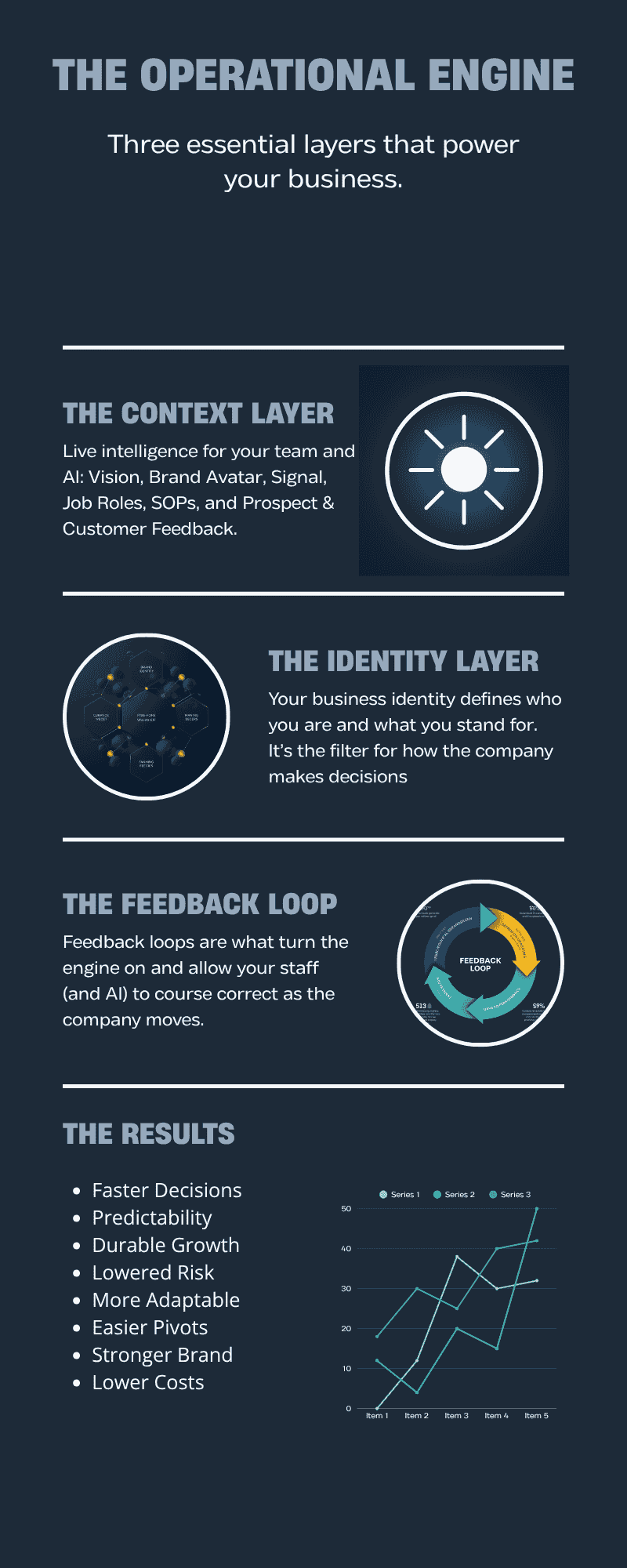
Context + Alignment + Feedback Loops = The Engine
Here's the formula that changes everything.
Context gives your team and your AI the raw material to make real decisions. When your identity, vision, customer avatar, and market signals are known and accessible, your team stops asking "what would the founder do?" They just… act.
Alignment ensures every function of the business moves in the same direction. Marketing knows the Lane. Sales knows the Edge. Customer success knows the Code. Fulfillment knows the SOPs. When everything connects to the same operating core, 1+1 doesn't just equal 2. It equals 5.
Feedback loops make the engine self-improving. Every campaign, every hire, every launch feeds data back into the system. The business gets smarter the longer it runs. Not because the founder works harder… but because the engine learns.
🧠 Think of a Formula 1 racing team. The driver matters. But the car's telemetry system, the pit crew's SOPs, the race engineer's real-time data feed… that's the engine that makes the driver competitive. Remove any one of those and the driver is just someone going fast in a direction.
This is what Modern Operations actually is. Not back-office administration. Not just "running the tools." It's the hub and intelligence layer that powers everything else.
But with siloed, disconnected tools and no company "brain": decisions happen slower, insights get lost, opportunities slip through the cracks, and the ship moves too slowly to respond. All while the founder and team are working longer and harder than ever before.
What Becomes Possible When the Engine Is Running
This is where the real payoff lives.
You want to bring on influencers to grow your business? An operational engine absorbs the incoming demand. Fulfillment knows what to do and the scalable capacity to do it. You scale the channel without breaking the business underneath it.
You want to test a new product or distribution channel? The engine tells you in real time how it's working. Signal comes back in days, not months. Adjustments happen fast, while the cost of error is still low.
You're navigating trade disruptions, tariff shifts, or rapid innovation? The engine gives your team a shared context for evaluating options. The Code tells you which values to lean on. The Vision tells you where you're heading. The feedback loops tell you what data to trust. You pivot with clarity instead of panic.
You're tired of being the glue? The engine does the connecting. Your team executes. You lead.
The compounding effect here is real. Every week the engine runs, it gets more refined. Every new hire who joins absorbs the context quickly. Every AI tool you deploy has a structured, living foundation to work from instead of a collection of scattered docs and tribal knowledge.
Modern Operations is the new scaling engine. And the founders who build it first aren't just scaling faster… they're building something that learns, adapts, and compounds over time.
✅ This week: Do you have an operational engine that makes your team smarter over time…helps them move faster (without you holding it all together)?
Final Thoughts
The businesses that survive what's coming… the economic volatility, the competitive pressure, the speed of AI-driven markets… won't survive because the brand looks good on the outside. It'll survive because its operational engine is built to handle anything the market throws at it.
Context. Alignment. Feedback loops. That's the engine.
The founders who build the engine won’t just survive. They’ll be building a company that compounds, adapts, and runs without them in the center of every single decision.
That's the company that actually wins over time.
This is Issue 45 of Modern Operators. We help founder-led businesses scale smarter by turning clarity into their ultimate growth lever.
How to get unstuck fast
Subscribe to our free newsletter that helps businesses go from working in the business to on the business.






Stay Updated with Us
Join the free weekly newsletter to see how smart founders operate modern companies.

Frameworks
Operational Models
Alignment


No Spam, Unsubscribe Any TIme