

Thought Leadership
The Right Speed: How to Deploy AI Without Breaking Your Business
The conversation shifted to AI. And almost immediately, the questions started flying…
"How fast should I be moving on this?"
"Should I just hire an AI person and hand it all over to them?"
"Am I already behind?"
I sat there watching some of the most experienced operators I know throw logic and reasoning out the window…because of the noise.
The "wave" of AI news is so loud right now that even battle-tested founders are starting to panic.
Below is what I told them…
First - Why This Matters Now
The pressure is real. AI is moving faster than any technology in history. According to McKinsey (2025), nearly nine out of ten organizations are now regularly using AI tools.
But here's the part nobody is quoting: Most organizations have not embedded AI deeply enough to see real business-level results. The transition from pilot to scaled impact is still a work in progress at the majority of companies.
And the ones who rushed? Many of them are spending additional money and resources to clean up the mess.
📞 - Recently, I was on a call with a founder who was choosing between two vendors to build a new fulfillment platform. Both made the final cut for good reasons. One wanted to lead with an AI agent approach… let the agents figure out what to build and how. The other recommended building a solid operating foundation first, with AI running on top so it actually had the context to do its job well.
The founder almost chose the first vendor. Because it sounded faster. More cutting edge.
That would have been a very expensive mistake.
The right speed for deploying AI isn't "as fast as possible."
It's "as fast as your foundation can support."
The Four AI Adopters: Which One Are You?
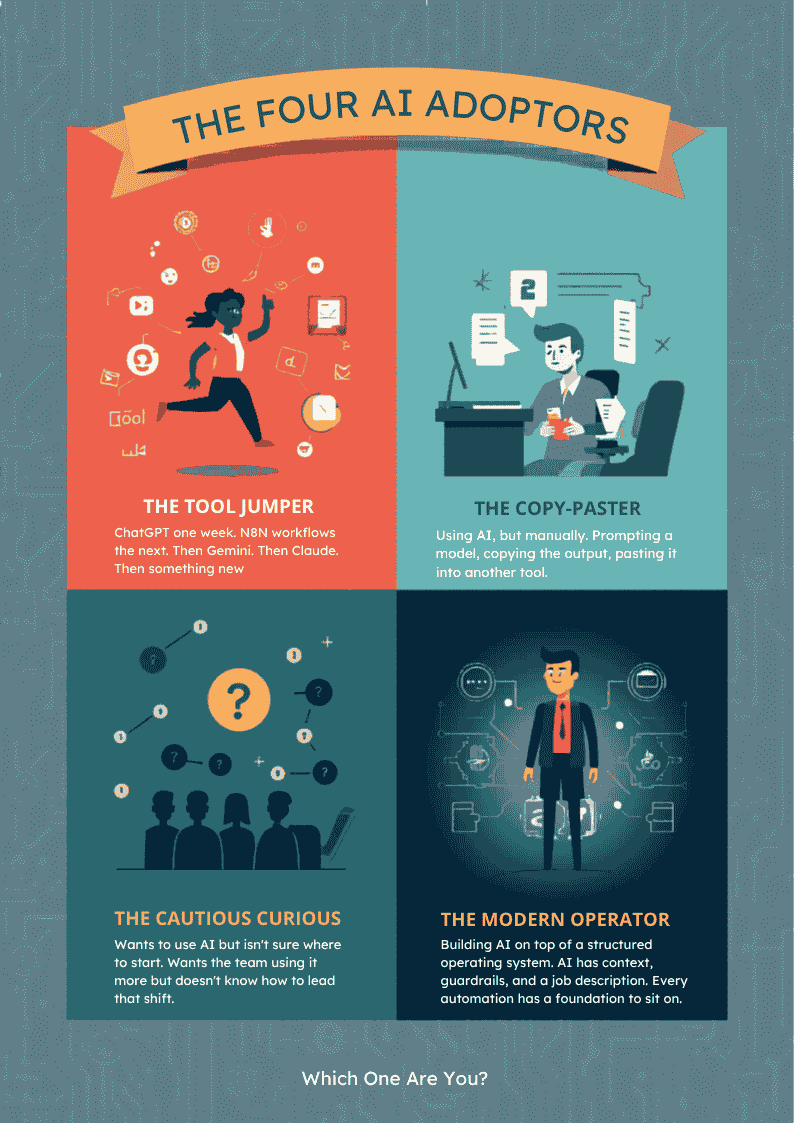
Before we talk pace, let's talk position. In my experience, most founders land in one of four places when it comes to AI adoption:
🔹 The Tool Jumper: ChatGPT one week. N8N workflows the next. Then Gemini. Then Claude. Then something new that just dropped. Always chasing, never compounding. They're busy but not building anything durable.
🔹 The Copy-Paster: Using AI, but manually. Prompting a model, copying the output, pasting it into another tool. It's better than nothing… but it's the equivalent of owning a sports car and only rolling it down the driveway.
🔹 The Cautious Curious: Wants to use AI but isn't sure where to start. Wants the team using it more but doesn't know how to lead that shift. Quietly wonders if they should even tell clients they're using it. This founder is aware, but stuck.
🔹 The Modern Operator: Building AI agents on top of a structured operating system. AI has context, guardrails, and a job description. Every automation has a foundation to sit on. These are the ones quietly pulling away from the pack.
The goal isn't to get to the fourth type overnight. The goal is to move deliberately from wherever you are right now.
Deploy Like You Hire: The Staffing Model for AI
Here's the reframe that clicked for the founders in that mastermind room once I walked them through it.
You wouldn't hire a new employee and on their first day hand them the keys to every office, the passwords to every system, and full access to your financials. That would be insane. You'd start them in a defined role with limited scope, watch how they perform, give them feedback, and expand their access as they earned it.
AI is no different.
Think of every AI tool or agent you deploy like a new hire climbing the ranks. Using a development analogy…it starts in the sandbox. You test it. You watch what it does. You find out where it gets confused or makes mistakes. Then you move it to a staging environment, where it interacts with a few of your systems but still isn't customer-facing. Then… and only then… you move it into production…starting small, monitoring closely.
🔹 Sandbox: Test in isolation. No customer impact. No live data. Just you and the tool figuring each other out.
🔹 Staging: Connect it to real systems in a controlled way. See how it behaves when things get more complex.
🔹 Limited Production: Release to a small subset of workflows or customers. Watch what happens. Fix what breaks before it scales.
This isn't moving slow. This is moving smart. A phased approach delivers up to 2.8x higher ROI than going all-in at once, according to research by Anyreach AI (2024).
The businesses that blow themselves up with AI aren't moving fast. They're risking it all by skipping steps.
The Foundation-First Principle
Here's the uncomfortable truth nobody is saying loudly enough:
AI amplifies whatever it sits on top of.
If your processes are inconsistent, your data is scattered, your team doesn't have clear roles, and your knowledge lives in 14 different places… AI will not fix that. It will just help you create chaos faster.
General Motors learned this the hard way. They used AI to design a seat bracket that was 40% lighter and 20% stronger than the original. Stunning result on paper. But their manufacturing systems were built for stamped steel. The AI-generated design could never make it into production. The innovation stalled because the foundation couldn't support it. (Harvard Business Review, 2026)
Same thing happens in founder-led businesses every day. Shiny new AI tool. No foundation to run it on. Expensive disappointment.
The founders winning with AI right now didn't start with AI. They started with clarity. Clear processes. A documented operating system. A team that knew their roles. Then they layered AI on top. And when they did, it multiplied.
🧠 Think of it like a recipe. AI is a powerful ingredient. But if you don't have a solid dish to add it to, you're not making something better. You're just adding heat to a mess.
The Hidden Keys Nobody Is Talking About
The entire conversation about AI deployment is focused on tools. What to use. What to buy. Who to hire. What to build.
But the actual keys to making this transition successfully? They have almost nothing to do with the technology.
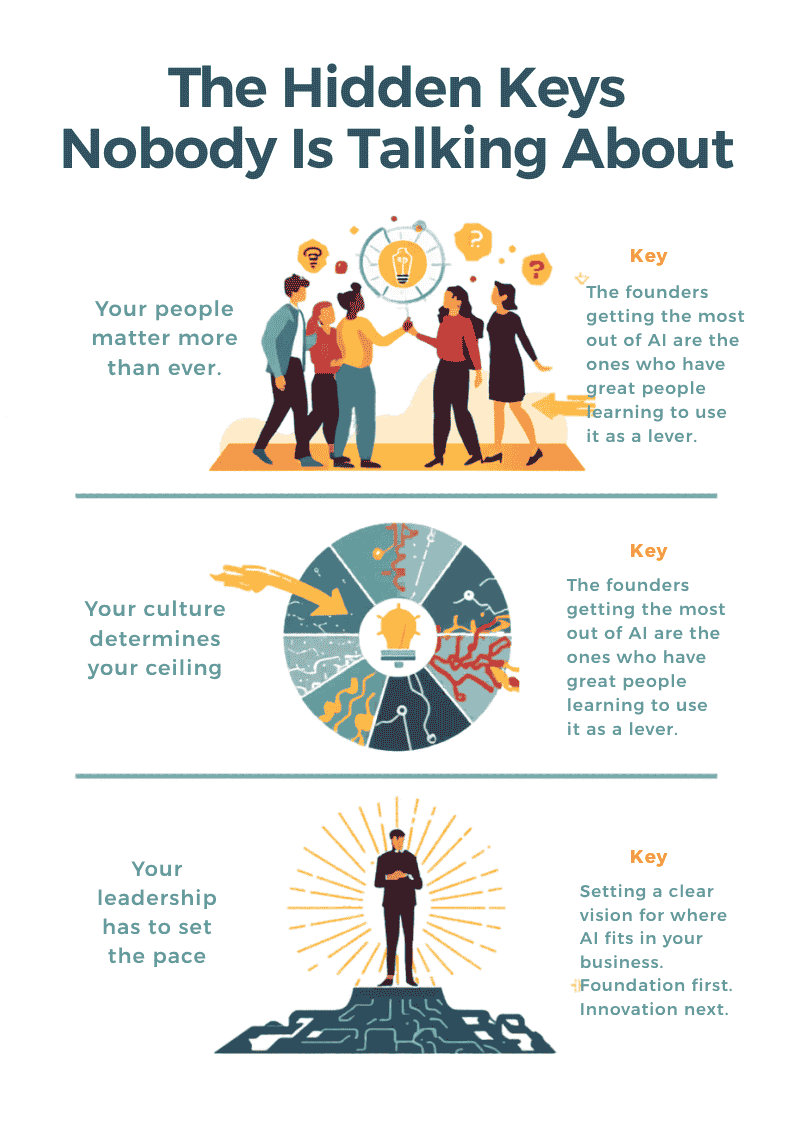
🔹 Your people matter more than ever. The idea that you'll fire staff and replace them with AI is one of the most dangerous myths circulating right now. The founders getting the most out of AI are the ones who have great people learning to use it as a lever. AI handles the repeatable. Your team handles the judgment, the relationships, the nuance. You need both. Firing your team and hoping AI fills the gap is not a strategy. It's a sucker’s bet with your business on the table.
🔹 Your culture determines your ceiling. The companies adopting AI well have something in common: a culture that promotes curiosity, encourages experimentation, and treats failure as data… not catastrophe. If your team is afraid to try new things and afraid to break things, your AI adoption will stall before it starts. Risk-averse cultures produce risk-averse rollouts. The flip side is also true: a team that celebrates small wins and learns openly from mistakes will outpace a better-funded competitor with a fear-driven culture. Every time.
🔹 Your leadership has to set the pace. Not the AI vendor. Not the consultant. Not the newest model that dropped this week. You. That means setting a clear vision for where AI fits in your business. Foundation first. Innovation next. Focused on the highest-priority use cases each quarter instead of chasing every shiny tool. Companies with visible leadership commitment to AI adoption see higher employee buy-in and hit their goals faster, according to Excaltech (2025).
Final Thoughts
The noise is real. The pressure is real. But here's what's also real: the businesses that win with AI over the next five years are not the ones who moved the fastest in 2026. They're the ones who built smart, stayed durable, and compounded their advantage one solid deployment at a time.
Common sense isn't the enemy of innovation. It's the foundation of it.
This is Issue 42 of Modern Operators. We help founder-led businesses scale smarter by turning clarity into their ultimate growth lever.
How to get unstuck fast
Subscribe to our free newsletter that helps businesses go from working in the business to on the business.






Stay Updated with Us
Join the free weekly newsletter to see how smart founders operate modern companies.

Frameworks
Operational Models
Alignment


No Spam, Unsubscribe Any TIme