

Leadership
The Modern CEO: What It Actually Means to Lead Today
The CEO role has quietly changed over the last several years.
No memo went out. No one updated the job description. The title stayed the same. But the changes are there…
If you haven't transitioned yet, you can likely feel it. In the decisions that never stop routing back to you. In the growth that feels harder than it should. In the nagging sense that no matter how much you do, the business is still constrained.
Here's the question worth sitting with: are you actually leading a modern company right now… or are you being the company?
The answer changes everything about what you need to do next.
Let's explore the changes to the CEO role and what it means for you.
Why This Matters Now
For the last thirty years, the pressures on founders and business owners have compounded in ways that simply didn't exist before.
In 1995, "running a business" meant managing operations, keeping customers happy, and watching your cash flow. That was hard enough. Today, the modern CEO absorbs an entirely new layer of responsibility: digital distribution, reputation management at the speed of social, cybersecurity risk, remote teams, platform dependency, and now… AI as a core productivity and competitive lever.
According to PwC's 29th Global CEO Survey (2026), productivity, technology adoption, and continuous transformation are now the top three CEO priorities globally. Not just in enterprise. In every business that wants to survive the next five years.
Here's the uncomfortable truth for founder-led companies: the way you defined your role when you started is almost certainly too small for the company you're trying to build.
A founder I worked with ran a high-growth agency. Revenue was climbing. The team was solid. But he was still the answer to every question, the approval on every proposal, the calm in every storm. Growth created more stress, not less. His team was busy… but he was buried.
The world didn't just get more competitive. It got more complex. And complexity punishes founders who haven't yet made the shift to the Modern Operator.
The New CEO Job Description
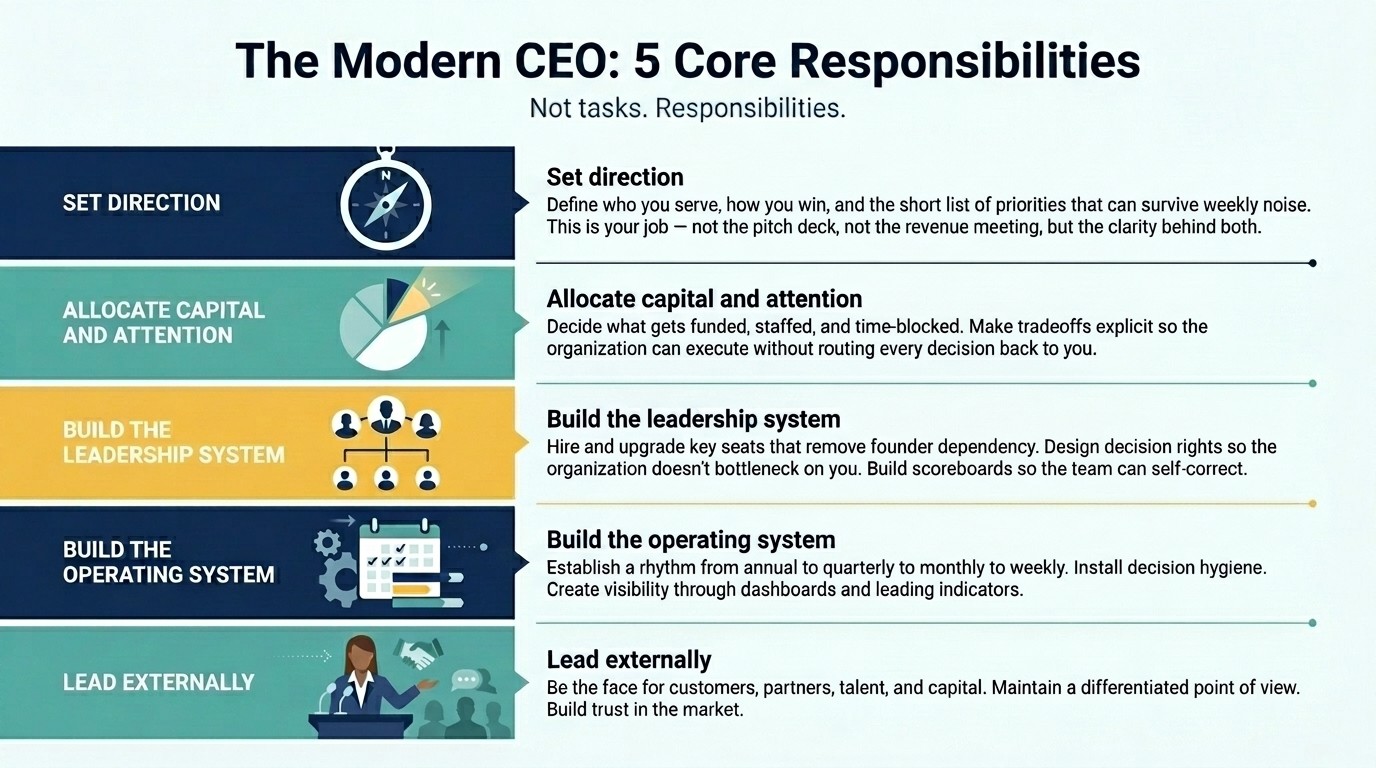
Here's what the research, the frameworks, and years of working with founders all point to: the modern CEO has five core responsibilities. Not tasks. Responsibilities.
And almost none of them are what most founders spend their time on.
🔹 Set direction. Define who you serve, how you win, and the short list of priorities that can survive weekly noise. This is your job. Not the pitch deck. Not the revenue meeting. The clarity behind both.
🔹 Allocate capital and attention. Decide what gets funded, staffed, and time-blocked. Make tradeoffs explicit so the organization can execute without routing every decision back to you.
🔹 Build the leadership system. Hire and upgrade key seats that remove founder dependency. Design decision rights so the organization doesn't bottleneck on you. Build scoreboards so the team can self-correct.
🔹 Build the operating system. Establish a rhythm from annual to quarterly to monthly to weekly. Install decision hygiene. Create visibility through dashboards and leading indicators.
🔹 Lead externally. Be the face for customers, partners, talent, and capital. Maintain a differentiated point of view. Build trust in the market.
Read that list again.
None of those say "answer Slack messages." None say "approve this proposal." None say "fix the client escalation." None say "jump in when things go sideways."
The modern CEO is not the most knowledgeable person in the room. They are the chief designer of leverage.
That shift in identity changes everything.
Why Most Founders Get This Wrong (And the Upgrade You Need)
For years, the Visionary/Integrator framework from EOS has been one of the cleanest explanations for why founder-led companies stall. The Visionary drives the future. The Integrator handles execution and accountability. Get both in place and things start to move.
It still holds as a pattern. But it's no longer complete.
Here's what's changed: the execution side of a modern SMB has split into two genuinely different leadership muscles. The Integrator used to mean "handles operations." In 2026, that's not enough. AI complexity, tool sprawl, cross-functional interdependence, data governance… these aren't just ops problems. They're strategic design problems.
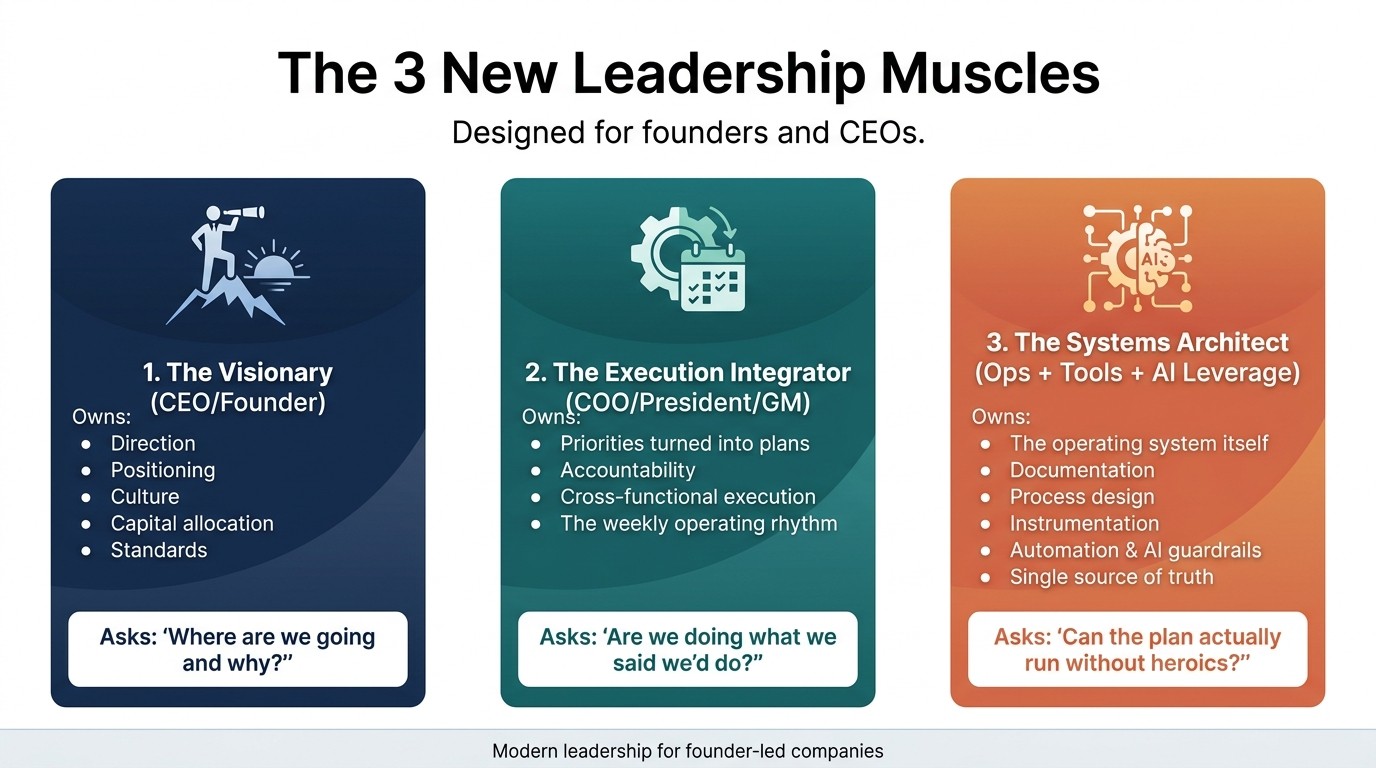
So the emerging model for founder-led businesses looks less like two roles and more like three:
1. The Visionary (CEO/Founder)
Owns: direction, positioning, culture, capital allocation, standards. Asks "where are we going and why?"
2. The Execution Integrator (COO/President/GM)
Owns: priorities turned into plans, accountability, cross-functional execution, the weekly operating rhythm. Asks "are we doing what we said we'd do?"
3. The Systems Architect (Ops + Tools + AI Leverage)
Owns: the operating system itself. Documentation, process design, instrumentation, automation, AI guardrails, and the single source of truth. Asks "can the plan actually run without heroics?"
🧠 Here's the quick test: if your founder says "we have meetings but nothing sticks," you need role number two. If they say "we can't trust the numbers, we have too many tools, everything is tribal knowledge," you need role number three.
In smaller companies, roles two and three can live in one person. But they are conceptually different jobs. Conflating them is one of the most common reasons founders stay trapped in execution long after they should have moved on to leading.
The Operating System That Makes You Optional
Here's what separates the founders who eventually step into the true CEO role from the ones who stay stuck: they build an operating system that doesn't require them to be present for it to work.
Not optional from the business. Optional from the daily decisions that slow everything down.
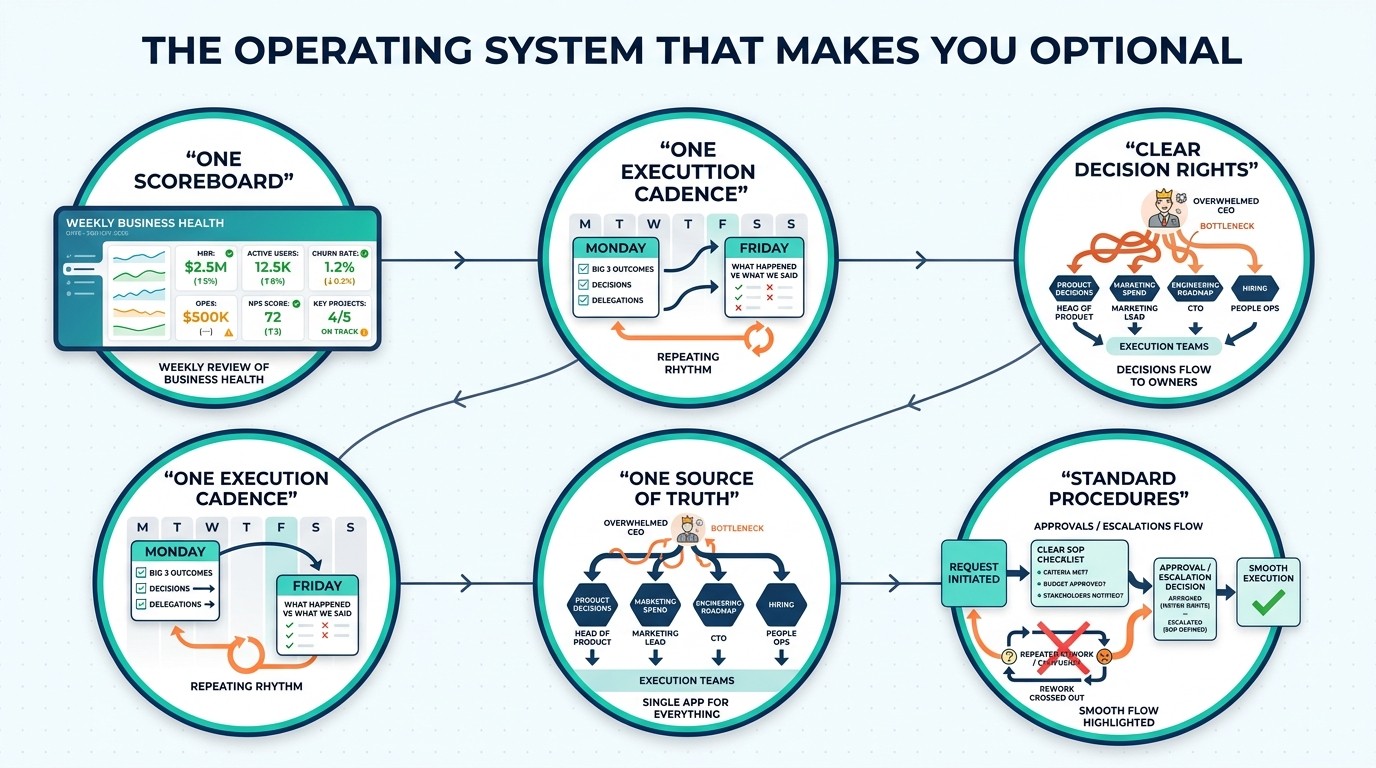
Five things must be in place for this to happen:
✅ One scoreboard. Five to twelve numbers that tell you whether the business is healthy, reviewed weekly, not "when there's time."
✅ One execution cadence. A weekly rhythm where the team plans, executes, and reviews truthfully. Monday: the Big 3 outcomes, decisions, delegations. Friday: what happened versus what we said.
✅ One source of truth. One place for priorities, projects, roles, SOPs, meeting notes, and decisions. Not three tools, six spreadsheets, and someone's notebook.
✅ Clear decision rights. Who can decide what without asking the CEO? If the answer is "everything comes to me," you have a design problem, not a people problem.
✅ Standard procedures for high-friction areas. Start where rework is highest and where founder approvals happen most. That's where leverage lives first.
This isn't glamorous work. It's not the stuff of keynote speeches. But it is the difference between a business that scales and a business that exhausts.
⚠️ One critical note on AI: AI doesn't fix a broken operating system. It amplifies whatever is already there. If decisions are ambiguous and centralized, adding AI tools creates more noise routed to the same bottleneck. If your operating system is solid — clear ownership, visible metrics, defined decision rights — AI becomes genuine leverage. Not before.
Final Thoughts
The hardest part of being a modern CEO isn't the market. It isn't the competition. It isn't even AI.
It's moving past the identity that got you here.
The founder who built the first million usually did it by being everywhere, knowing everything, and deciding everything. That was the right operating model at the time. Applied to a fifteen-person company trying to hit five million, it becomes the ceiling.
The best founders don't work harder. They work at a different level.
Strategy makes you chosen. Operations makes you scalable. Build both, and you stop being the thing your business runs on… and start being the person who designs what your business runs on.
That's what it means to be a modern CEO.
This is Issue 49 of Modern Operators. We help founder-led businesses scale smarter by turning clarity into their ultimate growth lever.
Subject Lines
"You're Not Running a Business. You're Trapped in One."
"The CEO Job Description Most Founders Have Never Seen"
"Still the Bottleneck? Your Role Needs an Upgrade."
"What Actually Changes When You Become a Real CEO"
"The 5 Things a Modern CEO Actually Does (Hint: Not This)"
"Why the Visionary/Integrator Model Is No Longer Enough"
"Your Business Can't Scale if You're Still Running It"
"The Identity Shift That Separates Founders Who Scale"
Preview Text
"Most founders are working inside the business long after they should be leading it. Here's what the role actually demands now."
"You built it to $1M working in the business. You'll scale to $5M by leading it. The shift is everything."
How to get unstuck fast
Subscribe to our free newsletter that helps businesses go from working in the business to on the business.






Stay Updated with Us
Join the free weekly newsletter to see how smart founders operate modern companies.

Frameworks
Operational Models
Alignment


No Spam, Unsubscribe Any TIme