

Thought Leadership
Built to Break
Right now, founders are burning resources they can't afford to lose…on an operational system no one will ever use.
We just talked with another prospect in this situation…let’s call him “Derek”..
Six months ago, he had a real vision. He needed a Company Operating System…something that would create genuine leverage across his staff and affiliate relationships. A central hub. A source of truth. Something that would let his team move without him having to be in every conversation, every decision, every thread.
So he hired a consultant. Someone who came highly recommended, spoke the language, and moved fast. Weeks passed. A system took shape. But when it rolled out, nobody used it. The consultant said it needed refinement, but didn’t know what to do. So Derek hired another Notion “expert”. Same story…confident, capable-sounding, delivered something that looked impressive and sat completely useless. By the third consultant, Derek was running out of patience and running low on budget. But he told himself: this time it'll be different. This guy really knows tools.
Six months. Three consultants. Thousands of dollars. And the system that was supposed to create leverage for his staff and affiliate relationships? It just sits there. Beautiful. Functional. Completely ignored.
Meanwhile, Derek’s more buried than when he started. Every day that passes, he's deeper in the daily grind… answering more questions, making more decisions, firefighting more fires.
The thing he built to free him up has become its own weight to carry. And now he's facing the question no founder wants to face:
Should I just throw away six months of work and thousands of dollars and completely start over?
That's not a tech problem. It’s an operations problem… and it's one we're unpacking to identify the real problem.
Why This Matters Now
We are in the golden age of "vibe coding." Tools like Cursor, Lovable, and Bolt have made it possible for anyone…literally anyone…to spin up platforms, dashboards, and business operating systems in hours or days. No CS degree. No dev team. Just a prompt and a pulse.
On the surface, that sounds incredible.
Under the surface? It's quietly becoming one of the most expensive mistakes founder-led businesses are making right now.
A new wave of consultants and "experts" has emerged alongside these tools. They've built a few things, shipped a few systems, watched a few YouTube videos…and now they're positioning themselves as operational experts. They speak confidently. They move fast. They deliver... something.
But there's a critical question almost no one is asking before they hand over the keys:
Has this person ever actually run a business?
According to Dual Boot Partners (2025), by 2026, analysts estimate that 75% of technology leaders will be dealing with severe technical debt tied to AI-driven development practices that prioritized speed over architectural understanding.
The result? Teams experiencing a 50–70% drop in velocity once that debt compounds…turning momentum into drag.
And Forbes Tech Council (2026) put it bluntly: when vibe coding is dropped into business users' hands, it can be "an IT department's worst nightmare, leaving a trail of AI-generated technical debt."
The founder we mentioned at the top? He now has a system that no one uses, a depleted budget, and — thanks to three rounds of consultants punching keys without understanding the bigger picture…no clear path forward.
He's stuck.
The Real Problem Isn't the Code. It's the Perspective.
Here's what each of those three consultants had in common: they understood tools. What they didn't understand was business.
They knew how to build a Notion workspace. They didn't know how to build leverage into an affiliate relationship. They knew how to wire up automations. They didn't know why staff adoption is more important than system functionality…especially early on.
And that distinction? It's everything.
🔹 Functionality without adoption is worthless. A system can be technically perfect and operationally useless. If your team won't use it (or doesn't understand why they should), it produces zero leverage. Zero. The most sophisticated dashboard in the world doesn't help if everyone is still working from a spreadsheet and a group chat.
🔹 A limited view creates a limited system. When someone who has never scaled a business builds your operating system, they build it from the perspective of a builder, not an operator. They optimize for features. Operators optimize for flow…how information moves, how decisions get made, how teams stay aligned at 3x, 5x, and 10x your current size.
🔹 AI makes it worse, not better. You think that AI will save you. And it can…but only if what you feed it is clean, structured, and strategically designed. If your Company OS is built without operational logic, AI doesn't understand it either. Garbage in, garbage out. The saying is old. The lesson is painfully current.
🔹 The expand → get stuck → rebuild → repeat cycle. This is the pattern we see most often. A founder builds a system that works at their current size. The company grows. The system can't keep up. Nobody anticipated how a change in one team would ripple through everything else. So they rebuild. Again. And again. Each rebuild costs time, money, momentum, and team trust.
Think of it like building a highway. A roadway engineer can tell you how to build for today. But a city planner thinks about what happens when the population doubles, when new neighborhoods come online, when commercial zones expand, when the infrastructure needs to carry 10x the load. You don't want the traffic consultant making 30-year infrastructure decisions.
Your Company OS is your infrastructure.
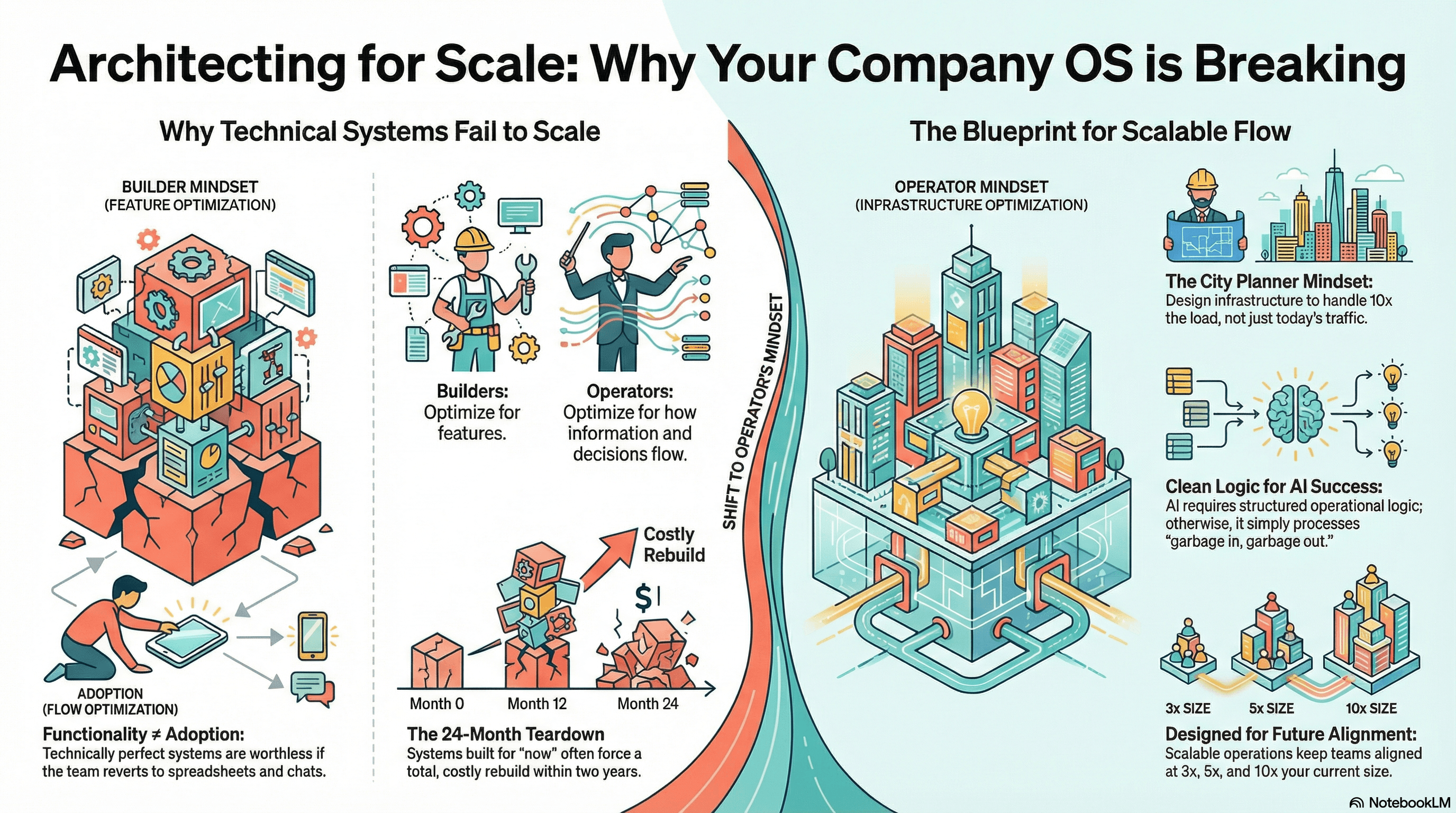
⚠️ The operations you install today will drive your ability to scale or force a total teardown in 6, 12, or 24 months.
The COO Paradox: Why Experience Is the Point
There's a reason the COO is typically the most experienced person in the C-suite (and often the oldest).
It's not a coincidence. It's a requirement.
Operations isn't one lane. It's every lane.
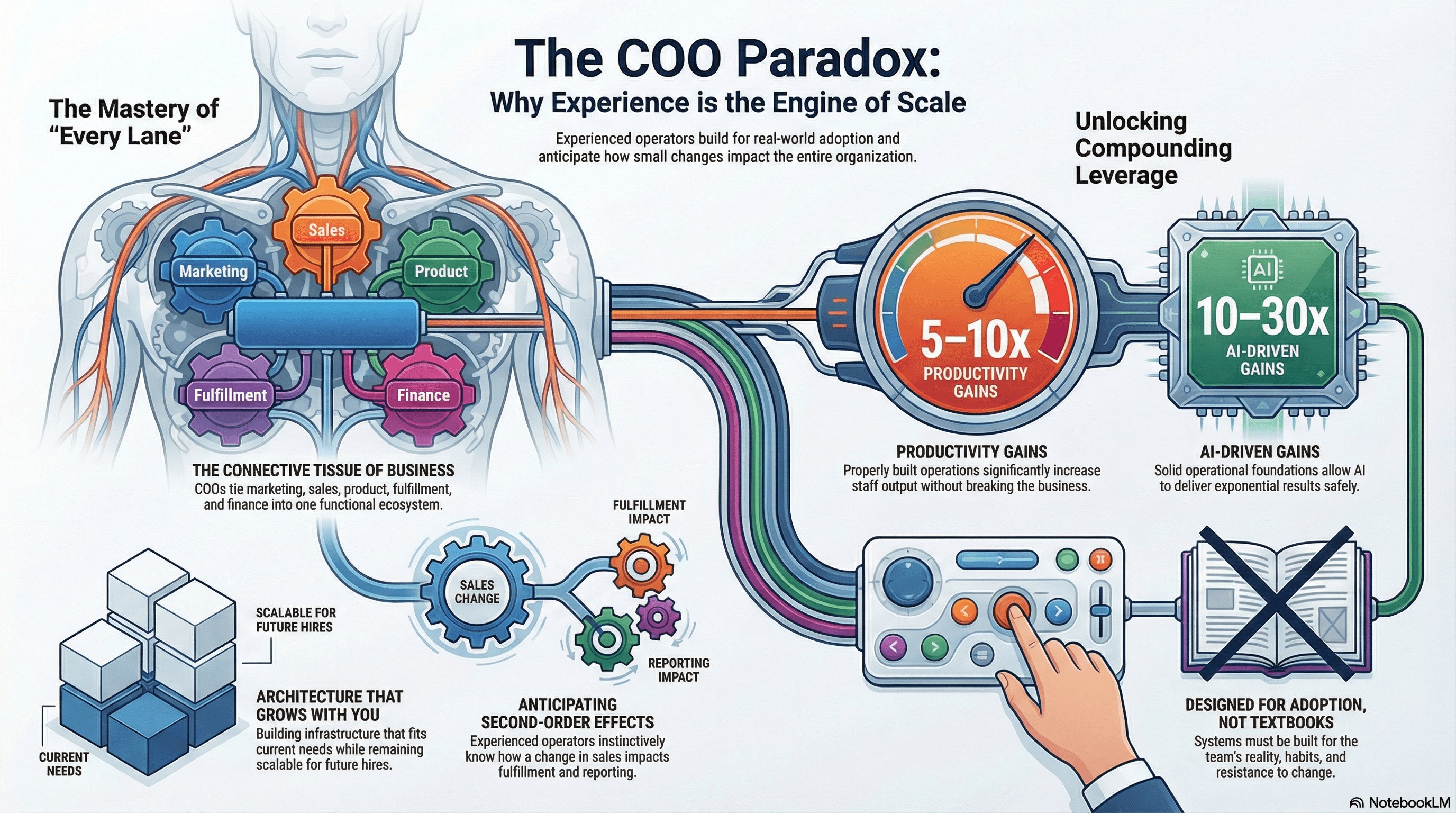
The COO is the connective tissue of the entire business tying marketing, sales, product, fulfillment, and finance together into an ecosystem that actually works.
McKinsey's research on COOs (2024) frames it directly: great operators don't just manage what exists. They design the systems that let every other function perform at its highest level.
Here's what that experience actually looks like in practice:
🔹 Knowing what to build now vs. later. An experienced operator won't load a 10-person team with enterprise-level infrastructure. They build for where you are, with an architecture that grows with you — not one that needs replacing the moment you hire your next 5 people.
🔹 Understanding second-order effects. A small change in your sales process affects how fulfillment is staffed. A shift in your onboarding flow changes your churn rate. A new affiliate structure changes how your reporting needs to work. Operators who've run businesses know this instinctively. Consultants who've only built tools... don't.
🔹 Building for adoption, not just function. Real operators know that the best system is the one people actually use. That means designing for your team's reality…their skill levels, their habits, their resistance to change…not the ideal version of a team in a textbook.
🔹 Unlocking compounding leverage. Modern operations, when built right, unlocks 5–10x productivity gains for staff…without breaking the business!
It creates the conditions where AI can deliver 10–30x gains again without breaking the business!. It enables more marketing and more sales…again without breaking the business. That's not a feature. That's a foundation.
The founders who scale fastest aren't the ones who build the most. They're the ones who build right, and if they don’t know, they seek out experts who understand how to play to win the game.
There is no shortcut for those lessons. No prompt. No tool. No weekend course.
Final Thoughts
A system built by someone who has never run a business will reflect exactly that. It might look good. It might even be impressive. But it won't be built to grow, to weather storms, or to serve the people who actually need to use it every day.
The operations you install today are a bet on your future. Make sure the person helping you place that bet has actually played the game.
Don't vibe code your foundation.
This is Issue 39 of Modern Operators. We help founder-led businesses scale smarter by turning clarity into their ultimate growth lever.
How to get unstuck fast
Subscribe to our free newsletter that helps businesses go from working in the business to on the business.






Stay Updated with Us
Join the free weekly newsletter to see how smart founders operate modern companies.

Frameworks
Operational Models
Alignment


No Spam, Unsubscribe Any TIme