

Delegation
Decision Layering: Build a Company Where Action Is the Default
A founder I know runs a 12-person marketing agency. The team's solid, processes work, revenue is growing. On paper, it looks fine.
His actual day tells a different story.
Seven Slack pings by 9am. "Quick question…" "Can I approve this?.." "Just checking with you before we send..." His project manager routes requests instead of resolving them.
Then we took on a new client who'd gone the opposite direction. He decided everything in advance.
He wrote an SOP for everything. If this happens, do this. If that happens, do that. Run this checklist daily and sign your name to it. Stacks of documented procedures, covering every scenario he could think of. Sounded good on paper. In practice, his team spends more time following procedures than delivering the actual value. Margins and revenue per staff have dropped steadily over the last year.
This founder did all the deciding in advance, hoping documented instructions would create a team that thinks and executes like him. They didn't. They followed the checklist and stopped thinking altogether.
Two founders, two opposite approaches, same outcome: the business is still constrained.
Neither founder is doing all the work. They're doing all the deciding.
That single bottleneck costs them more than they realize.
What's happening, and how to fix it permanently.
Why this matters now
The businesses winning right now aren't the ones with the most talented teams. They're the ones with the fastest decision loops.
Decision velocity is a competitive edge.
According to MIT CISR (2024), companies that empower teams with decision-rights guardrails outperform their peers on margins, growth, and innovation. Not because they hired better people. Because they engineered better decision flow.
AI and automation amplify whatever already exists in your business. If decisions are centralized and ambiguous, AI adoption creates more noise. More tools routing to the same bottleneck, more outputs waiting on the same approval queue.
A new client came to us recently after spending serious money on new tooling and AI. The setup was so complex no one understood how to use it... so he's burning out, pulled back into acting as the decision queue for his staff.
The fix isn't better tools. It's what we call Decision Layering.
What Decision Layering actually is
Let me define it clearly, because most founders confuse this with delegation.
Decision Layering = designing your organization so decisions are made at the lowest competent level, with guardrails that keep quality and alignment high.
You'll find versions of this idea under different names: decision rights (who has authority for what), guardrails (constraints that enable speed without chaos), intent-based leadership (action is the default, not permission), and mission command (commander's intent plus disciplined initiative).
Different names, same principle. The person closest to the work makes the call, within clear boundaries.
What it is NOT:
🔹 Not "everyone decides everything." That's chaos with a flat org chart.
🔹 Not abdication. "Figure it out, good luck" is not a system.
🔹 Not RACI "visuals." Beautiful responsibility charts that nobody actually uses.
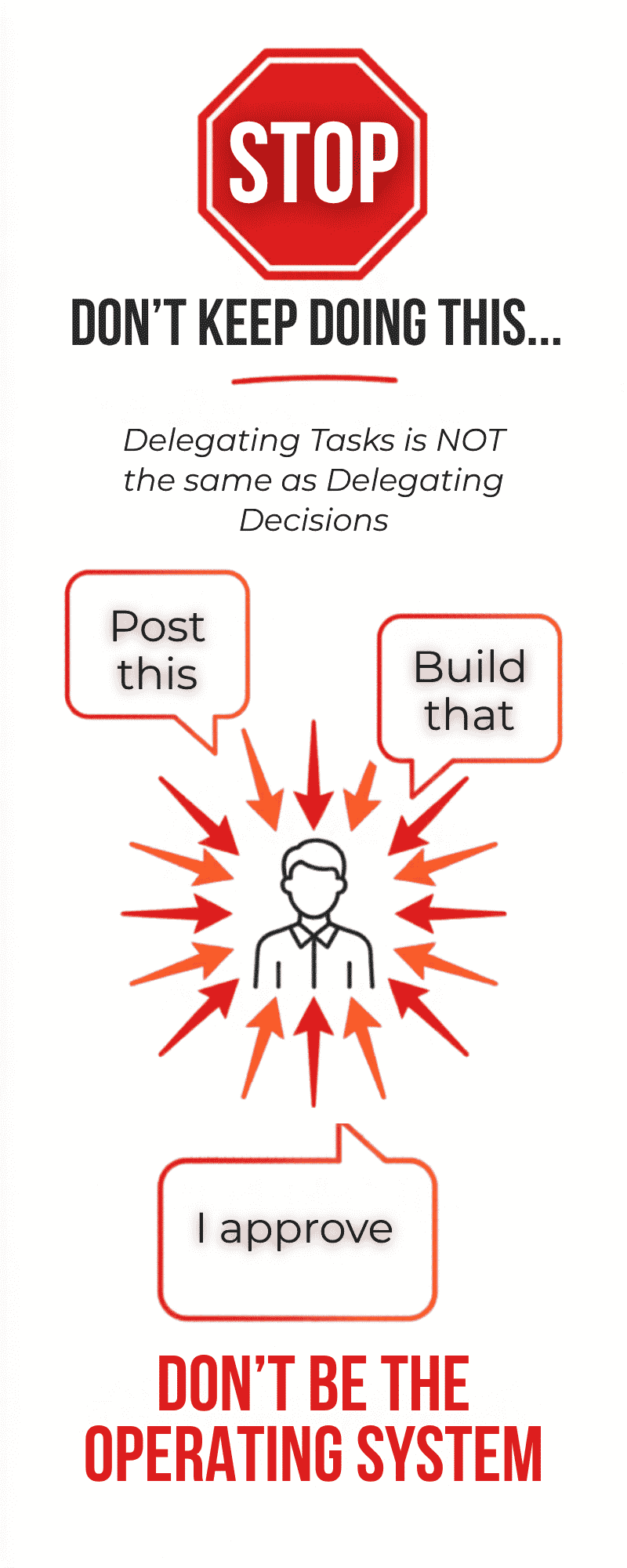
Decision Layering starts with a decision. Then you engineer it. Then you build it into your culture.
The real trap: delegating tasks while keeping decision ownership
This is the pattern that keeps almost every founder stuck.
You delegate tasks, but you don't delegate decisions.
You tell your team: "Post this content." "Build that process." "Schedule this campaign." The tasks get done. You're still handling every approval, every exception, every tradeoff call, every client-facing judgment.
Your team is busy. AND you're still the operating system.
IMPORTANT: Tasks are instructions. Outcomes are ownership. Once you see that distinction, things start to shift.
The move isn't delegating more tasks. It's assigning System Owners with Role responsibilities: clear decision rights, measurable outcomes, defined constraints, and a feedback loop. Not a task list. Ownership.
⚠️ Ask yourself honestly: does your team know what they can decide on their own today? Not what they're supposed to do… what they're allowed to decide without asking you first? If the answer is fuzzy, you have a design problem, not a people problem.
The Decision Layering Model: a practical framework
How to build this inside your business, in five steps.
Step 1: Run your Decision Inventory
This week, write down the top 10 decisions you get pulled into that have nothing to do with strategy. Recurring ops calls. The ones that show up over and over.
For each one, ask two questions:
Should this actually require me?
If not, what rule or guardrail would let someone else decide safely?
Most founders find that 7 of their 10 "essential" decisions could be pushed down with a single sentence of clarity. That exercise alone is where the sprint begins.
Step 2: Classify your decisions into 3 layers
🔹 Layer 1, Staff Decisions
Low risk, reversible, frequent. Needs a clear outcome, a guardrail, and an escalation trigger. That's the whole system at this level.
🔹 Layer 2, Manager Decisions
Cross-functional tradeoffs. Moderate risk. Touches multiple workflows or client relationships.
🔹 Layer 3, Founder Decisions (rare, high-leverage only)
Vision, brand positioning, hiring bar, major capital, existential risk.
The rule: Layer 3 should be a short list. If it isn't, you haven't built layers, you've built a bottleneck with job titles attached.
Step 3: Install guardrails
Guardrails are what make empowerment safe. Without them, delegation reverts to old habits. With them, it becomes leverage.
Pick 4–6 for each decision layer:
✅ Purpose/Intent: What outcome are we trying to achieve?
✅ Success criteria: What does "good" look like? (measurable)
✅ Risk thresholds: What's too big... by dollars, brand risk, or client relationship?
✅ Time thresholds: When does speed matter? What's the decision SLA?
✅ Reversibility: What can we undo fast if we're wrong?
✅ Escalation triggers: The exact conditions that require a manager or founder.
✅ Decision log: Write it down so learning compounds.
🧠 Think of guardrails like bumpers in bowling. You're not removing skill, you're removing the catastrophic misses that cost you clients, money, or months. Your team bowls their game. You just take the gutters out of play.
Step 4: Make work outcome-focused, not task-focused
Replace "do X" with "achieve Y by Z."
Every outcome your team owns should include four things:
A measurable result
Constraints (budget, timeline, brand standards)
Decision rights (what they can decide without coming to you)
A feedback loop (how you review it together)
That's what "assign System Owners, not just managers" looks like in practice. Roles are built on decision rights and outcomes, not task lists.
Step 5: Teach intent language
This is the culture mechanism that shifts how your staff see their work.
Most teams run on permission culture: "Can I do this?" Action waits for approval. Everything routes upward.
Intent culture flips it:
"I intend to do X because it achieves Y."
Action is the default. Escalation is the exception.
That's L. David Marquet's intent-based leadership, converted for your business. Once your team speaks this language, you stop being the bottleneck. And they start building real ownership.
The "Fix It / Flag It" attitude for your staff
The ownership mentality that separates fast-moving companies from the rest:
When you run into an issue or a snag…
If it's within your guardrails: Fix It.
If it's outside your guardrails: Flag It, with a recommendation.
Never just notice something wrong and ignore it. That's how decay compounds.
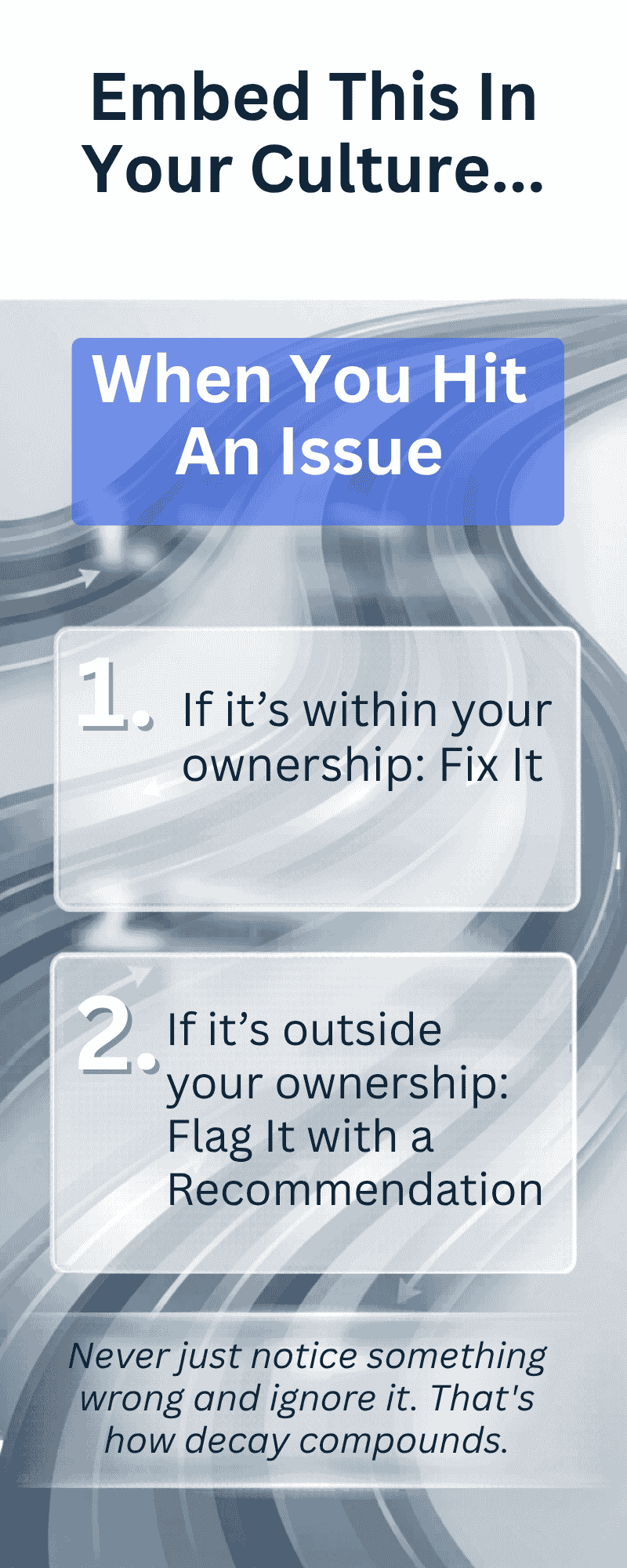
High performers self-correct without being chased. We don't repeat the same mistake over and over.
Build this into your weekly rhythm with a simple practice: every week, each team member shares a decision they made, an improvement they shipped, and an escalation they flagged along with what they learned. That loop turns a team into a self-correcting system.
Your 14-day Decision Layering sprint
How to start this week, not someday:
Days 1–2: Run your Decision Inventory. List the top 10 recurring ops decisions you get pulled into.
Days 3–5: Define your three layers. Choose 3 decisions to push down first. Start with high-frequency and reversible. Big ROI, lowest risk.
Days 6–7: Write guardrails and escalation triggers for those 3 decisions. One page. Keep it simple.
Week 2: Introduce intent language with your team. Start the decision log. Run your first weekly Decision + Improvement roundup.
Optional framework for multi-stakeholder decisions: RAPID (Recommend, Agree, Perform, Input, Decide). Use it when more than two people need clarity on who actually makes the final call.
⚠️ Watch-outs before you launch:
No guardrails leads to chaos
Everyone empowered but no decision log leads to repeated mistakes
Managers overriding after the fact leads to learned helplessness
Outcomes unclear, the team reverts to task-checking
Founder stays the default escalation point, nothing sticks
Final thoughts
The companies winning in 2026 aren't faster because they work harder. They're faster because thinking is distributed. Because action is the default. Because their founders spent time designing the system instead of staying trapped inside it.
Build the layers. Install the guardrails. Teach the language.
Your business should run without you being the answer to every question.
This is Issue 47 of Modern Operators. We help founder-led businesses scale by turning clarity into their growth lever.
How to get unstuck fast
Subscribe to our free newsletter that helps businesses go from working in the business to on the business.






Stay Updated with Us
Join the free weekly newsletter to see how smart founders operate modern companies.

Frameworks
Operational Models
Alignment


No Spam, Unsubscribe Any TIme