

Thought Leadership
The 50-Year History of Ops
In 1965, the most powerful force in a business was a person with ambition…a good memory and a Rolodex.
Today, it's a living, intelligent operating system that coordinates your entire company in real time, surfaces bottlenecks before they become fires, and runs without you (the founder) in the room.
So…how did we get here? And…why does it even matter?
In this newsletter, you’ll understand why the future for launching and running a business is AI-powered Operating Systems…and more importantly how to take advantage of this new wave of innovation.
Let’s unpack…
Why This Matters Now…
Founders are starting to ask me: "Is an AI Company OS just another tech trend I need to chase?"
Here's the honest answer: No.
This is the destination every business has been moving toward for five decades.
You know we like stats.. So, according to McKinsey (2024), companies with strong operational infrastructure make decisions 2.3x faster than their industry peers and are significantly more likely to adapt to market disruptions without losing growth momentum.
Unfortunately, here’s where 98% of businesses are today…
Consider a business owner I'll call Marcus. Seven-figure agency. Sixteen tools in his stack. Zapier stitching them together with duct tape and prayers. As his team, pipeline and clients have increased, the challenges and bottlenecks have also multiplied. As marketing ramped, fulfillment couldn’t keep up. Staff weren’t able to keep pace and maintain quality. Every new hire became an eight month drag. Costs have gone up. Margins have decreased. Marcus is no longer managing strategy…but is back trying to keep the day to day going. He’s not running his business anymore. He’s managing a Rube Goldberg machine.
What he needed wasn't another tool. He needs a different architecture entirely.
Let’s look at how Marcus got here…and more importantly, how he’ll get out.
The History That Explains Your Business Today
Every tool you've ever bought made sense at the time. Here's the story of why they stopped being enough.
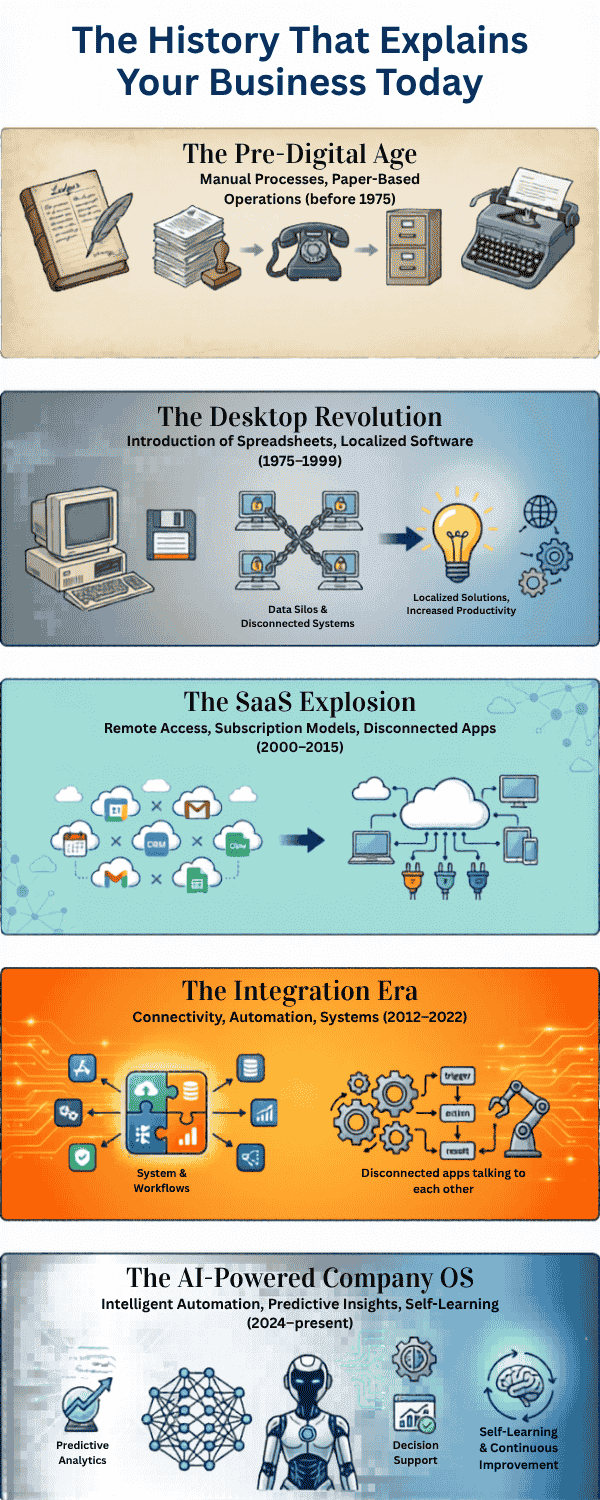
Business operations has evolved through five distinct eras. Each one solved the problem created by the era before it. Each one created a new problem. And the current era, for the first time in history, is solving the foundational problem all five eras were circling.
🔹 Era 0 — The Pre-Digital Age (before 1975):
Businesses ran entirely on human memory, paper ledgers, and phone calls. The owner was the operating system. Decisions, customer relationships, and institutional knowledge all lived between their ears. When that person left the room, the business slowed. When they left the company, it walked out with them.
The pre-digital era was, in one critical sense, unified. There were no data silos because there was essentially one system: the people who ran it. The problem wasn't coordination. It was scale. And, technology came along to fix it.
🔹 Era 1 — The Desktop Revolution (1975–1999):
IBM launched the personal computer in 1981 and detonated a slow-motion revolution. Finance got spreadsheets. Sales got digital Rolodexes. HR got databases. Each department computerized independently and became measurably more efficient in isolation. Reports that used to take a week now took an afternoon.
But a new problem was quietly born: data silos. Finance's numbers didn't talk to operations. Sales records didn't connect to fulfillment. And while the software solved departmental efficiency…it created creating cross-department blindness.
🔹 Era 2 — The SaaS Explosion (2000–2015):
Salesforce launched in 1999. Then HubSpot, Zendesk, Slack, QuickBooks Online, Asana, DocuSign… The "best of breed" revolution gave every function its own world-class platform. By 2020, the average mid-sized company ran 175 SaaS applications. By 2024, enterprises averaged 371.
The efficiency gains were real. So was the hidden tax: scattered data, disconnected workflows, and the founder and managers who had become the integration layer between all of it. You had solved every departmental problem and accidentally created a company that operated like a collection of separate teams working on adjacent islands.
🔹 Era 3 — The Integration Era (2012–2022):
Zapier launched in 2011. Then Make, then n8n. The promise: connect your apps and make the islands talk. And it worked, to a point. But research from MuleSoft found the average enterprise managed 897 applications with only 29% integrated, and IT teams spending 39% of their time building custom integrations.
The average employee still switched between 13 different tools approximately 30 times daily, losing 9% of their productive hours to context switching alone. Integration was a better workaround…but it was still a workaround. Every Zap that broke sent a cascade of missing data through the business. Every new tool required new mappings, new maintenance, new failure points.
🔹 Era 4 — The AI-Powered Company OS (2024–present):
This is where the arc lands. Not another tool. Not another integration layer. A fundamentally different architecture: a central intelligence hub that connects all functional areas, makes data queryable in real time, automates routine decisions, and gets smarter as it scales. Marketing, Sales, Finance, Fulfillment, Product… all connected to a single operating core. The founder is no longer the integration layer. The OS is.
And, the shift from Era 3 to 4 isn't just slightly incremental. It's an exponential leap forward.
🧠 Think of it this way. For fifty years, we kept building better roads between islands. The AI Company OS is the bridge that makes the islands one landmass.
What the AI Company OS Actually Solves
Here's what makes this era different from every previous one: The business operating systems being deployed today solve for it all: efficiency, faster decisions, faster PMF (product market fit), better customer experience, reduced risk, durability in uncertain times, lower risk. And, it solves the founder bottleneck problem that every era created but none could fix.
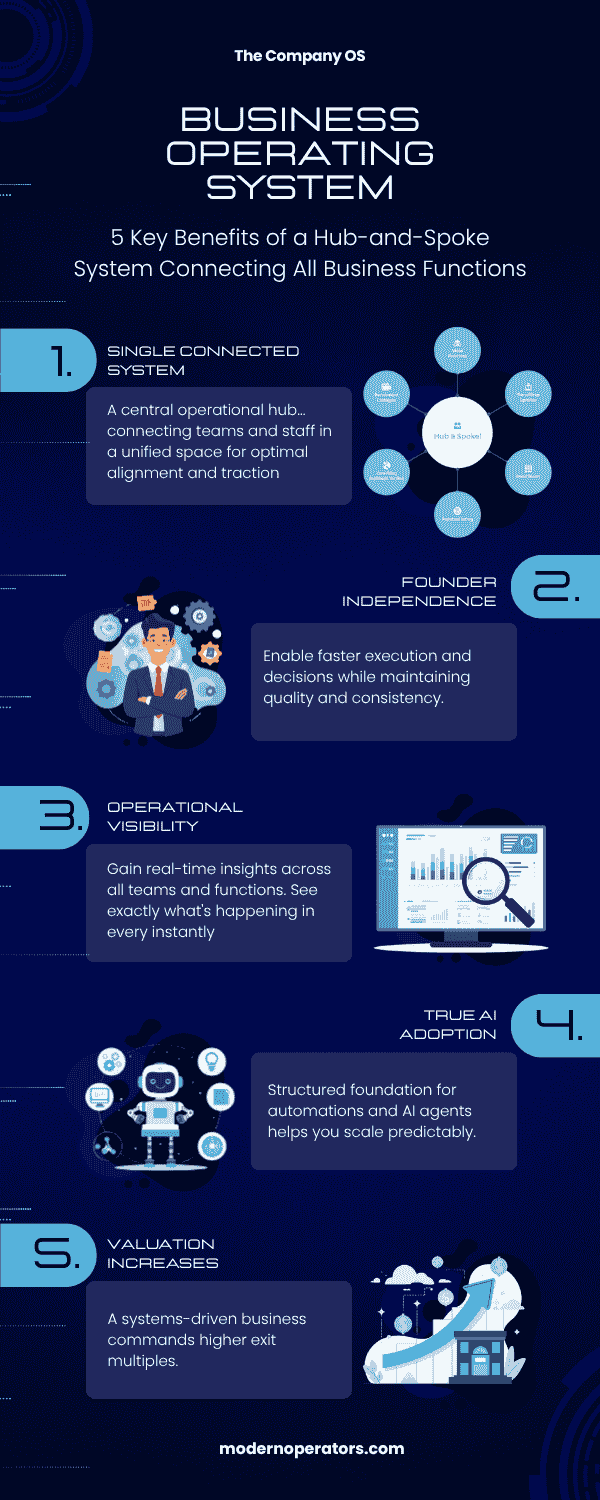
The Company OS is hub-and-spoke by design. Every functional area of your business, Marketing, Sales, Finance, Fulfillment, Legal, connects into a central operational hub. Information flows in automatically. Decisions get made with real-time data. Workflows execute without a human manually moving them along. And the founder's role shifts from being the glue to being the orchestrator and the strategist.
Specifically, here's what it gives you:
🔹 Single connected system: A unified hub replaces Drive, scattered sheets, siloed apps, and Slack threads where communication and decisions is orphaned from the work.
🔹 Founder independence: Execution and decisions move out of your head and into repeatable, documented systems your team can run without you.
🔹 Operational visibility: Real-time data across marketing, sales, finance, and fulfillment, queryable anytime, by anyone who needs it.
🔹 True AI adoption: Automations and AI agents have a structured foundation to sit on, so they don't break your business the moment something changes.
🔹 Valuation increases: A business that runs on systems, not on the founder's presence, commands a stronger exit multiple. Full stop.
⚠️ Here's the hard truth most founders need to hear: AI without structure just amplifies the stress.
If your processes are inconsistent, your data is scattered, and your knowledge lives in 14 different places, AI will not save you. It will just help you create more system stress faster. But with a Company OS as your structured foundation…AI becomes a genuine multiplier. And, the business gets smarter as it scales, not more complicated.
Where Do You Go From Here?
You don't need to rebuild everything on Monday. You need to start with clarity.
Identify your current era. Be honest. Are you still the operating system (Era 0)? Running 15 SaaS tools that don't talk (Era 2)? Duct-taping it together with Zapier (Era 3)? You cannot move forward from a place you won't acknowledge.
Find your highest-friction workflow. Pick one process where scattered tools are creating the most drag. Not everything, one. What's the single workflow that, if it were unified and intelligent, would give you the most visibility or save the most time?
Build the foundation before the AI. Before you add an agent or automation, ask: do I have clean, consistent data here? Documented processes? Clear ownership? A solid foundation means acceleration. Weak foundation means AI multiples bottlenecks.
Think hub, not stack. Stop evaluating tools in isolation. Start asking: does this add to the hub or add to the sprawl? The goal isn't the best individual tool for each function. The goal is a unified system where every function feeds the whole.
✅ This week: Sketch your hub-and-spoke model on paper. Marketing spoke. Sales spoke. Finance spoke. Fulfillment spoke. What's in the center connecting them? If the answer is "me," that's a problem.
Final Thoughts
The 50-year arc of business operations is the story of humans trying to capture, organize, and act on information faster and smarter than their competitors.
Every era was the right answer for its moment. The Rolodex was brilliant. The spreadsheet was a revolution. Zapier was a genuine lifesaver. None of them were wrong…but they were limited.
We're not limited anymore.
For the first time in business history, a 5-person founder-led company can run on the same kind of unified operational intelligence that used to require 500-person enterprise teams and eight-figure tech budgets. The architecture problem that every era created and none could solve?
It's finally solvable.
The founders who win the next decade won't win because they worked harder or had better ideas. They'll win because they built systems that compound… systems that capture institutional knowledge, run repeatable processes, surface real-time intelligence, and scale without adding proportional complexity.
Clarity is the first multiplier. Systems are how you build it.
This is Issue 43 of Modern Operators. We help founder-led businesses scale smarter by turning clarity into their ultimate growth lever.
How to get unstuck fast
Subscribe to our free newsletter that helps businesses go from working in the business to on the business.






Stay Updated with Us
Join the free weekly newsletter to see how smart founders operate modern companies.

Frameworks
Operational Models
Alignment


No Spam, Unsubscribe Any TIme