

First Principles
Exit-Ready from Day One
Over the last 20 years, I've had a front row seat (and behind the scenes look) at hundreds of small businesses as an owner, consultant, buyer and investor.
You might be surprised to learn that maybe 30 were actually sellable.
The rest? Founders thought they were sitting on gold. But when we pulled back the curtain, we found the same thing every time: a job with revenue, but not a business.
Here's the reality: Your business is only worth what someone will pay for the future cash it can generate without you.
Not what you've sacrificed. Not the late nights or the blood, sweat, and tears. Not your past performance.
All of that means absolutely zero.
It all comes down to what your business predictably produces while you’re not around.
Why This Matters Now
Most founders build businesses backwards.
They're chasing revenue, putting out fires, keeping customers happy. They think, "I'll worry about systems and scalability later, once I'm bigger."
That's a mistake.
Because by the time "later" arrives, founder dependency is baked into every corner of the business. You are the product. You are the relationship. You are the knowledge.
And that makes your business nearly worthless to a buyer.
According to research from the Exit Planning Institute (2024), only 20-30% of businesses that go to market actually sell. The rest either get lowball offers or no offers at all.
Why?
Because buyers don't want to inherit your job. They want a system that prints cash predictably…without the founder.
What buyers actually pay for
In two decades of seeing behind the scenes, I can tell you exactly what a business buyer is looking for:
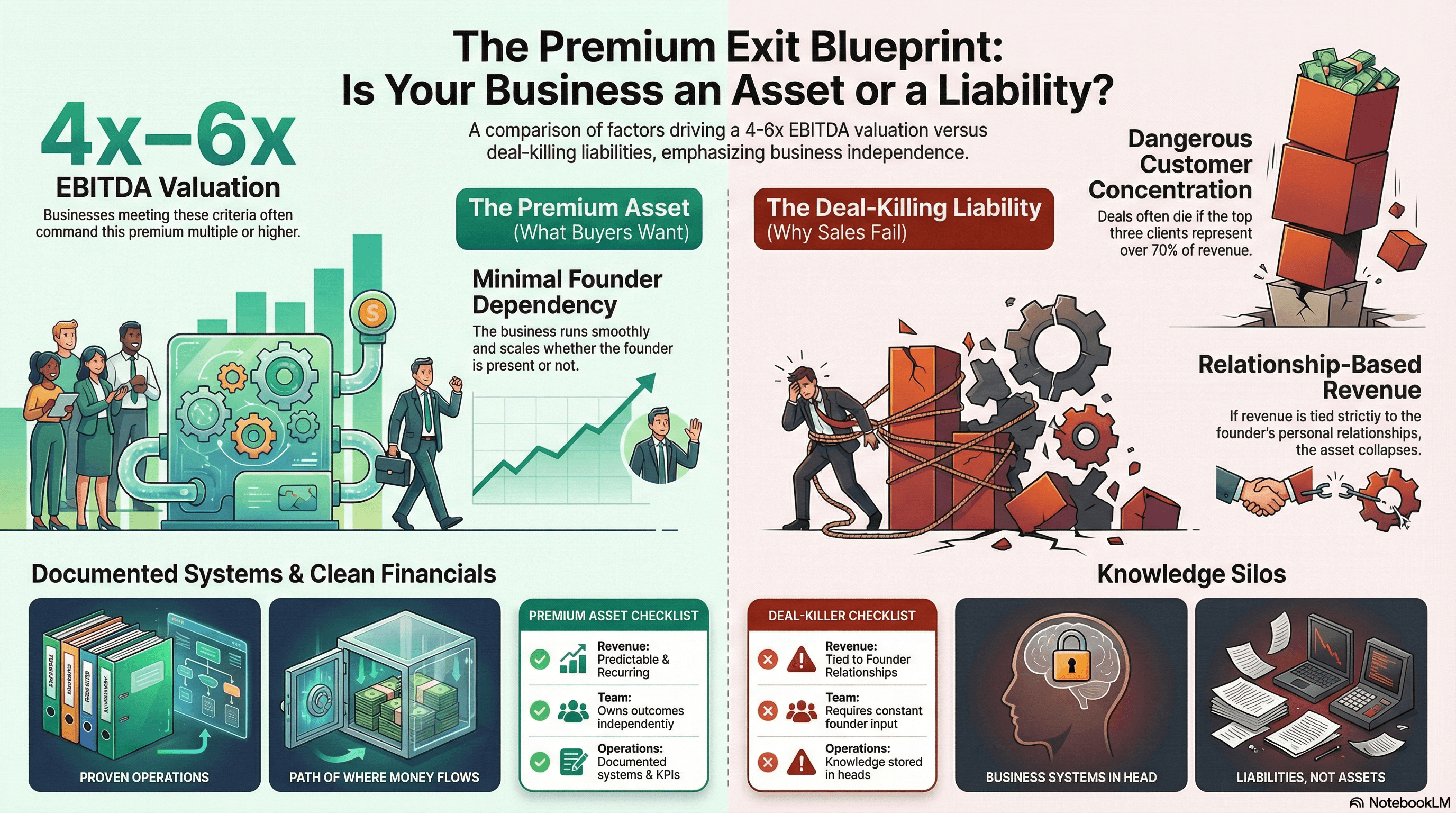
🔹 Predictable revenue — Recurring customers, contracts, or proven acquisition channels that can continue to scale
🔹 Minimal founder dependency — The business runs whether you're there or not
🔹 Clean financials — Clear path to where money comes from and where it goes
🔹 Clear KPIs and levers — Clearly knowing what drives growth and how to control it
🔹 Documented systems — Clean operations that run in every area of the business
🔹 Strong team — People who own outcomes, not just execute tasks
When those six things are real? That business owner can expect a premium offer. Often 4-6x EBITDA, sometimes more.
When it’s not? It then takes a lot more due diligence which lowers the price or forces a walk away situation.
Why most businesses don't sell…
Any one of these kills deals:
⚠️ Revenue tied to the founder's relationships
⚠️ No systems…everything's knowledge stored in someone’s head
⚠️ Chaotic financials with personal expenses mixed in
⚠️ Customer concentration (top 3 clients = 70%+ of revenue)
⚠️ Team that can't operate without constant founder input
I've walked away from businesses doing $2M+ in revenue because it was obvious…the second the founder left, the whole thing would collapse.
That's not an asset. That's a liability.
Build Exit-Ready from Day One
Here's the mindset shift: every decision you make should assume you're selling your business.
Not because you are.
But because it forces you to build the right way.
Exit-ready businesses aren't just more sellable. They're more valuable, more scalable, and way less stressful to run.
The "Stress Test" that reveals everything
Want to know if your business would sell?
Run this simple test:
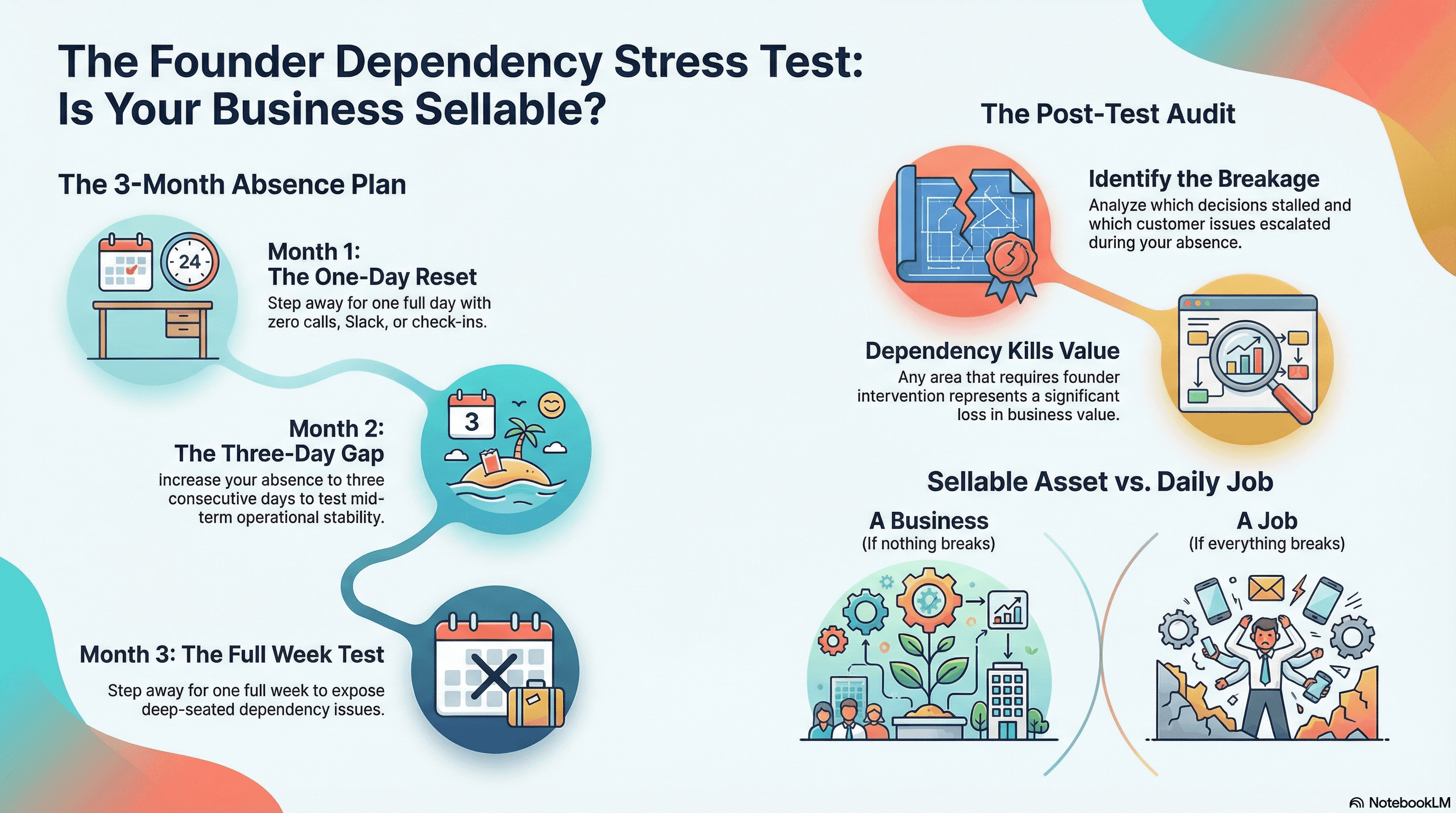
Month 1: Step away for one full day. No calls, no Slack, no "quick check-ins."
Month 2: Step away for three full days.
Month 3: Step away for a full week.
After each absence, ask:
✅ What broke?
✅ What decisions couldn't be made without me?
✅ What customer issues escalated?
✅ What revenue was at risk?
If the answer is "nothing"…you've got a sellable business.
If the answer is "everything"…you've got a job.
This test doesn't lie. It shows you exactly where founder dependency lives. And where it lives is where value dies.
Final Thoughts
Smart business owners treat their business like an asset from day one. They build so they become optional over time. This means having documentation, systems, workflows, dashboards, and aligned staff in place.
When it came time to sell, the process was smooth. The valuation was strong. And they walked away with life-changing money.
The desperate ones? They realized too late that they'd built a prison. Then, they couldn't sell, couldn't scale, and couldn't step away.
Your business is a promise for future performance, not a reward for past effort.
So build like you're selling tomorrow.
Even if you never do, you'll end up with a business that's worth owning.
This is Issue 37 of Modern Operators. We help founder-led businesses scale smarter by turning clarity into their ultimate growth lever.
How to get unstuck fast
Subscribe to our free newsletter that helps businesses go from working in the business to on the business.






Stay Updated with Us
Join the free weekly newsletter to see how smart founders operate modern companies.

Frameworks
Operational Models
Alignment


No Spam, Unsubscribe Any TIme