

Identity
The Identity Doctrine: How to Align Your Team
Your Team Isn't Confused. Your Company Is.
I have a good friend who has been running a seven-figure branding company for almost 20 years. For most of that time, he was the heartbeat of the organization. The cheerleader. Rallying the troops, shouting the mission, pouring energy into every room he walked into. His staff showed up with purpose. They had fun. They got results.
For the last two years, he's been checked out.
Not because he stopped caring. Because he stopped knowing. He doesn't know where his company is headed. He's not sure how to read where things are going. So he's pulled back. And what's happening as a result? The culture is fragmenting. The Identity is eroding. His staff are confused, because the thing holding it all together was him. Not a system. Not a doctrine. Just him showing up every day and playing the role of the brand.
His staff have told him directly: they want leadership. They want clarity. They want to know who they are as a company and where they're going.
I see this playing out over and over right now with founders at every level.
Here's what's at the root of it, and what actually fixes it.
Why This Matters Now
Businesses weren't built for the pace of change we're living through. Founders built their companies on instinct, hustle, and momentum. It worked... until it didn't.
According to Deloitte (2024), only 23% of employees strongly agree that they can apply their organization's values to their daily work. Three out of four people on most teams are operating without a clear, internalized sense of who the company is and how to act on its behalf.
That gap is an Identity problem, not a staff problem.
The overwhelming majority of new businesses skip Identity entirely. They jump straight to tactics: which channel to post on, which ads to run, which tool to try next. Activity after activity, grasping at what might work... but never actually building a business.
And for existing companies where founders are feeling less confident, teams have gone reactive, lurching from problem to problem instead of leading their markets. The root cause is almost always the same.
They never built an intentional Identity.
Uncertainty is exposing that gap wide open.
What Modern Identity Actually Is
At Modern Operators, we describe Modern Identity as the DNA of a modern company.
Not a tagline. Not words on a wall or a dusty binder from a retreat two years ago. A living doctrine that tells your team who you are, why you exist, what you stand for, and how you operate in every single interaction, every single day.
Modern Identity is built on six core elements:
🔹 The Cause: Why you exist beyond revenue. The deep mission that gets people out of bed and into the work.
🔹 The Lane: What you do, and just as importantly, what you don't. Scope clarity ends bottlenecks before they start.
🔹 The Code: Your non-negotiable values. The lines that don't move, even when the pressure is on.
🔹 The Edge: What makes your brand uniquely valuable. Not your features. Your specific, defensible advantage in the market.
🔹 The Vibe: How people feel experiencing your brand. Culture, tone, energy, standards.
🔹 The Line: Your one memorable phrase. The sentence that captures everything you stand for.
And sitting above all of it is your Vision.
Vision answers the question your team is quietly asking every single day: Where are we going?
A clearly documented Vision gives your people a destination. It connects daily work to a bigger story. Without it, effort may be real but direction is fuzzy. Staff stay busy without ever becoming truly aligned.
Together, Modern Identity and Vision create the operating context for everything else in your business. They're the What and the Why. And those must always come before the How.
What Happens When Identity Is Left to Chance
If you don't build your Identity on purpose, one gets built for you.
It forms around the founder. Their strengths become the company's strengths. Their blind spots become the company's blind spots. What they value and what they tolerate becomes the unwritten rule book. And if a few loud voices carry weight in the organization, their worldview gets folded in too.
The result? An Identity that's inconsistent, incomplete, and invisible. Staff are left guessing what actually matters. They interpret the company's values differently depending on who they last talked to or how they feel that day.
And when the founder steps back, like my friend did, the whole thing wobbles. Because the Identity was never integrated into the business. It was just him showing up every day.
That's not a foundation. That's a dependency.
⚠️ Ask yourself: does your business run on a culture of "I look to the founder to tell me what to do" or "I know who our company is, why we exist, and what outcomes I'm responsible for"? The answer tells you how much work is still ahead.
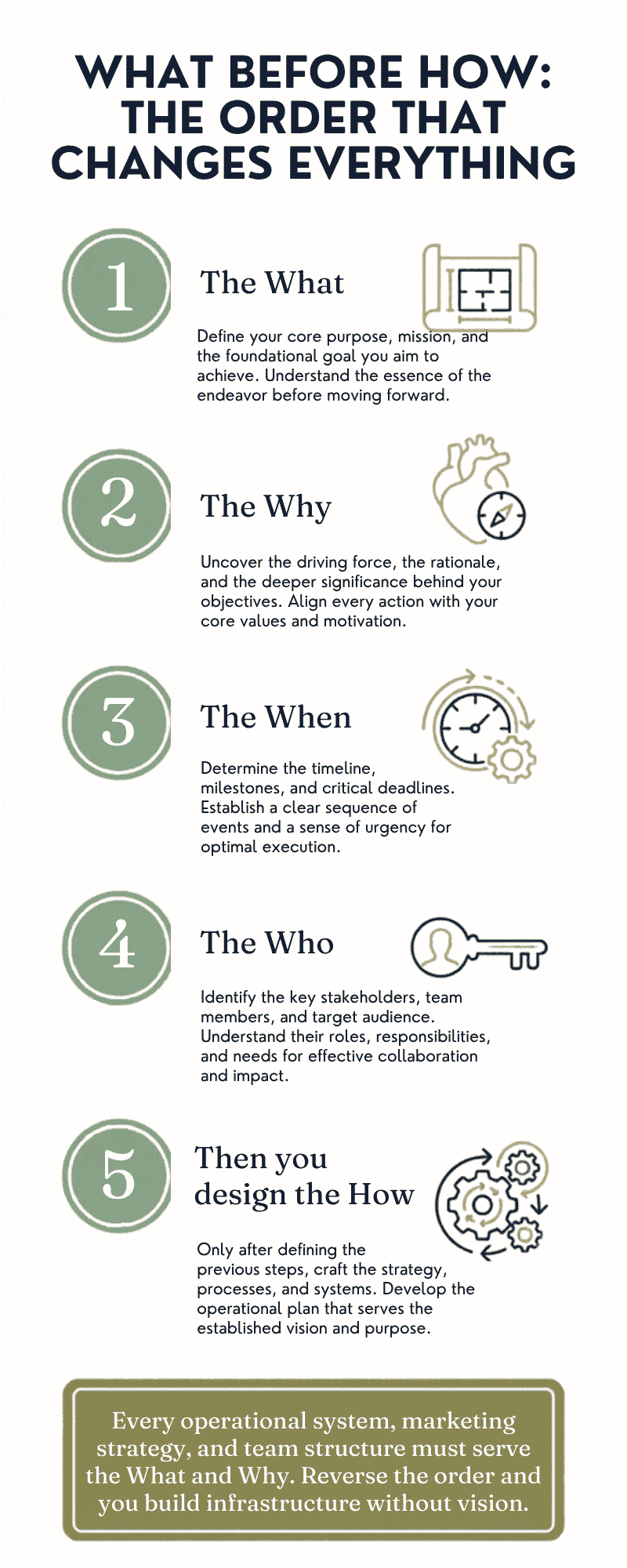
What Before How: The Order That Changes Everything
There's a sequencing error that quietly costs founders profit and speed over the life of their business.
They jump straight to How.
How do we market this? How do we scale the team? How do we implement AI? How do we improve operations? The How questions feel urgent and concrete. But without first answering the What, the Why, and the When, the How becomes an expensive exercise in building the wrong things quickly.
The What: What are we building? What do we stand for? What outcomes are we responsible for?
The Why: Why does this company exist beyond profit? Why should someone choose us over anyone else?
The When: When do our principles get tested? When do our values get applied under real pressure?
The Who: Who owns what? Who is responsible for the results in each area of the business?
Then you design the How.
This order matters because every operational system, every marketing strategy, every team structure must serve the What and the Why. Reverse it and you build infrastructure that serves no clear vision. You end up with tools without context and people without purpose. And no amount of hustle closes that gap.
Identity answers the What, Why, and Who. It must come first.
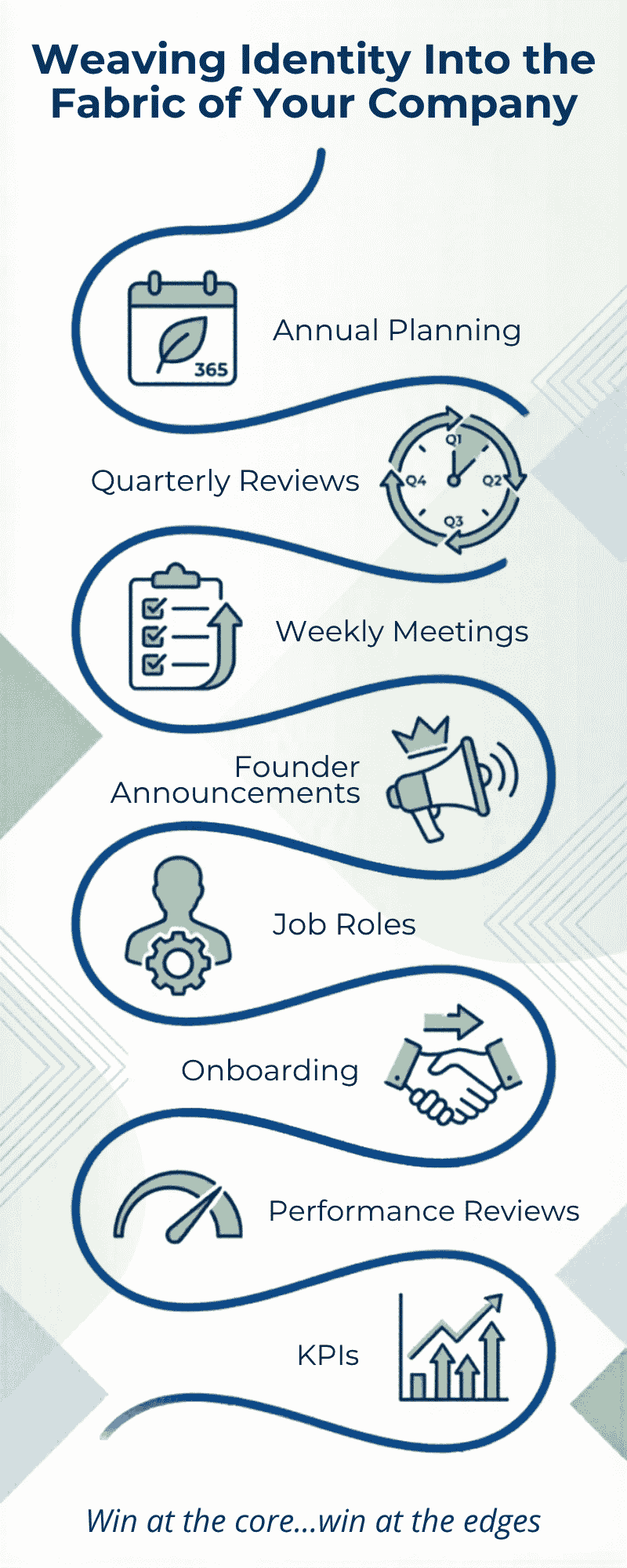
Weaving Identity Into the Fabric of Your Organization
Defining Modern Identity isn't the finish line. The real work is integration.
An Identity doctrine only creates alignment when it shows up everywhere. Not just in a PDF. Not just during onboarding week. Everywhere.
High-performing founders weave Identity into their organization like this:
🔹 Annual Review and Planning: Start every planning cycle with Identity. Before you set goals, reground the team in who you are and where you're going. Vision should anchor every strategic conversation.
🔹 Quarterly Review and Planning: Revisit the Code and the Lane every quarter. Are we still operating in alignment? Where did we drift? Course-correcting quarterly costs far less than course-correcting annually.
🔹 Weekly Leadership and Team Meetings: Open with a values story or a shoutout that reflects the Vibe in action. Make Identity a living conversation, not an annual retreat topic.
🔹 Founder Announcements: When you celebrate a win, name the value it reflects. When you share a failure, name what you learned and what the Code says about how you respond. Shoutouts tied to Identity are exponentially more powerful than generic praise.
🔹 Job Roles: Every role description should articulate outcomes that connect directly to the Cause and the Lane. "What does this role stand for?" matters as much as "What does this role do?"
🔹 Onboarding: Identity should be the first thing every new hire experiences. Not the benefits package. Not the org chart. Who are we? Why do we exist? How do we operate here? This is the foundation everything else gets built on.
🔹 Performance Reviews: Evaluate not just results but how results were achieved. Were decisions made in alignment with the Code? Were client interactions true to the Vibe? Reviewing against Identity makes your culture real, not theoretical.
🔹 KPIs: Yes, you can and should measure Identity. Track the metrics that reflect your most important Identity Markers: client satisfaction, team cohesion, response time, referral rates, net promoter scores. Identity without measurement is aspiration. With measurement, it's strategy.
The companies that do this consistently win at the core. And that translates to winning at the edges.
What Alignment and Synergy Actually Unlock
When Identity is integrated, the results compound fast. And they touch every corner of the business.
🔹 The team moves faster because decisions don't require escalation to the founder.
🔹 Fewer bottlenecks form because people know what to do, why it matters, and how to act.
🔹 Product/market fit arrives sooner because everyone deeply understands the customer and the mission.
🔹 Brand messaging sharpens because every team speaks from the same doctrine, which builds a stronger, more recognizable market position.
🔹 Customers are happier because every touchpoint reflects a consistent Vibe.
🔹 Customer acquisition cost drops because a strong, coherent brand earns referrals and organic trust.
🔹 Risk goes down because aligned teams catch problems before they compound into crises.
🔹 The organization becomes more resilient and adaptable in uncertain times because Identity enables pivoting when shifts happen.
🔹 Staff loyalty deepens. People who believe in the mission stay longer, sacrifice more, and recruit others like them.
🔹 And perhaps most underrated: people have more fun. Work is more meaningful when it connects to something bigger than the task in front of you.
This is what my friend's company used to feel like. When he was in the room, all of this was alive. The mission drove the work. The work drove the culture. The culture drove the results.
The mistake wasn't that he stepped back. The mistake was that the Identity only ever lived in him. The moment he pulled back, it pulled back with him.
Final Thoughts
Identity isn't fluff. It isn't a values exercise you do once and post on a wall. It's the operating doctrine of your entire business.
Every decision your team makes. Every interaction with a prospect, a customer, a vendor, a new hire. Every response to adversity, uncertainty, and change. All of it flows from Identity.
Build it on purpose. Integrate it everywhere. And your business stops depending on you to be the glue. Your team won't need you to show up every day and play the cheerleader. They know who they are. They know where they're going. They know what winning looks like.
That's the company that doesn't just survive uncertain times. That's the company that leads through them.
This is Issue 46 of Modern Operators. We help founder-led businesses scale smarter by turning clarity into their ultimate growth lever.
How to get unstuck fast
Subscribe to our free newsletter that helps businesses go from working in the business to on the business.






Stay Updated with Us
Join the free weekly newsletter to see how smart founders operate modern companies.

Frameworks
Operational Models
Alignment


No Spam, Unsubscribe Any TIme