

Burnout
You Built Your Business for Freedom..Right?
I recently came across a social media post from a business owner that caught my eye...
The text read - "Is it normal to feel trapped by your business? We built it for freedom, but sometimes it feels like we're trapped inside it."
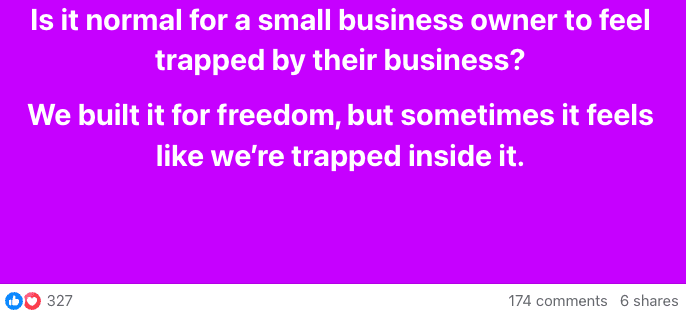
Notice the # of engagements and comments… 327 reactions. 174 comments.
And, the comments weren't advice. Most were Founders from every industry, every revenue level, every stage of growth...reporting the same thing: yes. I feel it too.
Comments like…
"The business slowly wrapped itself around me and now it's hard to move without pulling everything with it."
"I was the founder, CEO, and the #1 bottleneck, trapped in a system I had built to create freedom."
"I basically created a job."
"Trapped."
"Prison."
If you’re feeling trapped or overwhelmed right now...this issue is for you.
Why This Matters Now
The gap between why most founders built their business and what they're actually experiencing is one of the most common…least talked-about problems in the world today.
According to the Capital One Small Business Confidence Survey, 48% of small business owners experienced full on burnout in the past year. Not a rough week. Burnout. Nearly half. (Capital One, 2022)
UCL's School of Management found that 93% of founders show signs of mental health strain. 76% report feeling lonely. That loneliness rate is 50% higher than CEOs of larger companies.
You built a business to be your own boss…for freedom. And yet, for many…it’s gotten “heavier” to carry.
One founder I recently spoke with put it as plainly as I've ever heard it: "I should be happy and motivated, but I haven’t had the space to think about taking time off. And now, I just can't."
That trajectory doesn't happen overnight. It follows a pattern that's worth understanding clearly, because once you see it, you can't unsee it.
The Prison You Built…One Good Decision at a Time
Nobody traps themselves on purpose.
That's the part most of the advice gets wrong. Founders who end up working 60+ hour weeks and fielding every escalation didn't choose that life. They made good decisions. Individually rational, organizationally destructive decisions.
In the early days, you were the best at most things. So the work flowed through you. Fast. Accurate. Done right.
A client called with a problem and you handled it, because you could do it faster than explaining it to someone else. A decision needed to be made and you made it, because the judgment call required context that only you had. A team member didn't know the answer, so they came to you, and you told them, because it was faster than building a system to hold the answer.
Each decision was correct. At the time.
Michael Gerber named this pattern in The E-Myth Revisited nearly 40 years ago. He called it the "technician trap." A skilled person starts a business doing what they love, becomes the primary worker, and never builds the system that runs without them. The business grows. The founder just becomes a more exhausted version of themselves.
The trap isn't built in one bad decision. It's built in a thousand good ones.
🔹 The expertise loop: You were the best at something, so it flowed to you. Over time, it only flows to you, because no one else has ever been asked to own it. They're not incapable. They've just never been handed the wheel.
🔹 The approval ceiling: Decisions get escalated because the people around you have never been given a clear mandate to decide. So they wait. You become the speed limit of your own organization.
🔹 The knowledge gap: Your processes live in your head, not in a system. Nobody can operate at your level because they don't have access to what you know. So they ask. Every day. And you answer, because it's faster than fixing the root cause.
🔹 The relational cost: It doesn't stop at time. One founder posted: "My relationship ended because I was married to Shopify, not her." Another: "I can't stop thinking about taking time off. Now I just can't." The business didn't just take the hours. It took that and the rest.
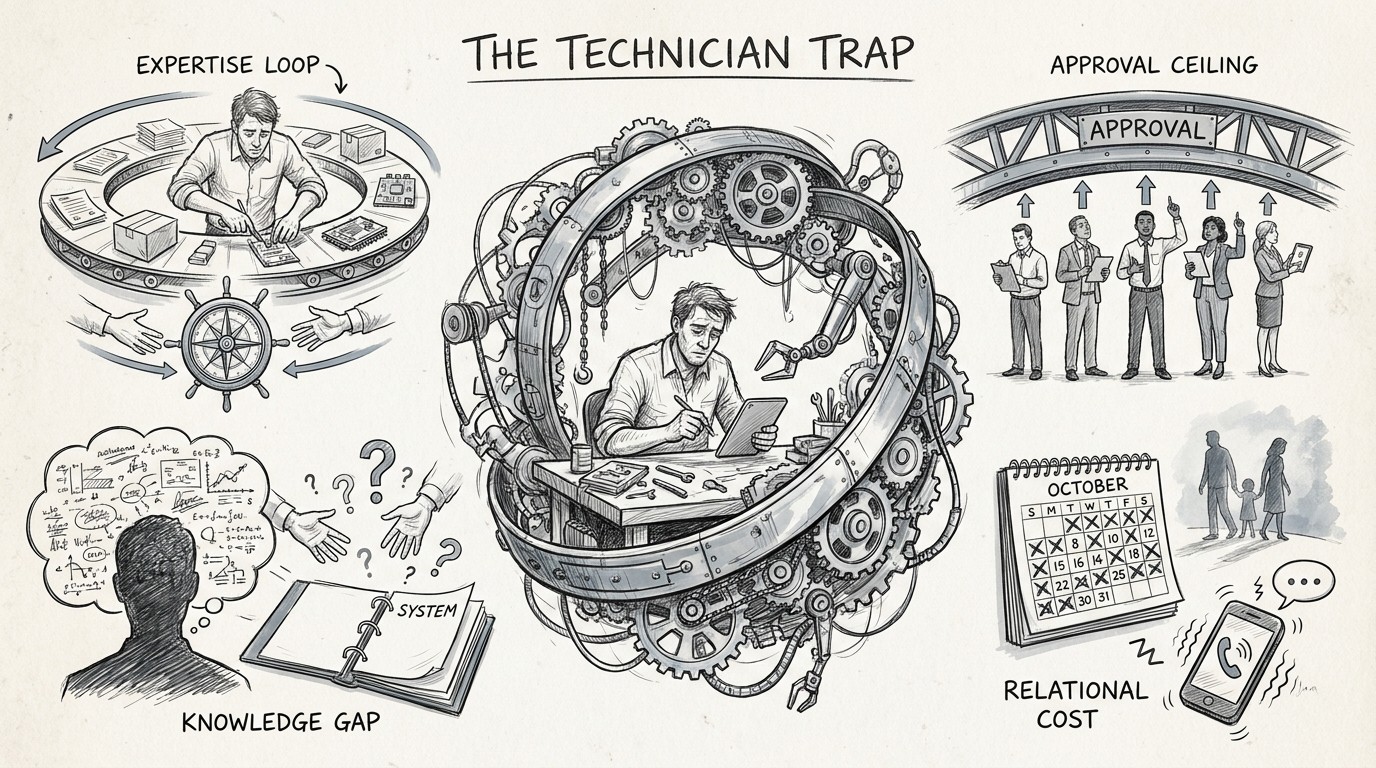
The diagnosis is structural, not personal.
The business was built to route through you. Every escalation path leads to you. Every gap in process defaults to you. When the structure sends everything to the founder, the founder handles everything. That's not a character flaw. That's an architecture problem.
And structural problems don't fix themselves. They get fixed by first…taking a hard look at what’s gotten you there.
The Way Out…One Step at a Time
This is where most advice gets too shallow.
"Delegate more" is not enough. "Write SOPs" is not enough. Most founders have already tried some version of that. They hired people. They handed off tasks. They recorded Looms. They created docs. And somehow, the business still found its way back to them.
That's because the real problem is not that your team lacks instructions. The real problem is that the operating context still lives with you.
Your team may know the steps, but not the judgment behind the steps. They may own tasks, but not outcomes. They may have access to documents, but not a clear source of truth. They may be responsible for execution, but still need you to interpret priorities, make tradeoffs, approve exceptions, and decide what matters when the situation changes.
So delegation fails, not because your people are incapable, but because they were given work without the operating system required to carry it.
The way out is by rebuilding the operating layer so decisions, knowledge, and accountability stop defaulting back to you.
That means clear ownership. Documented judgment. Visible priorities. Repeatable workflows. A single place where the team can find the context they need before they interrupt you. A structure where the business can route work to the right person, with the right context, at the right level of authority.
And today, there is a second (and arguably much bigger) unlock inside that structure: AI.
Not Joe's Claude project. Not Suzy's ChatGPT thread that no one else can see. I’m not talking about a sharp staff member on your team using a tool in a private session while the rest of the company keeps operating the old way.
AI becomes powerful when it has access to the operating context of the business: how decisions get made, what good looks like, who owns what, where the work lives, what the priorities are, and what the company already knows.
That's when AI stops being a personal productivity hack and starts becoming company leverage.
Your staff can ask better questions. Make faster decisions. Draft better client responses. Process information quicker. Get valuable insights.
But AI can't do that if the company's knowledge, judgment, and workflows are scattered across people's heads, private chats, old docs, and disconnected tools. Without an operating system, AI is just another app. With one, it becomes a force multiplier for the whole team.
This is not a personal failure. But it is creating real debt for you.
And that debt is going to continue growing…unless yo change.
The first move is not to systemize everything. That's too big, and it's why most founders never start. The first move is to find the place where the business keeps routing back to you and build one release valve there.
Where are you still the default answer?
Client escalations? Team questions? Sales decisions? Delivery problems? Operations? Approvals?
Start there. Not with a 90-page playbook. With one repeated loop that can be redesigned so the next decision doesn't automatically land on your desk.
There's one more number worth putting on the table.
Businesses with extreme founder dependency (that are capable of selling) sell for up to 50% below market comparable. That means a company that should exit at 7 to 8x EBITDA often trades at 3 to 4x. And, many never sell at all because there is not enough “packaged value” outside the founder.

You're not just paying for this with your time. You're paying for it with the future value of everything you're building.
Final Thoughts
The business wrapped itself around you because you let it. Not carelessly. Carefully. One good decision at a time, made by someone who was trying to get things done in a company that rewarded them for staying close.
That means this isn't a character flaw. But it is a debt that is growing against the value of your company.
The fix is to take this on yourself or hire a firm to do it with you. To build the systems, document the judgment, clarify ownership, and delegate decisions with enough context for the team to actually own the outcome. Build a structure where the business can move without you being the engine.
And if you're building that structure today, AI has to be part of the conversation. Not as a shiny add-on. As part of the operating layer.
Because the real opportunity is not that one person on your team gets good at prompting. The opportunity is that EVERY person on your team can unlock the full power of AI…using the company's context, standards, workflows, and insights.
That's the difference between growing a company and running inside a very expensive…very demanding job.
If you're feeling the trap right now, reply with the place where the business still routes through you most: decisions, client escalations, team questions, sales, delivery, or operations.
I read every response.
See you next week,
Damon & Mark
Co-Founders, Modern Operators
This is Issue 56 of Modern Operators. We help founder-led businesses install the operating infrastructure that lets their team run without the founder in the middle of everything.
How to get unstuck fast
Subscribe to our free newsletter that helps businesses go from working in the business to on the business.






Stay Updated with Us
Join the free weekly newsletter to see how smart founders operate modern companies.

Frameworks
Operational Models
Alignment


No Spam, Unsubscribe Any TIme