

Systems
Workflow-First Wins: Why the Operators Pulling Ahead Aren't Adding More Tools
A few months ago, I sat down with a new client, a business owner named Bilal.
He runs a medical spa in the northeast and is in the middle of growing from one location to two. Sharp guy…driven… And, completely buried.
Not because he lacked skill or his team wasn’t capable. But because every question his staff had, no matter how small…eventually found its way back to him.
So, he created more SOP’s and documented more processes.
He described it like this: my team was spread across so many Google Sheets and Docs that staff didn’t know where to find it or stopped using. Staff would get comfortable with a document, then forget where it lived a month later. His operations manager didn't have the answer. So she went to Bilal. His staff didn't have the answer. So they went to Bilal.
"I would be getting calls multiple times a day for like very, very little things," he said.
A loop with no exit.
And over the course of a year, the pain just got worse.
But this isn't an essay about Bilal's Google Sheets problem. What I want to highlight is the assumption most founders make when they hit this wall, and why it keeps them stuck longer than it should.
You probably have more tools, docs, processes than you realistically need.
CRM. Project management. Communication. Scheduling. AI assistants. SOP’s. Maybe a couple of things you signed up for six months ago that you're still paying for but can't quite remember why.
And yet…you're likely still the bottleneck.
The assumption baked into most business advice is that the right tool solves the problem. So founders keep searching for the next one. The better one. The one that finally gets their team running the way it should.
And, it still doesn't work. And the data is starting to show it.
Employees are spending only 45% of their workday on productive tasks, according to a 2025 study by Howdy (Inc., 2025). The rest is consumed by tool-switching, context-switching, and hunting for information.
The operators growing faster right now aren't the ones with the best “tools”. They're the ones who stopped asking "what tool?" and started asking different questions entirely.
Why This Matters Now
Small business owners are losing an average of 96 minutes every day to wasted time and process friction, according to a Slack/Salesforce study from August 2024. That's three weeks a year. Per person.
The average SMB wastes $135,000 annually on unnecessary software and overlapping tools, according to research from Corcava. Not on bad hires. Not on wasted ad spend. On software that sits underutilized because the underlying process was never defined well enough to actually use the tool.
And…if those stats don’t drive the point home…how about this one →
Inefficient processes are the number one cause of wasted time at work, above paperwork and above meetings, according to Planview's Powering Productivity research.
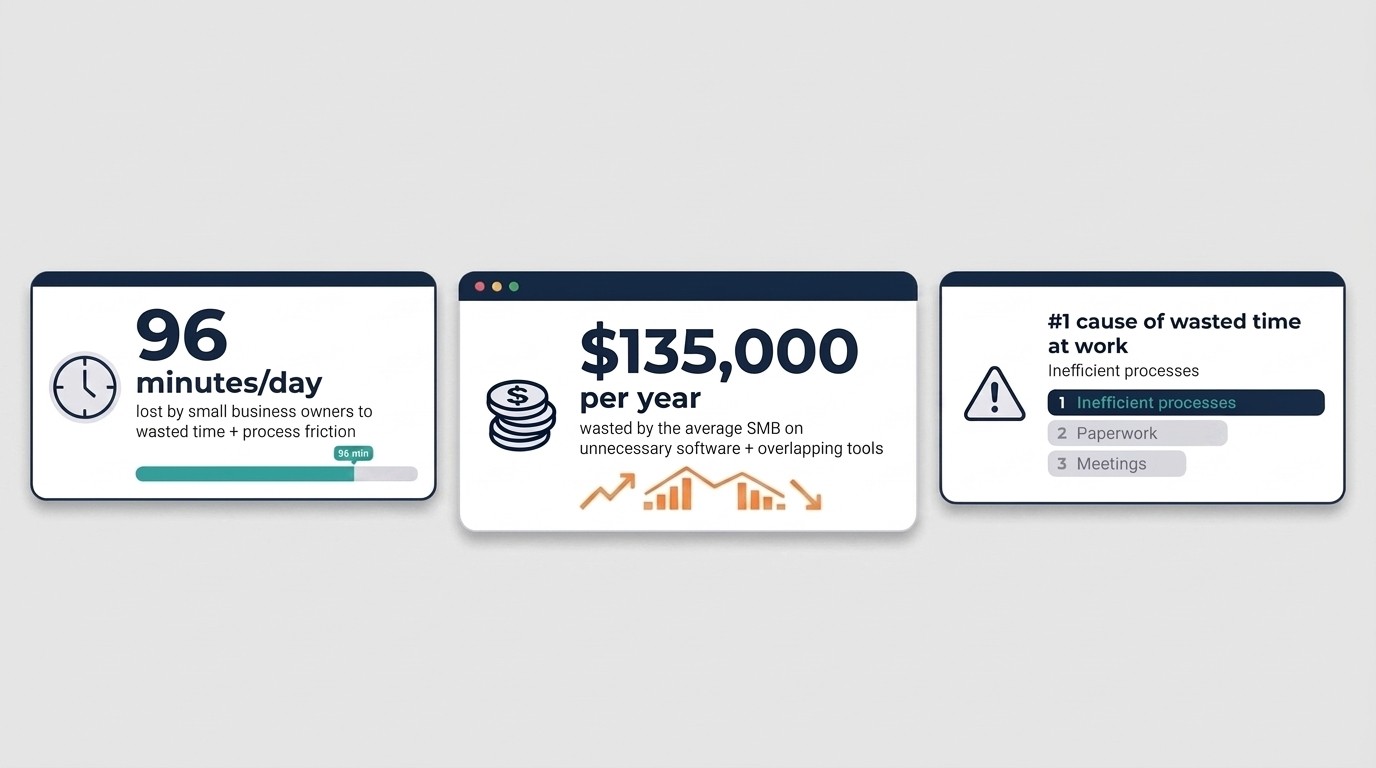
I see this play out all the time. A business has 12 siloed places to go and now multiple AI “tools”. Information lives in multiple places, none of them reliable. Sometimes, more SOP’s get created. A question routes to the founder because nobody is sure where the answer lives. That routes to a second question. Then a third. The founder becomes the system.
The problem gets addressed by adding another tool or SOP. And the cycle continues.
The Difference Between a Process and a Workflow
Most founders use these words interchangeably. They're not the same thing and the gap between them is where most businesses leak.
A process is documented knowledge. It's the recipe. It exists on a page somewhere and tells you how something should be done. Processes are useful. But they don't run themselves.
A workflow is that process made operational. It's the recipe converted into an executable, ownable, repeatable sequence that moves work from a trigger to a specific outcome, the same way every time, regardless of who's executing it. Let’s look at a few more definitions…
🔹 Trigger: the event that starts the work. A new client signs. A form is submitted. A status changes. Something specific and named kicks the sequence off.
🔹 Steps: the ordered actions that move work from the trigger to the outcome. Each step has a clear owner (a person, a role, or a system), clear inputs, and a clear definition of done. Maybe calls on AI…maybe not.
🔹 Handoffs: the rules that govern how work passes between steps. This is where most businesses leak. Not inside the steps... between them. The handoff that lives in someone's memory. The question that gets answered by the founder because there's no defined path for it to go anywhere else.
🔹 Outcome: A specific end state. A deliverable. Not "we worked on it." A status change. Something you can point to and say: DONE.
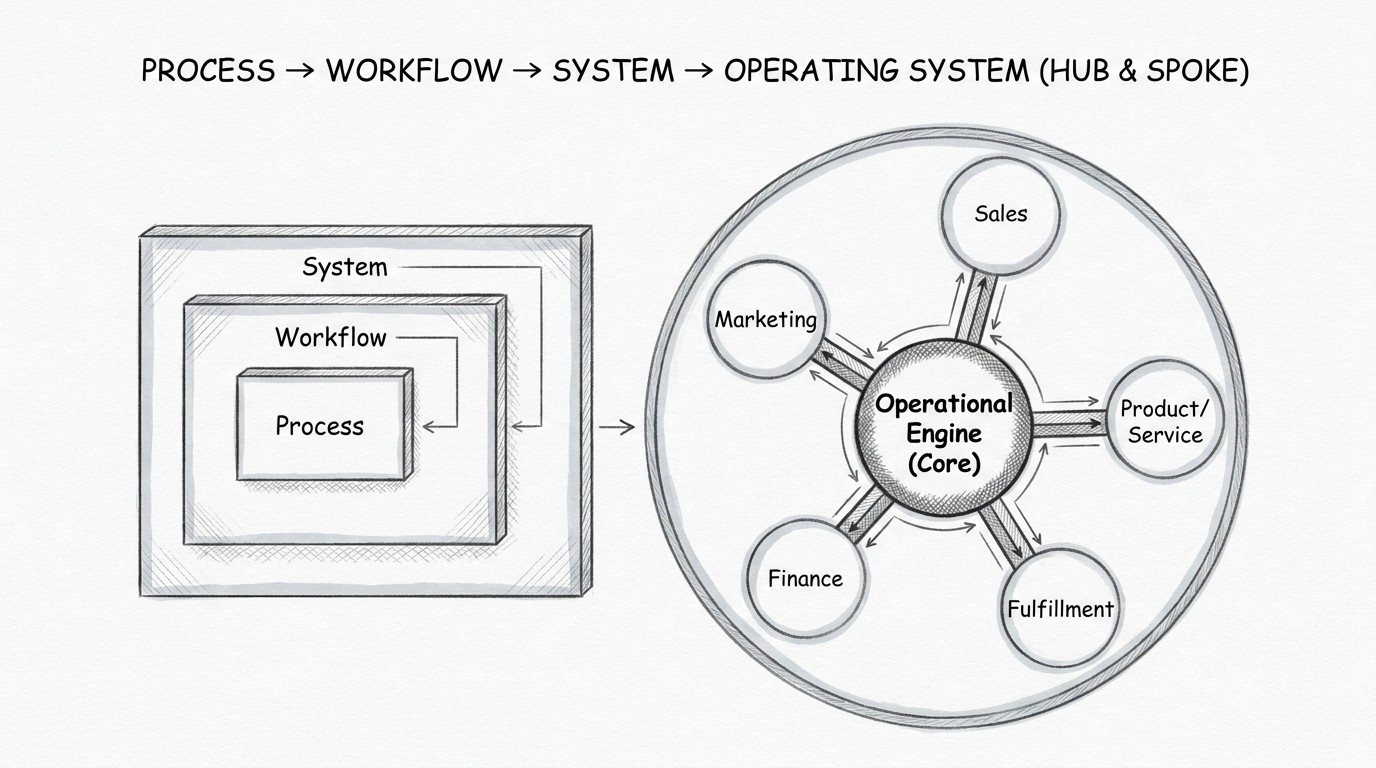
The distinction that matters: adding a tool is NOT the same as building a workflow. A tool without a defined trigger, step owners, handoffs, and outcome is just a place where work goes to get lost.
This is the trap. Founders mistake the tool or the SOP for the workflow. They implement the software without defining how work actually moves through it. Then they wonder why the team defaults to texting, emailing, or calling the founder instead.
⚠️ If your team routes around the system to get answers, the issue almost never sits with the people. It sits with the missing structure underneath them.
What Changes When You Get It Right
Three months after Bilal started working with Modern Operators, here's what he told us.
"My managers barely reach out to me now."
He said that on a day when his manager and director were both supposed to start at 9:00 a.m. It was 12:09 p.m. and he hadn't heard from either of them.
"I love it," he said. "I don't want to hear from anybody to be honest."
But what struck me most was what came next.
"Just having all of this in place also stabilized my culture as well. And that's something that I didn't necessarily think would happen."
That's the second-order effect most founders don't expect. When your workflows are built into the system instead of living in someone's head or defaulting to the founder, people stop operating in a state of low-grade confusion. They know where the answer lives. They know who owns what. They know what "done" looks like for their part of the process.
"My staff can implement and get work done without me," Bilal said.
10 hours a week back and growing. 95% or more of projects completed on time. A second location opening by end of year. Culture improved.
None of that happened because he added a better tool. It happened because workflows were built into a system that handled how work flows best.
Bilal put it best: "There's no dollar amount to that freedom."
How to Apply This (This Week)
You don't need to rebuild your entire operation to start. Pick one workflow.
Find the process that routes to you most often. The one generating the most "quick question" messages. That's your highest-leak handoff. Start there.
Name every step and its owner. Write it out as a sequence, not a general description. Who does what, in what order, and what does "done" look like for each step.
Map every handoff explicitly. Where does work pass from one person or system to another? Who triggers the next step? What's the signal that says "your turn"? If the answer is "someone just knows," that's the leak.
Define the trigger. Name the specific event that starts the sequence. If work begins because someone happened to remember it needed to happen, that's not a workflow yet.
Run it manually three times before touching a tool. Walk through the steps. Watch where it breaks. The gap between the workflow you think you have and the one you actually operate is almost always visible within the first two manual runs.
Final Thoughts
The operators pulling way ahead right now aren't the ones selling better products or services…or have better marketing than you.
They've stopped asking "what tool do we use?" and instead started asking "how do we build a system that enables our staff to operate better and faster?"
That shift in thinking is the lever to get you to where you want to go.
Your team is not the problem. Your missing operating system is.
Build the workflows so that your team is supported and works without you.
What are you going to do this year to start pulling ahead? Hit reply and let us know. We read every response.
See you next week,
Damon & Mark
Co-Founders, Modern Operators
This is Issue 54 of Modern Operators. We help founder-led businesses install the operating infrastructure that lets their team run without the founder in the middle of everything.
How to get unstuck fast
Subscribe to our free newsletter that helps businesses go from working in the business to on the business.






Stay Updated with Us
Join the free weekly newsletter to see how smart founders operate modern companies.

Frameworks
Operational Models
Alignment


No Spam, Unsubscribe Any TIme