

Thought Leadership
The MO Scale: What Level Is Your Business?
Today I’m going to ask you to think about maturity level your business is at.
Over the last 10 years, I’ve had in inside view of hundreds of businesses operating at $1M to businesses consistently growing over $300M.
When I ask founders what's holding their business back, the answers are almost always the same: not enough time, the team isn't quite right, the systems are a mess, or they can't get out of the day-to-day.
What they rarely name (and what I've come to believe is the actual root) is that they're operating at the wrong level for the problem they're trying to solve.
Every business sits at one of five levels of operational maturity. Each level has its own ceiling, its own cost, and its own specific lever to pull. Most founders have never seen the map. So they keep pulling the wrong levers, wondering why the business won't move.
The map is called the MO Scale. And once you see where you actually are on it, you can't unsee it.
Why This Matters Now
The data on this is uncomfortable.
According to SAS Institute's SMB AI Maturity Study from May 2026, 70% of small businesses are still operating at the early stages of operational maturity. MIT's CISR Enterprise AI Maturity Model found that businesses at these early stages consistently underperform their industry average financially. The gap is structural, not a one-time dip.
Ness.com's 2026 AI Maturity Assessment said it plainly: "In 2026, it is no longer about adoption or experimentation. It is about survival."
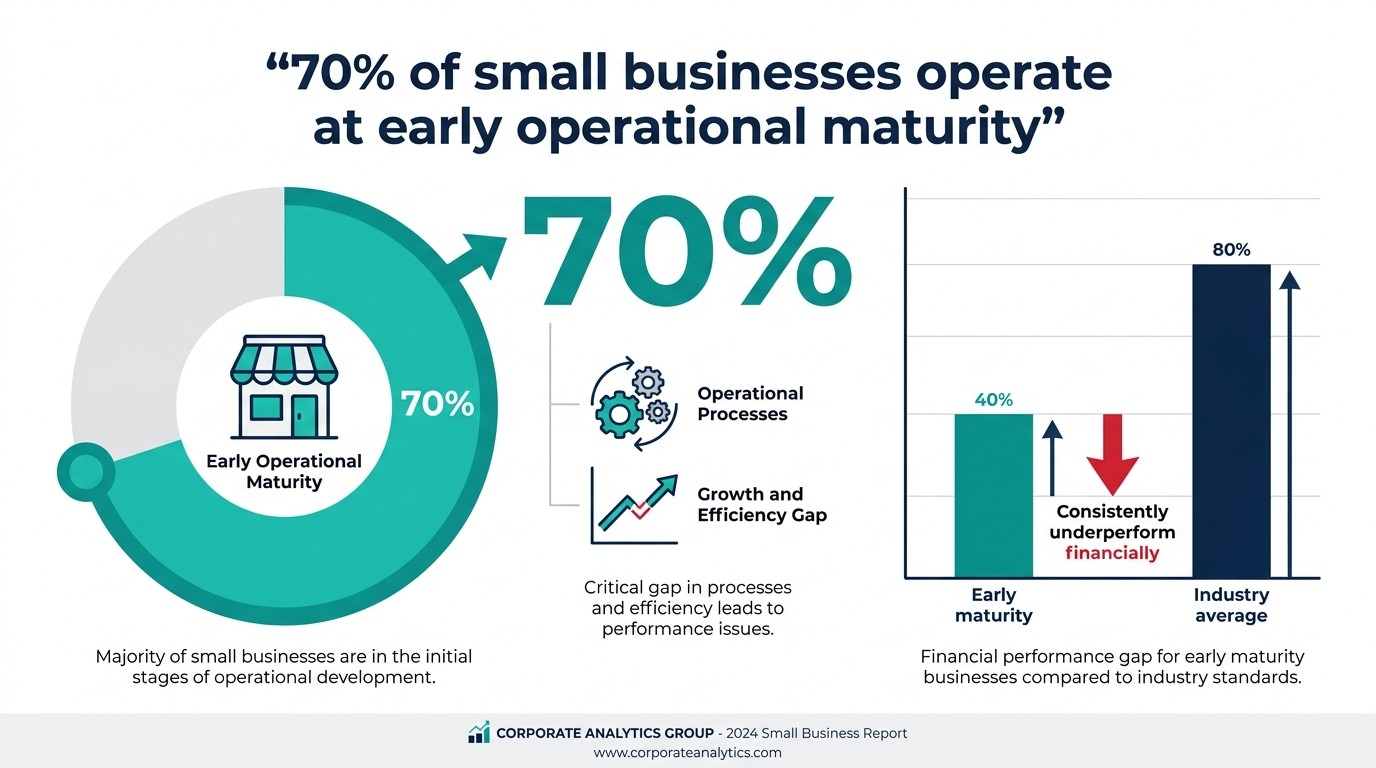
What level your business operates at today is directly correlated with your revenue performance, your team's capacity, and what the company is worth when you want to exit.
A founder I spoke with recently had been running a $4M service business for nine years. Great team. Solid margins. Good reputation. Every week, she’s spending 15-22 hours chasing information, answering questions and routing data..and it’s been happening for years. Her team can’t find what they need without asking. Every new hire slows things down before they ramp up.
She had built a real business. It was running at Level 2.
That's the most common story I hear. And the cost of staying there is compounding every quarter.
The MO Scale: What Level Is Your Business?
Five levels. One diagnostic question at the end of each. Answer honestly and your number will be clear.
Level 1 — All On You
The business runs on founder heroics. Every decision, every question, every escalation finds its way to your desk because there's nowhere else for it to go. Your team isn't the problem. The architecture is. Information lives in your head. Processes live in your head. Judgment calls live in your head.
Seventy percent of small businesses are operating at Level 1 or Level 2. Most don't know it yet.
🧠 AI at this level: Occasional and personal. Someone on the team uses ChatGPT to draft an email or summarize a doc. It's an individual habit, not a company practice. Nothing is shared. Nothing compounds.
Diagnostic: Can you be completely unreachable for five consecutive business days without something going sideways?
Level 2 — Held Together
You've invested. Tools purchased. People hired. A workspace somebody set up six months ago that half the team actually uses. Things mostly work... until they don't. Then the path of least resistance runs straight back to you.
This is where most founders spend years. Long enough to feel like progress. Not long enough to get ahead. The data on Level 2 businesses is consistent: they underperform their industry average financially, even after investing in tools and people.
🔹 40–60% of your week is still operational, even when you think you've delegated
🔹 Your team switches between four to six tools a day to complete a single workflow
🔹 Two to three hours per person, per week, lost to reconciling information that should live in one place
🧠 AI at this level: Slightly more intentional, but still fragmented. A few team members use Claude as part of their regular routine. There's no shared prompt library, no company-level protocol. Everyone's AI session is invisible to everyone else.
Diagnostic: Could a new hire answer most of their operational questions by looking at your workspace, or would they still need to heavily lean on staff around them?
Level 3 — Breathing Room
You can take a real week off and come back to a business that's still standing. Your team knows where things live, follows the processes, and only escalates what genuinely requires your judgment. You're leading, not managing.
This is real progress. It's also where founders stall for years. The system is organized, but every deliverable still requires a human hour. Scaling still means more headcount. The technology investment is high relative to what it's actually producing.
🧠 AI at this level: Moving from individual to team use. First protocols are in place. A prompt library is started. AI tools are beginning to connect to the workspace, but they're not yet embedded in cross-functional workflows. Nothing is automated yet.
Diagnostic: Can your team run operations for a full week without you? If yes, but you're still the primary engine behind growth, and scaling requires adding people rather than improving systems, you're at Level 3.
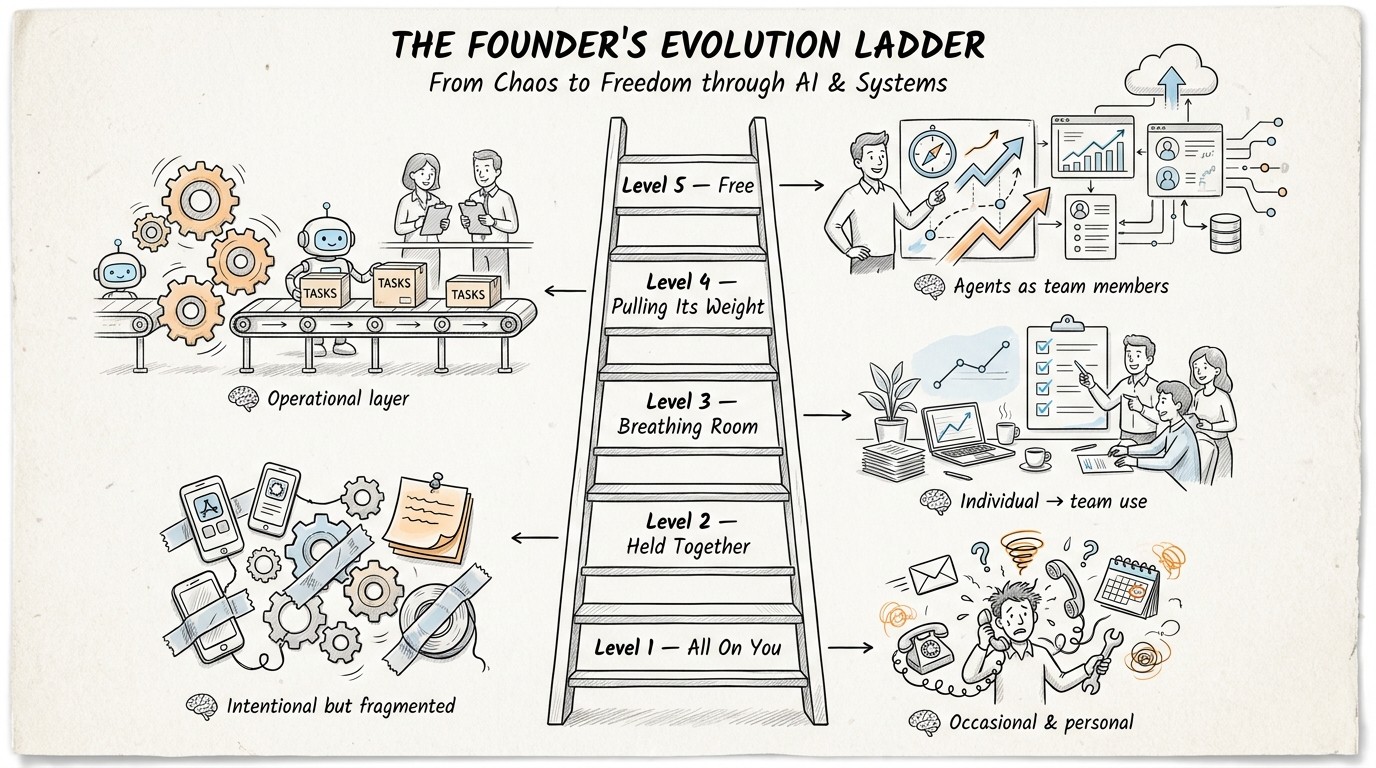
Level 4 — Pulling Its Weight
The business wakes up before you do. Automations trigger. Tasks get created. Reports update. Nobody had to run a Monday morning checklist.
Your team handles the standard path. You handle decisions that require actual judgment. The cost per deliverable is declining. The math has changed.
🔹 At least 30% of recurring operational tasks complete without a human initiating them
🔹 The team's first stop for information is the system, not a colleague
🔹 Onboarding a new hire takes weeks, not months, because the system delivers the training
🧠 AI at this level: AI is an operational layer. Agents handle meeting notes, first-draft client responses, scheduling, and data lookup. The prompt library is comprehensive and role-specific. New hires learn AI protocols as part of onboarding. Humans review and approve outputs. AI carries the load but doesn't decide alone.
Diagnostic: Do 30% or more of your recurring operational tasks run without a human starting them, and is your team's first stop for information the system, not a colleague?
Level 5 — Free
You set the direction. The business executes. Clients get served. Metrics get tracked. Exceptions get surfaced to whoever is on point. You could take a month off, launch something new, or focus on what you actually built this thing for.
This is why founders build companies.
Owner-dependent businesses sell at 3–4x EBITDA. Systematized, founder-independent businesses sell at 7–8x. That gap is built level by level, over years, while you're running operations.
🧠 AI at this level: Agents are operating team members with defined roles, permissions, and performance expectations. They read from the company's knowledge base, write back to it, trigger workflows, and surface exceptions to humans. When a new client signs, onboarding starts without anyone initiating it. AI isn't assisting the business. It's running significant parts of it.
Diagnostic: Could you be fully absent for 30 days and the business would operate, serve clients, and self-correct without any degradation?
Most founders land at Level 2 when they go through this honestly. Some think they're at Level 3 because they've survived a vacation. But they come back to a backlog that only they can clear. That's still Level 2. The ceiling held.
The point of the MO Scale is simple: stop solving a Level 2 problem with Level 1 tools, or a Level 3 problem with Level 2 thinking. Each level has a specific bottleneck. Each bottleneck has a specific lever. Knowing your level tells you which lever to pull.
How to Apply This (This Week)
This week, run the diagnostic. Go through each level and answer the question at the bottom honestly. Binary. Yes or no. Where does your first "no" land? That's your level.
This week, name your primary bottleneck. For most Level 2 businesses, the bottleneck is information: decisions, client details, and process context that lives in someone's head. For Level 3, it's initiation: the system exists but nothing runs without a human triggering it. Name yours specifically before you try to fix it.
This week, track where your team goes first. When your team has an operational question, what actually happens? If the answer is "they message me" or "they message the ops lead," your system is a person. That's your most urgent structural problem.
This week, calculate the valuation gap. Take your current EBITDA. Multiply by 3.5x (founder-dependent). Then multiply by 7.5x (systematized). Look at both numbers. That range is what your exit will fall within depending on what you build between now and then.
This week, decide which level you're actually building toward. Most founders say they want to be free, but the systems they're building will get them to Level 3 at best. Level 5 requires different infrastructure than Level 3. Know which one you're pointed at before you build anything.
Final Thoughts
The businesses pulling away are built to operate at a higher level. Information is centralized. Workflows initiate themselves. Teams self-serve answers the founder used to carry. AI is part of the operating layer, wired into workflows, drawing on shared company context. Not sitting in one person's private chat session while the rest of the business keeps running the old way.
The MO Scale is a diagnostic, not a judgment. And most founders, if they're honest, already know they're stuck. They've felt it for years. They just didn't have a name for the level they're stuck at.
Now you do.
Reply and tell me: what level are you at, and what's the one thing keeping you from the next one?
I read every response.
See you next week,
Damon Flowers
Founder, Modern Operators
This is Issue 58 of Modern Operators. We help founder-led businesses install the operating infrastructure that lets their team run without the founder in the middle of everything.
How to get unstuck fast
Subscribe to our free newsletter that helps businesses go from working in the business to on the business.






Stay Updated with Us
Join the free weekly newsletter to see how smart founders operate modern companies.

Frameworks
Operational Models
Alignment


No Spam, Unsubscribe Any TIme