

Leadership
The Founder Who Steps Away Wins
Recently, I was somewhere in the Wyoming backcountry, physically tired from a hike that had pushed my body past my normal threshold. I was there as part of a 3 week cross country trip that took me through Colorado, Arizona, and New Mexico. The reason? To ground and think.
No phone service. No email or text. No way for anyone to reach me.
And…Modern Operators ran just fine.
That didn't happen by accident. It happened because we spent dedicated time building the engine before I ever trusted myself to step away from it.
But if I’m being honest with you…even with the engine in place, there's still some moments every summer when I feel the pull. That familiar low-grade guilt. The thought that stepping away means something important might slip, or that a serious founder doesn't take time off.
If you're running a founder-led business, taking serious time away to reflect…to process…to think is more important today than it’s ever been before.
Let’s take a look at this seeming paradox and why grinding still seems like a badge of honor (hint: it’s not)
We built an AI system that creates SOPs in 5 mins to help us delegate work
Watch Mark break down step by step how we create standard operating procedures with AI that anyone on our team can follow.
Your Real Job as the Founder
Your job as a founder is not to be inside the business.
Your job is to go ahead of it.
To see what's coming in the market…in the industry…in the world and come back prepared to help your team move through it. That is a job that cannot be done from inside the machine. You need distance. You need exposure. You need a completely different set of inputs than the ones you get from another week at your desk.
This summer, my wife and I road-tripped through Wyoming, the Colorado Rockies, Sedona, and Santa Fe for 3 weeks. Most days: no phones, no electronics. We hiked trails that pushed my body past what I normally do. We got off-grid with no service and limited supplies. I spent extended time in meditation, real space to think, not about tactics, but about the bigger picture…and direction. We watched World Cup games with locals we had never met. Sat in conversations I never would have had at my desk.
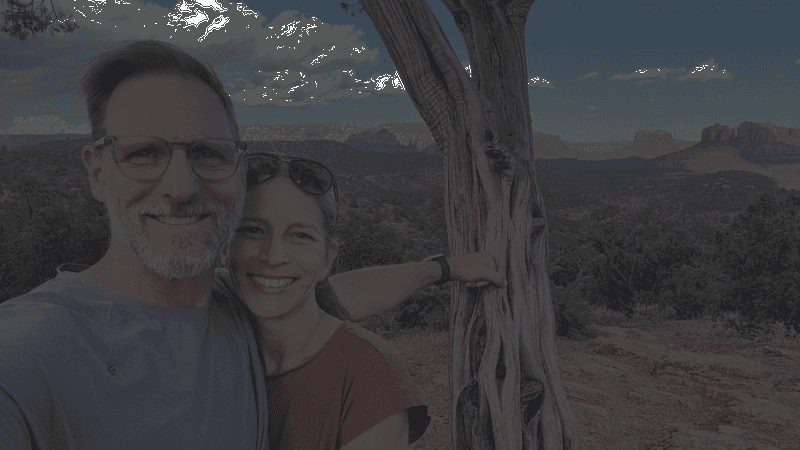
None of that looks like work. But all of it is connected…producing better work…strategic work…more sustainable work.
The guilt some of you feel about stepping away is real. I'm not dismissing it. That guilt is usually a feeling that I “should” be there with my team. It’s understandable…but just like I said earlier. Your role is not to be inside the business. It’s to bridge both the bigger vision AND the company’s movement towards it.
In order to do that…you have to build the engine. Then step away and let the engine do it’s job…so you can do yours.
The Growth Framework
For years, I've operated with a framework for how I spend personal time away from my business…each week, each month and year. There are four categories, and I try to make sure each summer (and shorter breaks throughout the year), covers all of them.
Read. Books, articles, briefs, case studies in fields you want to grow in. Not industry news. Not content marketing. Things that expand your thinking into adjacent domains. If you only consume content in your own category, you’ll stop growing in your category. The best ideas usually come from somewhere else.
Listen. Podcasts, YouTube lectures, self-help, affirmations. Consume other people's ideas at pace. I've solved real operational problems while on a walk with headphones in, because someone else's framework unlocked something I couldn't see from inside my own business.
Experience. This one is the most underrated. Get outside your normal mode. Try things you would not normally try. Be deliberately uncomfortable. Explore situations and circumstances that have nothing to do with your business. The Wyoming backcountry has nothing to do with building operating systems, except that it does, because it helps me see how the connections are going to happen.
Network. Connect with peers at three levels: people where you are, people ahead of you, and people behind you. Each one teaches something different. Peers validate and challenge. Those ahead pull your thinking forward. Those behind remind you what you've already figured out, and often ask the questions that reveal your blind spots.
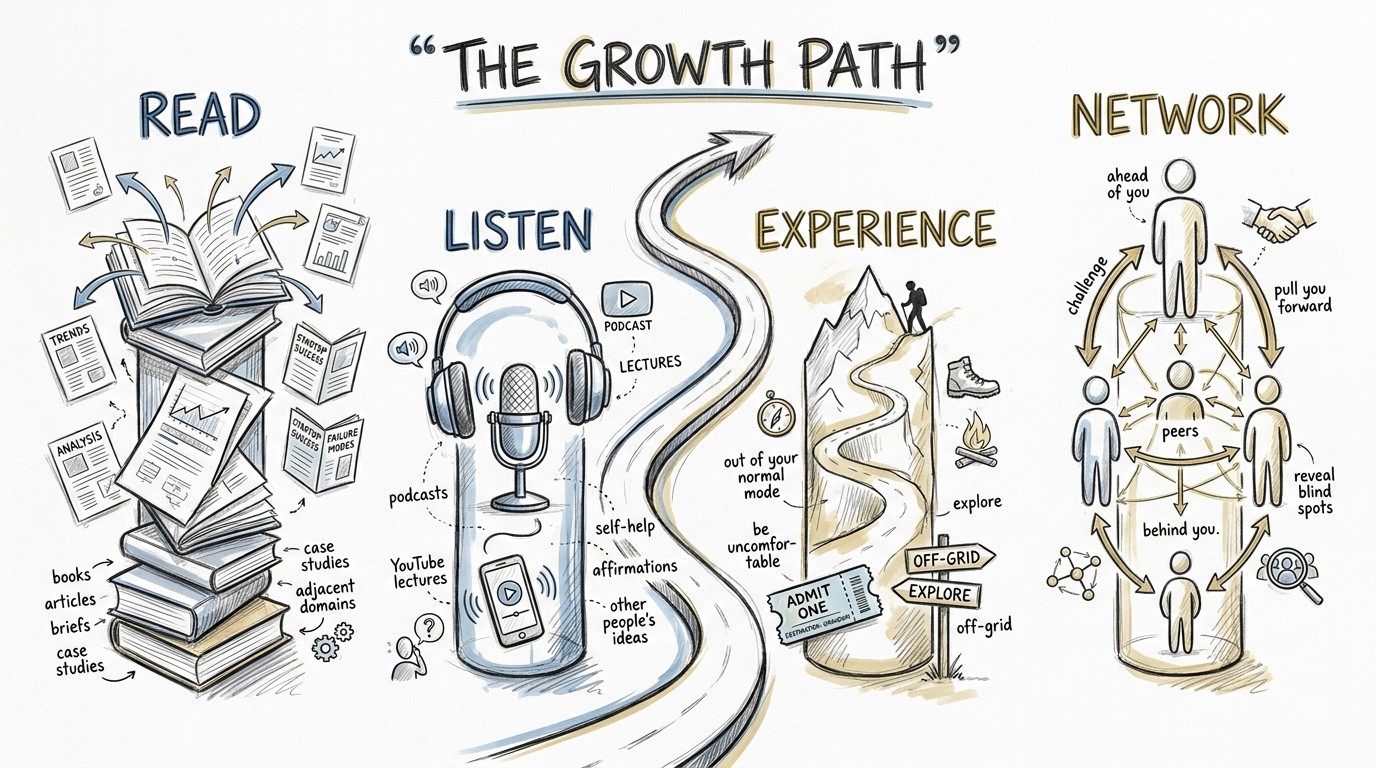
This framework isn't complicated. Yet…a lot of business owners skip over it..because they let their attention drift into the news cycle or social media and consume their available bandwidth. They take time off without intention. They come back vaguely refreshed but without the clarity or the new thinking that actually moves their business forward over time.
Intentional input is the difference.
Remember in a previous issue we talked about the power of “Long Time Thinking” and how this has been shown to be a key driver of success.
The Cadence
I always take time to get away (even when I felt I couldn’t afford to).. I've operated this way for years now, and I can tell you directly: my best strategic decisions, my clearest thinking about the business's direction, and my most productive quarters all trace back to time I spent away.
My recommendation for any founder: every other month, at minimum, take 3 to 4 days. Not a long weekend where you check in once. Fully away. Let the engine come to a rest, so you can find your awareness again.
The prerequisite is real, though. This only works if you've built an operational engine that doesn't need you in the middle of everything. If the business stalls the moment you step away, the answer isn't to leave. It's to fix the engine. That problem is solvable.
When the engine works, stepping away stops being a risk. It becomes the unlock to seeing how to go further.
Side note - - I was recently on a podcast where the host talked about the stress of growing and that he eventually decided growth was just not worth it. This thinking suggests that in order to grow, you have to deal with more chaos…more overwhelm…more fires. If that’s the case, then of course…why grow?
The fix that sidesteps this problem is putting an operational engine in place that can handle the growth of the business without causing more strain on you (or anyone else).
That kind of thinking isn't just a personal operating principle. The sharpest macro voices in the world are telling business leaders the same thing right now…
Insights From a Recent Private Breakfast…
A few weeks ago, Modern Operators sponsored a private breakfast through a group I’m proud to be a member of called Crew Exec. The room held 50+ executives, entrepreneurs, and senior leaders. I was humbled to be introducing Ozan Ozkural for a live intimate talk about the intersection of geopolitics and how it is shaping business decisions across the world.
Ozan is a unique and highly gifted individual. He’s the Founder and Managing Partner of Tanto Capital Partners, based in London. Over 25+ years, he has originated and executed more than $50 billion in investments across debt capital markets, structured finance, private equity, and special situations. Former Merrill Lynch banker. Regular commentator on CNBC and Bloomberg. Guest lecturer at the University of Cambridge. Trusted by boards, CEOs, and investors worldwide.
His gift is helping turn global complexity into actionable decisions for leaders, CEO’s and investors. As an aside - the thing I love the most about Ozan is how down to earth he is. He’s unbiased, curious, aware, and humble…qualities that are not normally associated with someone who regularly meets with world leaders and billionaire capitalists.
A few themes from his talk and Q&A…
🔹 We are very early in the AI supercycle. AI is becoming an infrastructure and energy story, not a software story. The demand for compute is going to be enormous, and the physical build-out required to support it, power, data centers, water security, is where serious capital is moving. Most people haven't caught up to this yet. (AIM Summit London, May 2026)
🔹 The pace of change is unlike anything before it. Boards and leadership teams must be in the business of foresight. Governance without active risk management is no longer a viable posture. The leaders who win will be the ones who look at brutal reality clearly and stay optimistic about what's on the other side of it.
🔹 Leadership must be proactive, not reactive. It takes real courage to push change before the market forces it on you. Most leadership structures are reactive by design. The ones that aren't have a structural advantage that compounds over time.
🔹 Volatility is opportunity for those paying attention. Geopolitical shifts, tariff uncertainty, AI disrupting entire industries, monetary policy in flux, these aren't abstractions. They land directly on your pricing, your hiring, your capital allocation. Founders who are positioned to act when others are frozen are the ones who pull ahead.
My major takeaway from the session…
We are entering a period of unprecedented change, and the most important capability a founder can build right now is adaptability. The ability to learn AND unlearn. To release the assumptions and models that got you here when the world stops rewarding them.
Those who adapt most fluidly will prosper. Those who defend their current playbook will find themselves outpaced by founders who don't.
That's worth sitting with…
How to Apply This (This Week)
Put your next break on the calendar today. Not "sometime soon." A specific date range within the next 60 days for at least 3 to 4 days fully away. If it isn't scheduled, it won't happen.
Audit your RLEN inputs. In the last 30 days: what have you read outside your industry? What have you listened to that wasn't about business tactics? What have you experienced that pushed you outside your normal mode? If any of those are blank, that's where to start.
Map your three network levels. Who are you currently connected with who is ahead of you and actively pulling your thinking forward? Who is behind you and asking the questions that surface your blind spots? If those relationships don't exist, build one of each this quarter.
Diagnose the guilt. If the thought of stepping away for even a week produces real anxiety, that's diagnostic. Ask: what specifically would break? Name it. That gap is the most important thing to fix before anything else.
Pick one domain outside your business to go deep in this summer. One book, one lecture series, one field you know almost nothing about. Not marketing. Not AI tools. Something with no obvious connection to your company. Let the cross-pollination happen.
Final Thoughts
The founders who win over the long term aren't the ones who grind harder than everyone else.
They're the ones with the clarity to see where the business needs to go, and the discipline to protect the time and space that generates that clarity.
Stepping away is not abandoning your company. It's doing the job that only you can do: going ahead, seeing what's coming, and coming back ready to lead your team through it.
Build the engine. Then trust it.
See you next week,
Damon & Mark
Co-Founders, Modern Operators
This is Issue 53 of Modern Operators. We help founder-led businesses install the operating infrastructure that lets their team run without the founder in the middle of everything.
How to get unstuck fast
Subscribe to our free newsletter that helps businesses go from working in the business to on the business.






Stay Updated with Us
Join the free weekly newsletter to see how smart founders operate modern companies.

Frameworks
Operational Models
Alignment


No Spam, Unsubscribe Any TIme