

Transition
The Cage Only Locks from the Inside
There's a moment most founders never talk about.
It usually happens sometime after the initial excitement fades — after the hustle has become routine, after the business you built with your bare hands starts to feel less like a vehicle and more like a weight you can't put down.
You wake up one day and realize: the thing you started for freedom has quietly become a cage.
The uncomfortable truth? You handed it the keys.
Here's what nobody tells you: proximity is a superpower early on. Being close to your business…knowing every detail and touching every decision is exactly how you survive the early years. But the same closeness that protects you in the beginning is what blinds you later.
Let's unpack why this is important and why it happens…
Why This Matters (Now More Than Ever)
Most founders don't lose their business to a bad market or a bad hire.
They lose it…slowly and quietly…to themselves.
McKinsey (2023) found that founders who fail to evolve to strategic leader are significantly more likely to plateau or decline after crossing the $1M revenue mark. The skillset that built the business becomes the ceiling that caps it.
Think about a craftsman-turned-founder we'll call Marcus. He launched a boutique video production company seven years ago out of pure love for storytelling. By year three, he was doing $800K in revenue. By year five, he was exhausted, creatively numb, and couldn't understand why his passion had dried up.
He thought he needed a vacation.
What he actually needed was a new relationship with his business.
Marcus was too close. And it was costing him everything. We'll come back to him.
The Closer You Get, The Less You See
Here's the paradox nobody warns you about: love for your business can become the very thing that blinds you to what it actually needs.
When you're too close, a few things quietly happen — and they compound.
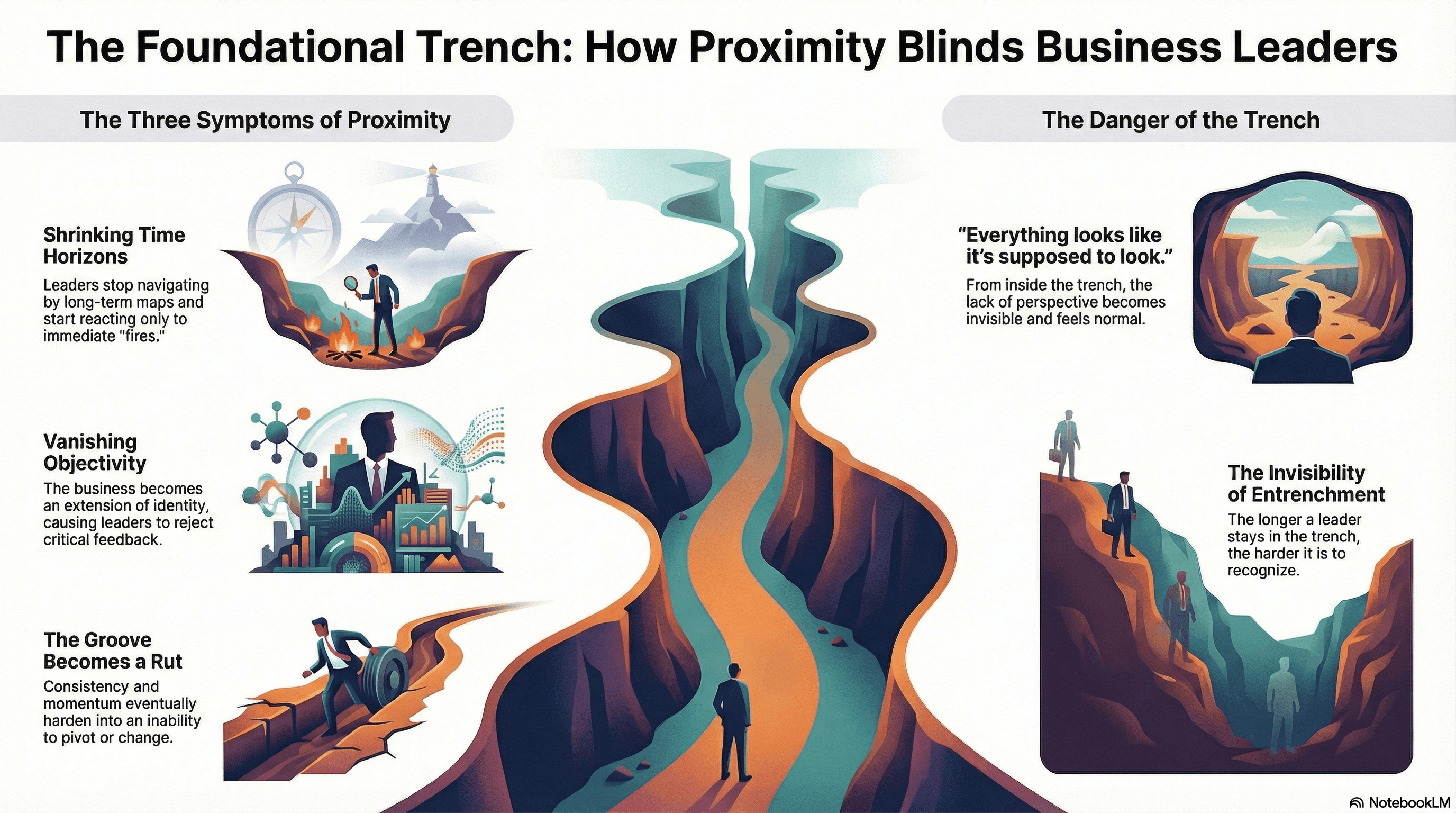
🔹 Your time horizon shrinks. You stop thinking in years and start thinking in weeks. The urgent always wins over the important. You're so busy solving today's fire that you stop seeing the road ahead. Leaders call this losing your long-time perspective — and once it's gone, you're navigating by headlights instead of a map.
🔹 Objectivity disappears. The business becomes an extension of your identity. Every critique of your model feels personal. You stop hearing feedback clearly because you're too emotionally invested to separate signal from noise. Research consistently shows that leaders who actively seek contrary voices improve decision quality and reduce risk — but founders who are too close do the opposite. They stop listening.
🔹 The groove becomes a rut. Early on, consistency is a virtue. You find what works and you repeat it. But the more entrenched you become in how things are done, the harder it gets to see how things need to change. The groove that built momentum starts to prevent you from turning.
And here's what makes it dangerous: the longer you stay in it, the more invisible it becomes.
You're not just in a routine. You're in a trench. And from inside a trench, everything looks like it's supposed to look that way.
From Maker to Architect
Remember Marcus? His problem wasn't that he'd lost passion. His problem was that he never changed his role.
He was still the maker…still on the edit screen…still the one every client called…still the craftsman. His identity was fused to the work itself. And the moment the business required him to systematize, delegate, and lead, the joy evaporated. Because what he loved was making things…not running a business that makes things.
This is the transition that quietly breaks most founders. And it almost never gets talked about honestly.
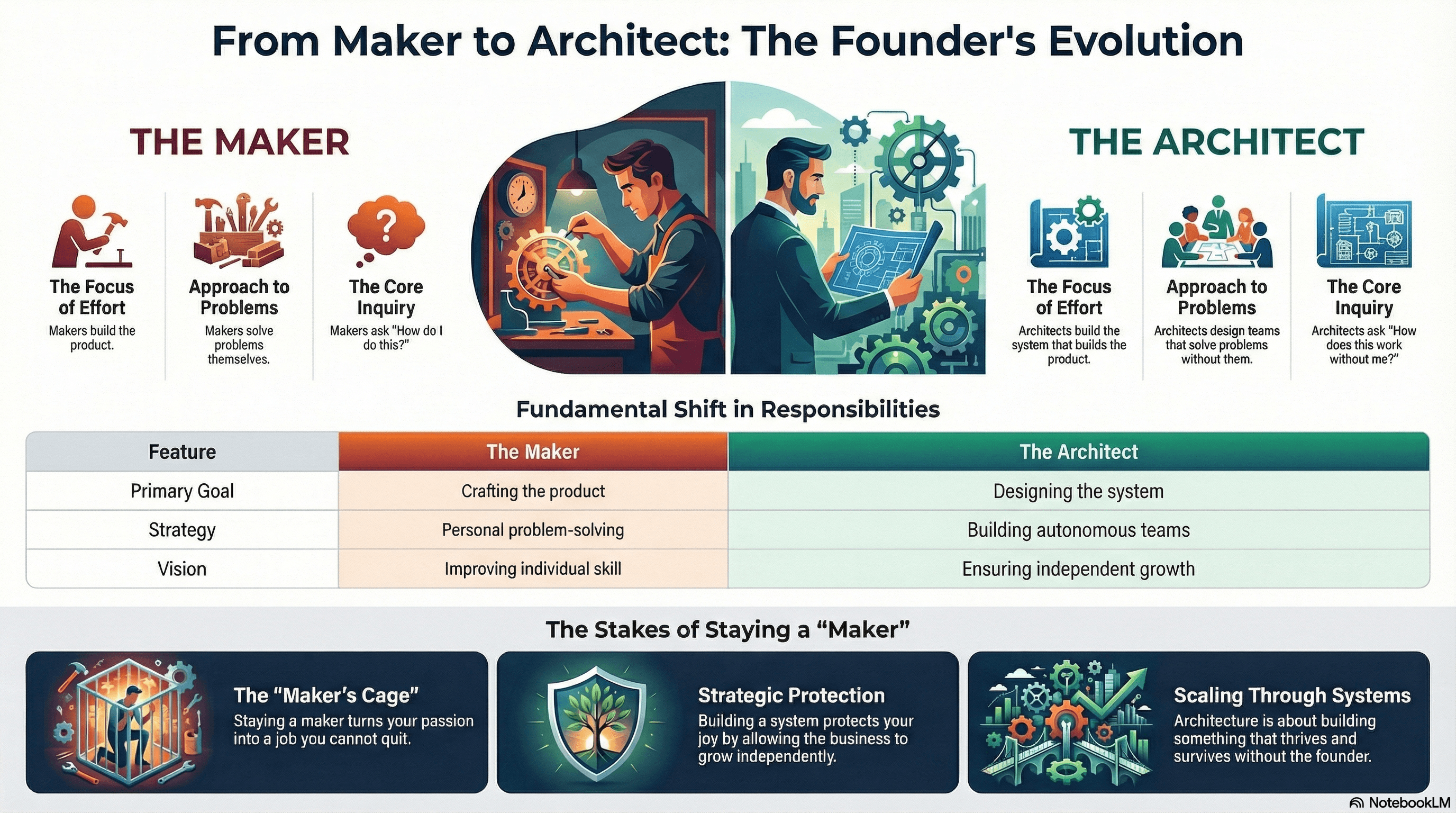
There comes a point in every growing business when the founder has to stop being the best craftsperson in the room and start being the architect of the room itself.
🔹 The maker builds the product. The architect builds the system that builds the product.
🔹 The maker solves the problem. The architect designs the team that solves problems without them.
🔹 The maker asks, "How do I do this better?" The architect asks, "How do I build something that does this without me?"
This isn't about abandoning what you love. It's about protecting it and opening it to the wild so that it survives and grows without you.
Because here's the truth: if you stay the maker forever, the business will slowly consume the thing you loved most about it. Not in one dramatic moment. Brick by brick, late night by late night, until one morning the thing you built for joy feels like a job you can't quit.
That's the cage. And it's built entirely from the inside.
Stop Waiting for Joy to Come Back
Before we get to the application, there's one more trap worth naming.
A lot of founders are running on deferred joy: "I'll grind through this hard season, and once I get to the other side, I'll love it again."
That's not a strategy. That's a bet you'll probably lose.
Joy doesn't return at some future finish line. It returns when you reclaim your relationship with the work…by stepping into a role that fits where you are now, not where you started.
The founders who stay energized aren't the ones who grind the hardest. They're the ones who evolve the fastest. They find new things to love: building teams, designing strategy, creating leverage. They don't wait for the feeling to come back.
They choose a version of the work that has joy in it.
Marcus eventually did this. He stepped out of the edit bay and into the architect's seat. He brought in help to build the team, document workflows, and started spending his energy on vision and growth. The business tripled in 18 months. And he started enjoying it again…not despite the change, but because of it.
Final Thoughts
Being “in” your business is what built it. But staying in it won’t scale it.
The most dangerous place a founder can live is inside the thing they created.
…too close to see it objectively
…too invested to hear the truth
…too entrenched to change.
The shift from maker to architect isn't a loss. It's an evolution. And on the other side is a business that runs better, a founder who leads better, and a version of joy you actually get to keep.
The cage only locks from the inside.
This is Issue 38 of Modern Operators. We help founder-led businesses scale smarter by turning clarity into their ultimate growth lever.
How to get unstuck fast
Subscribe to our free newsletter that helps businesses go from working in the business to on the business.






Stay Updated with Us
Join the free weekly newsletter to see how smart founders operate modern companies.

Frameworks
Operational Models
Alignment


No Spam, Unsubscribe Any TIme