

First Principles
The Advanced 80/20 Approach: Finding Your ONE Thing
There's a story I heard years ago that changed how I see business forever.
A manufacturing plant was losing millions.
They had 247 potential quality issues identified across their production line. The CEO brought in a consultant who did something unusual.
He didn't try to fix all 247 problems.
Instead, he asked: Which 20% of these issues are causing 80% of our defects?
Turns out, it was 12 problems.
They fixed those 12.
Defects dropped 78%. Costs plummeted. Production accelerated.
Here's the kicker: they never touched the other 235 issues.
Because they didn't matter.
That's the 80/20 principle in action. And it's not just about manufacturing.
It's about where you're spending your time right now.
Why This Matters Now
The 80/20 rule used to be a productivity hack.
Now? It's survival.
According to a Deloitte report (2024), companies that systematically apply the 80/20 principle to resource allocation outperform their peers by 3.2x in profitability.[1]
But here's the problem.
Most founders have it backwards
You're spending 80% of your time on the 20% that drives the least results.
Let me paint the picture:
Endless Slack messages about minor decisions
Meetings that could've been a Loom
Tweaking the website footer… again
Reviewing work that your team should own
Putting out fires that shouldn't exist
Saying yes to "quick calls" that aren't quick
Meanwhile, the high-leverage work sits untouched:
Clarifying your offer so it sells itself
Having the hard conversation with that underperforming hire
Doubling down on the 20% of customers driving 80% of your revenue
Creating the strategic plan that everyone's been waiting for
You're not lazy.
You're just working on the wrong stuff.
The new business reality
In 2026, you can't brute-force your way to growth anymore.
Markets are faster. Competitors are sharper. Customers expect more. Your team is watching how you lead.
80/20 thinking isn't optional. It's required.
Because the founder who can identify and relentlessly focus on the vital few will always beat the founder drowning in the trivial many.
But here's what most people miss: 80/20 thinking doesn't happen by accident. It requires infrastructure. The Modern Operators Company OS…a system that captures work, routes decisions, and runs operations without constant founder input…is what unlocks 80/20 thinking naturally within your team, because staff now have space to move away from firefighting. It's the difference between knowing what matters and actually having the space to focus on it.
The Underground 80/20 Method Nobody Talks About
Everyone knows the basic 80/20 rule:
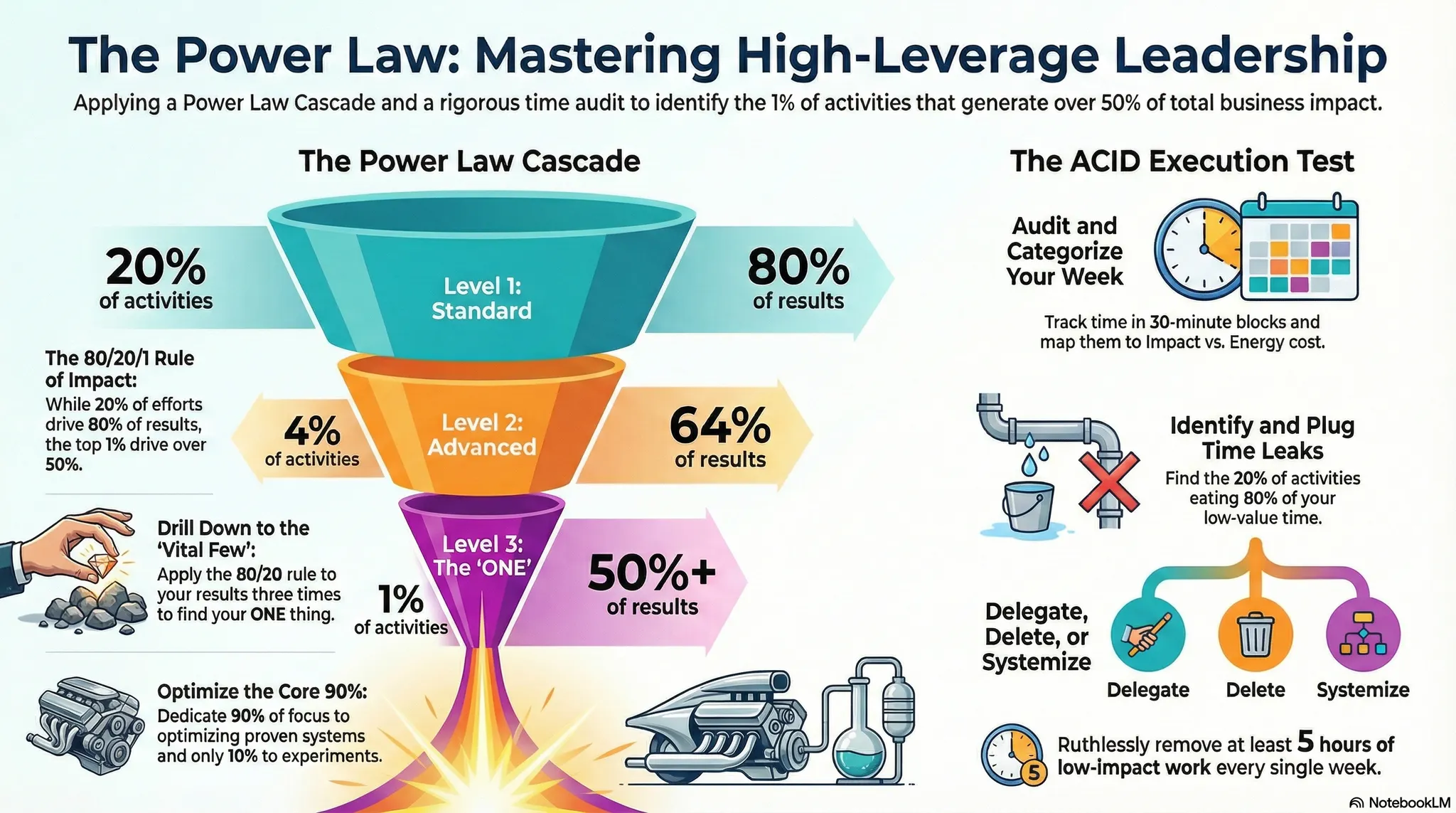
20% of your efforts drive 80% of your results.
But there's an advanced technique that most people have never heard of.
It's called The Power Law Cascade — and it's been quietly used by top operators and capital allocators for years.
Here's how it works.
Step 1: Find your top 20%
Identify the 20% of activities, customers, products, or channels driving 80% of your outcomes.
This is standard 80/20.
Step 2: Apply 80/20 to the 20%
Now take that top 20%… and apply the rule again.
What's the top 20% of the top 20%?
That's 4% of your original list.
But it's driving 64% of your total results.
Step 3: Go one more layer (find the ONE)
Take the top 20% of that 4%.
You're now looking at roughly 1% of your activities.
But this 1% is responsible for over 50% of your measurable impact.
This is your ONE thing.
The single highest-leverage action you could take right now.
Real example
Let's say you have 50 tasks on your plate this week.
First pass: 10 tasks (20%) drive most of the value
Second pass: 2 tasks (4%) drive most of the value from those 10
Third pass: 1 task (1%) is THE thing that changes everything
That ONE task might be:
Simplifying your core offer
Fixing your cash conversion cycle
Documenting the system your team keeps asking about
Having the strategic conversation you've been avoiding
Everything else is noise.
This is how world-class operators think.
They don't try to do everything. They find the ONE thing. And they go all in.
The 90/10 Execution Split
Once you've found your vital few, here's how to allocate your energy:
90% of your focus: Your proven core
This is the stuff that's already working:
🔹 Your main products/services — The 20% of offerings driving 80% of revenue
🔹 Your best customers — The 20% who pay on time, refer others, and don't drain your team
🔹 Your best marketing channels — The 20% generating 80% of qualified leads
🔹 Your core operations — The systems that deliver results consistently
Your job here isn't innovation.
It's optimization and protection.
Double down. Systemize. Scale. Protect what's working from the chaos of what's not.
This is where the Modern Operators Company OS becomes your unfair advantage. When you have clear systems for how work flows, how decisions get made, and how your team executes without you, the 90% starts to run itself. That frees you and your leadership team to think strategically about the 10%…the experiments that could unlock your next level of growth.
10% of your focus: High-leverage experiments
This is your learning budget.
The tests that could unlock a new level:
A bold pricing experiment
A new distribution channel
An AI automation that could save 20 hours/week
A partnership that could 3x your reach
A process redesign that changes everything
But here's the key: You cap it at 10%.
Because most founders flip this ratio.
They spend 90% of their time chasing shiny objects and 10% protecting what's working.
That's how you plateau and eventually get overwhelmed with shit day in and day out.
The discipline
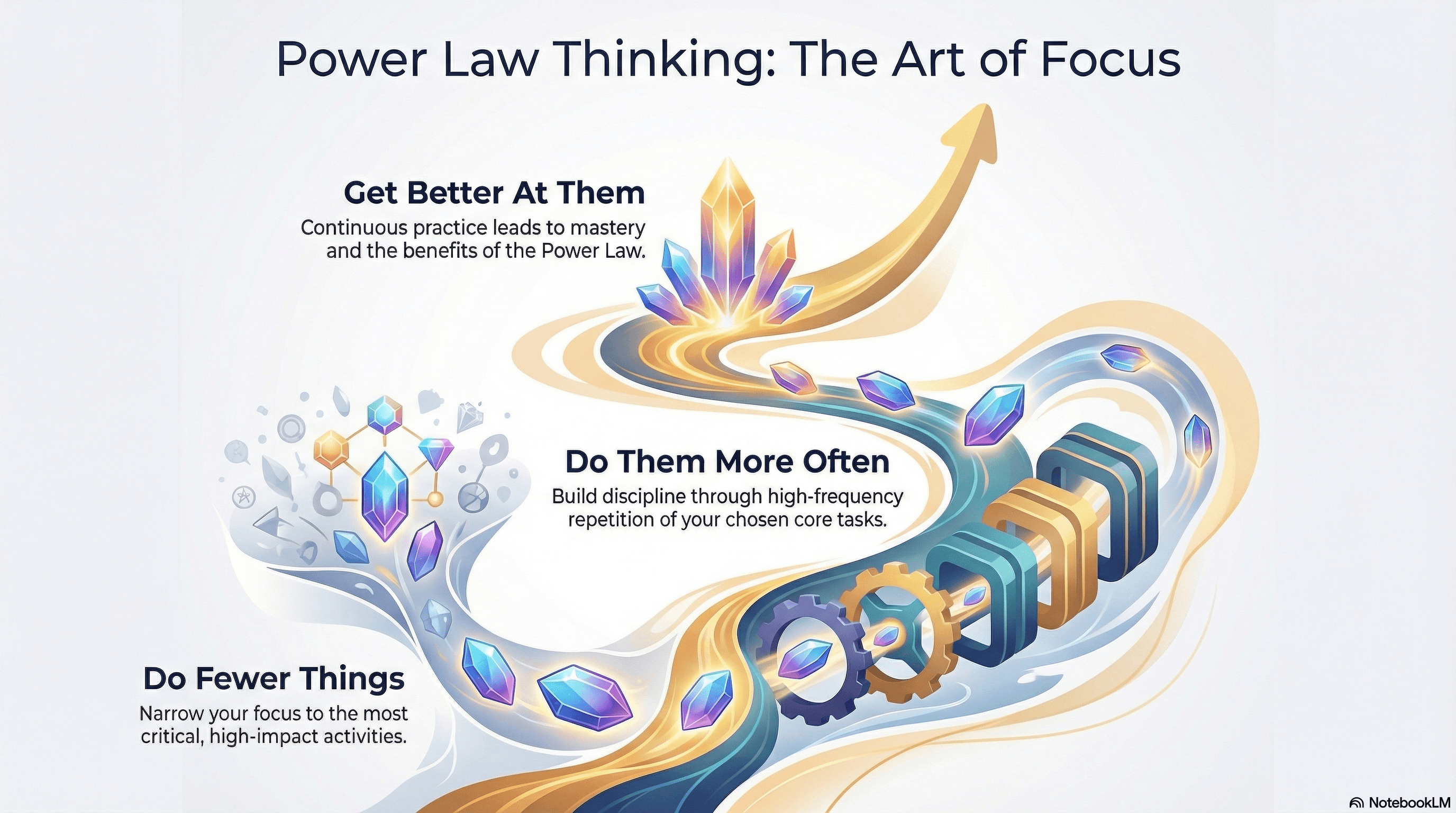
Do fewer things, more often. Get better at them.
That's it.
That's the mantra.
World-class isn't built by doing 47 things at a mediocre level.
It's built by doing 3 things at an elite level.
The Founder Time Leak Audit (Your Framework)
You can't fix what you can't see.
So let's shine a light on where your time is actually going.
Most founders think they know how they spend their time.
But when they actually track it? They're shocked.
Here's a simple 4-step framework to audit your time, identify the high-friction/low-impact tasks keeping you stuck in operator mode, and systematically eliminate them.
Framework: The ACID Test
A — Audit (Week 1)
C — Categorize (End of Week 1)
I — Identify Leaks (Week 2)
D — Delegate or Delete (Week 2)
Let's break it down.
Step 1: Audit (Track Everything for 5 Days)
For one full work week, track every single thing you do in 30-minute blocks.
Use a simple spreadsheet or tool like Toggl.
Capture:
What you did
How long it took
Whether it was planned or reactive
No judgment. Just data.
This will feel annoying. Do it anyway.
Because awareness is the first step to change.
Step 2: Categorize (Map Your Time to Impact)
At the end of the week, categorize every activity using this simple matrix:
High Impact / High Energy Cost — Strategic work that moves the business forward and requires your best thinking
Examples: Closing key hires, strategic planning, major client negotiations, building core systems
Target: 40-50% of your time
High Impact / Low Energy Cost — Leverage activities that create results without draining you
Examples: Delegating with clear frameworks, reviewing dashboards, quick decisions with systems in place
Target: 20-30% of your time
Low Impact / High Energy Cost — The killers. Tasks that drain you but don't move the needle
Examples: Pointless meetings, reviewing work you should trust, firefighting preventable issues, getting pulled into weeds
Target: 0-5% of your time ⚠️
Low Impact / Low Energy Cost — Busywork. It's easy, but it's not important
Examples: Inbox zero obsession, tweaking slides, minor admin tasks, endless Slack scrolling
Target: 5-10% of your time
Now add up where your time actually went.
Most founders discover they're spending 50-60% of their time in the bottom two quadrants.
That's the problem.
Step 3: Identify Leaks (Find the Bottlenecks)
Look for patterns in your low-impact activities:
✅ What keeps showing up that shouldn't?
✅ What are you doing that someone else could own?
✅ What tasks exist because a system is missing?
✅ What meetings could be eliminated or async?
✅ What decisions are you making that should be delegated with a framework?
Write these down. Be ruthless. Be honest.
You're looking for the 20% of activities eating 80% of your low-value time.
Step 4: Delegate or Delete (Take Action)
Now the work begins.
For each leak you identified, choose one of three paths:
1. Delegate it
Who on your team can own this?
What do they need from you to take it over (training, framework, authority)?
By when will you hand it off?
2. Delete it
Does this actually need to happen?
What's the real cost of NOT doing it?
Can you just stop?
3. Systemize it
Can this be automated or templated?
Can you create a decision framework so it doesn't need you?
Can you turn this into a repeatable process?
💡This is exactly what our Company OS does. It gives you the infrastructure to delegate and systemize at scale…not just one task at a time, but across your entire operation. When your business has a central system for goals, workflows, decisions, and accountability, 80/20 thinking becomes automatic. Your team knows what matters. And you finally have space for higher-level strategy instead of drowning in tactical firefighting.
Commit to removing at least 5 hours of low-impact work per week.
That's 20 hours a month.
240 hours a year.
That's 6 full work weeks you just bought back.
What could you build with 6 extra weeks?
Becoming World Class
Here's the question that separates good founders from great ones:
What could I become world class at if I actually focused?
Not good.
Not decent.
World class.
Maybe it's:
Selling your vision
Building systems
Hiring A-players
Strategic clarity
Product design
Capital efficiency
Whatever it is, you can't get there by spreading yourself thin.
You get there by doing fewer things, more often, and getting better at them.
The brutal truth
You will never be world-class at 12 things.
But you could be world class at 2 or 3.
And world class at 2 things always beats mediocre at 12.
Every. Single. Time.
So pick your battles.
Protect your focus.
And build mastery in the areas that actually matter.
How to Apply This Week
You don't need a perfect plan. You need a starting point.
Here are 5 actions you can take right now:
1. Run the Power Law Cascade on one area
Pick one domain: customers, products, marketing channels, or weekly tasks.
Apply 80/20 three times:
What's the top 20%?
What's the top 20% of that?
What's the ONE thing?
Write it down. That's your North Star for the next 30 days.
2. Start your time audit today
Don't wait for Monday. Start now.
Track your time in 30-minute blocks for the next 5 work days.
Use a spreadsheet, a notes app, or a time-tracking tool. Just do it.
3. Block 3 hours this week for your ONE thing
Put it on your calendar. Protect it like a client meeting.
No Slack. No email. No interruptions.
Just you and the highest-leverage work you could be doing.
4. Identify 3 tasks to delegate or delete
Look at your calendar and to-do list right now.
Find 3 things that are low-impact, high-friction, or just shouldn't be your job anymore.
Delegate one. Delete one. Systemize one.
Do it this week.
5. Ask yourself the world-class question
Grab a blank page.
Write this at the top:
"What could I become world-class at if I actually focused?"
Set a timer for 10 minutes. Write whatever comes up.
No editing. No judgment. Just honest reflection.
You might surprise yourself.
Want Help Finding Your ONE Thing?
If you're serious about breaking free from mediocre fire fighting to focusing on the 20% that actually drives growth, we can help.
Book a quick call and let’s bounce some ideas on how to achieve your 2026 vision without you being the glue that holds everything together.
Final Thoughts
The 80/20 rule isn't about working less.
It's about working on what matters.
And what matters is rarely what's urgent, rarely what's easy, and rarely what everyone else is doing.
What matters is the ONE thing that could change everything.
So stop trying to do it all.
Find your 20%. Then find the 20% of that. Then find your ONE thing.
And go all in.
Do fewer things, more often. Get better at them.
That's how you build something world class.
This is Issue 35 of Modern Operators. We help founder-led businesses scale smarter by turning clarity into their ultimate growth lever.
News
🧑🏽💻 SaaS Disruption via AI Coding Tools - AI tools like Claude Code and Cowork enable founders to rapidly build custom software, replacing expensive SaaS subscriptions and gaining operational control. [More or Less Podcast]
🧑🏽💻 Four principles that separate successful AI system builders from those who quit - Nate B Jones reveals four key principles from watching dozens build AI "second brain" systems, showing architecture matters more than tool choices. Read more
🧠 Hope is a systems skill - Embrace uncertainty as the foundation for action in complex systems; small changes cascade unpredictably while AI tools may mask critical complexity. Read more
🧑🏽💻 AI Vibe Coding Threatens SaaS - AI tools like Claude Code enable founders to build custom software in hours, replacing expensive SaaS contracts and threatening workflow automation businesses. [More or Less Podcast] [StartupHub]
🧠 The madness behind becoming the greatest - Founders Podcast host David Senra argues legendary founders choose singular obsession over work-life balance after studying 400+ entrepreneurial biographies. Read more
🧠 The Internal Scorecard - Elite performers measure success by their own standards, not external validation—a mindset that helps founders avoid people-pleasing and make decisive, independent choices. Read more
🧑🏽💻 Visual AI as Infrastructure - Leaders capture only 30% gains treating visual AI as a design tool versus 300% building it as core infrastructure that automates beyond text-only processes. natesnewsletter.substack
How to get unstuck fast
Subscribe to our free newsletter that helps businesses go from working in the business to on the business.






Stay Updated with Us
Join the free weekly newsletter to see how smart founders operate modern companies.

Frameworks
Operational Models
Alignment


No Spam, Unsubscribe Any TIme