

Planning
Supercharge Annual Planning with a Company OS
Most founders don’t hate annual planning… they hate the time suck it creates (especially during the holidays).
Time spent gathering data, spreadsheets, files, stats…
Scheduling meetings with team leads to do the same...
Coordinating sessions in person or over zoom..
Endless discussions with lots of notes to then synthesize or make sense of after everyone leaves.
And then…nothing really changes throughout the next year
This year was different for us at Modern Operators…
We ran our annual planning event inside our Company OS and when it was said and done,
We not only ended up with a sharper plan than any previous year but we saved 50+ hours of leadership time
The process was the most enjoyable it has ever been (and I enjoy planning)
Not because we worked harder or faster.
Because our system did the heavy lifting for us.
In this issue, we’re talking about the proven power of Annual Planning (you are doing that, correct?)
Why This Matters Now
December is the time for most teams to do their annual debrief and planning for next year.
It can be harder to do in times like now where there is more uncertainty and rapid changes that are happening all around.
But…in times like this, it’s actually more important to spend time thinking and less time doing (or worse…reacting)
Most teams either don’t do a formal planning cycle or it’s done in a silo with little connection to the action that will need to take place throughout the new year.
Those who are planning are usually…
Pulling spreadsheets from Finance
Copy pasting screenshots from HubSpot or Salesforce
Asking Marketing, Sales, Product, and Ops leads to “update the deck” the night before the offsite
Making bets on fuzzy data and gut feel
Research from places like McKinsey and Harvard Business Review over the last few years has highlighted a simple pattern:
Most leadership teams spend a huge amount of time in planning… but very few feel their plan is tightly linked to day-to-day execution.
You probably don’t need to be told that. You’ve lived it.
A quick story with a founder friend of mine…
A founder I know (mid-8-figure company) told me their last annual planning cycle took six weeks end-to-end!
The team was exhausted before the year even started.
When I asked, “What changed in how you operate because of that plan?” he replied:
“We came out with a theme, a revenue target, and a bunch of slide swag. But we were still chasing fires three weeks later.”
The risk here is quiet but deadly:
It can be time consuming to go through every aspect of the business
Staff can get so exhausted that they lose momentum in turning a new plan into reality
Employees can start to see planning as theatre…not strategy
Views can be more driven by loud opinions and under-weighted on hard data
Because functions may not be fully aligned, trends and potential compounding gains can be missed
Real unbiased analysis can be lost because of blind spots in founders and staff
There’s a new way and after seeing it…you won’t want to do planning the old way any longer (hell..you can’t afford to keep doing things the old way).
From Time Suck Planning to a Company OS
Let’s define terms.
When I say Company OS, I’m referring to a single operating layer that:
Holds your vision, strategy, and targets
Connects them to live data from each function
Translates that into clear priorities, projects, and tasks
Stores information flow from meetings, SOP’s, and more
Gives you a weekly operating rhythm to stay on track
Think of it like this:
Your slide deck is a snapshot.
Your Company OS is a living dashboard.
Annual planning inside that OS feels completely different.
Instead of:
“Everyone, please send me your numbers and initiatives before the offsite.”
You’re saying:
“Let’s open the OS and see what the business is already telling us.”
How we structured our Company OS for planning
Here’s the simple structure we used. The names will look familiar because you probably already have these somewhere… just scattered.
In our OS, these aren’t separate islands. They’re connected:
Vision & Targets
Core Databases (live, not static)
Operating Rhythm
During planning, the OS pulls from all of this at once.
Instead of 12 tools and 1034 files, you have one source of truth.
What changed in the actual planning process
Here’s the before/after...
Old way:
Data is pulled by hand
Plan is built in slides
Each function presents their view of reality
Planning conversations are opinion heavy
Execution lives “somewhere else..” (project tool, inbox, random docs)
New way (inside your Company OS):
Plan is built on top of live company data
Targets are linked directly to owners, projects, and metrics
Cross-functional priorities are visible and aligned with owners
Capacity constraints are obvious before overcommitment
The outcome of planning is not a deck… it’s a clear vision with a set of linked targets.
It’s like moving from someone else’s map to GPS.
The map can tell you where you think you’re going.
The GPS tells you where you actually are, where you’re headed, and when you need to re-route.
How our Company OS actually saved 50+ hours
Let’s make the time savings concrete.
🔹 Our Pre-work Was Auto Compiled
Because the OS already contains data from Marketing, Sales, Product, Fulfillment, and Finance PLUS a detailed Annual Planning outline and training that we built, pre-work looked like:
“Goto our 2025 Annual Planning | Year End Debrief and answer the questions based on information you have access to over the last year.”
No one was hunting for data.
No one was trying to remember what happened in March or June or September.
No one was running reports on individual systems or tools or databases.
No one was looking through calendars to see who met with whom.
No one was up late after work changing slides from last year.
Instead…
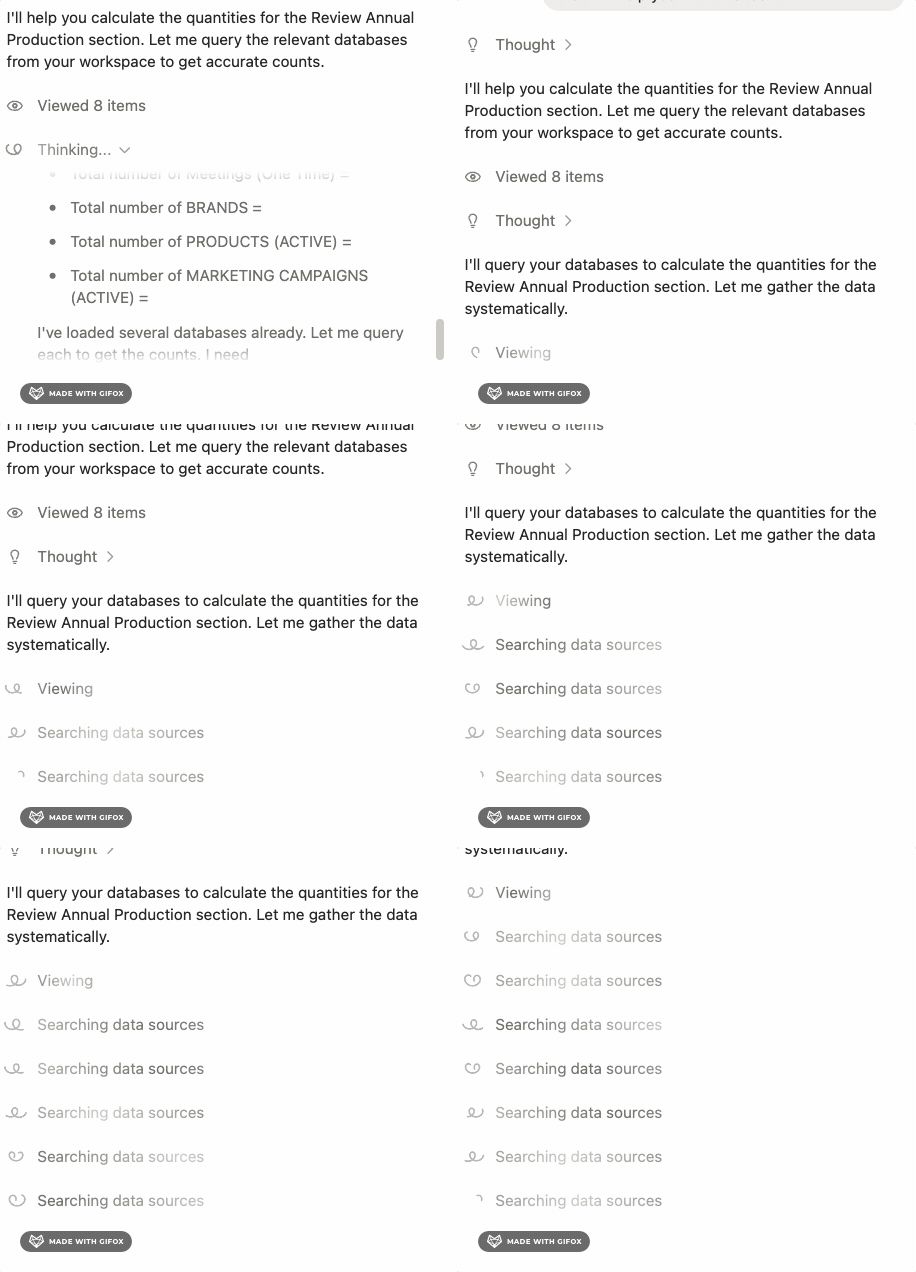
The system reviewed hundreds of meetings…
Scanned for outcomes in Product, Sales Prospect, Change Log, Publishing & Customer fulfillment databases…
Analyzed marketing campaigns…
Gathered our failures, mistakes, issues across teams and initiatives
Calculated outputs on Targets, Projects, Tasks, Staff, and Knowledge flow
Reviewed stats for our newsletters and social media publishing
And, then synthesized all of that into bulleted answers that told us specifically…
What we accomplished in 2025…
What improvements we made to the business…
What went as planned and what didn’t go as planned…
Analysis of Prospects, Customers, Staff, Targets, Projects, Tasks, SOP’s, Support Tickets, and more and how that compared to last year…
What our revenue metrics looked like every month and year to date…
What major lessons we learned from this past year…
Where we hit our 2025 annual goals and where we fell short…
What lessons learned to take away from 2025 and incorporate into 2026…
I was literally shaking after issuing the command and watching our system build these beautiful detailed reports one by one.
I’m not kidding when I say that I had to walk away and process on what just happened.
Was it 100% perfect…no. Was it 93% complete and ready…yes
This is the kind of mind blowing expansion that allows us as founders to play at a completely higher level.
🔹 One Set of Numbers…One Source of Truth
Now that the reports were compiled (just as we had trained & fine tuned our Chief of Staff AI to do)…we could switch gears as a team to processing it.
Something magical happens…
Finance isn’t debating Sales.
Sales isn’t debating Marketing.
The data is already normalized and visible, so the conversation now shifted from:
“Are these numbers right?”
into
“Given these numbers, what are we going to do?”
We now have time and space to THINK.
Think about what the outcomes mean and where we want to go.
In a weird way, it also provided detachment…failures didn’t seem personal. They were just data points.
Our company OS brought a diverse perspective that I’m not totally sure we would have gotten if done the old (manual) way
We now have the bandwidth to ask deeper questions and get deeper insights on things like:
Given the capacity that produced these results… how can we run more marketing experiments…sell more…better fulfill customers?
What does a typical product cycle or runway look like and how can we shorten it?
What opportunities are we not seeing?
How could we achieve our vision 3x faster?
🔹 Better Alignment | Faster Execution | Wired From Day One
When teams have the full, real-time picture of what’s happening across the business…from high-level KPIs down to daily tasks…alignment isn’t something you have to fight for.
It’s the default.
Decisions get made with everyone looking at the same facts.
Priorities are unambiguous.
Owners and deadlines start to take shape automatically with the team.
Teams move together and get tighter, not working in parallel universes.
Execution picks up speed because everyone knows exactly what matters this week.
As soon as you decide on annual and Q1 priorities, they’re already:
Assigned to owners
Broken down into projects
Showing up in weekly meeting agendas
Not “We’ll translate this into projects next week.” It’s done in the room right then.
That’s where the hours disappear.
The OS bakes this rhythm into daily operations, so there’s no gap between what you plan and what you work on.
🔹 Tighter Projections and Analysis
Because every past initiative, result, and variable is being tracked and synthesized by the OS, forward-looking projections actually mean something.
Want to model out three possible growth paths or evaluate the impact of an experiment?
The system already has the history, so it can run those scenarios instantly…no manual back-and-forth.
You go from “best guesses” to evidence-based models, stress tests, and what-ifs that help you pick the path that fits your goals, resources, and reality.
It’s not just about forecasting…it’s about building confidence.
Your plan is tied to proof in the form of data…not hope.
How to Apply Now
For years, we refined a set of Vision and Annual Planning playbooks that we used to grow multiple brands. Those are the same playbooks now built into our Modern Operators Company OS…
You can use these standalone guides to help your own planning process this month.
1. Start with a Clear, Modern Vision
Before you talk targets or projects, you need a vivid, shared picture of where you’re going.
Our Modern Company Vision Playbook walks you through:
Turning your vague “3–5 year idea” into a clear, written vision your whole team can rally around
Defining the outcomes, identity, and business model of the company you’re actually trying to build
Translating that vision into a practical lens for decisions, priorities, and hiring
👉 Get the Vision Playbook here:
2. Run a Real Annual Planning Cycle (Without the Six-Week Slog)
Once your vision is clear, the next step is wiring it into a sharp, executable annual plan.
Our Annual Planning Playbook is the same structure we used to:
Debrief the past year using real data, not fuzzy memories
Choose 3–5 high-leverage bets instead of 47 scattered goals
Tie those bets directly to owners, metrics, and an operating rhythm inside our OS
👉 Get the Annual Planning Playbook here:
These are the same playbooks we used manually with clients to drive more clarity, tighter focus, and a cleaner bridge from vision → plan → execution.
Final Thoughts
Annual planning doesn’t have to be a six-week slog that produces a pretty deck and a tired team.
You now have access to innovation that makes the process much easier and faster and delivers back much better results.
When you run it through an integrated and unified Company OS, you get:
Sharper decisions rooted in reality
Faster alignment across functions
A direct line from vision → targets → projects → calendar → outcomes
The real unlock isn’t just saving 50+ hours.
It’s building a company that runs on clarity and leverage…without the founder involved at every level and pushing everything forward.
Want an Intelligent, Highly Trained, and Experienced AI That Helps Your Staff 10x Their Productivity?
If you see yourself as a Modern Operator… the kind of founder or operator who:
Wants a business that can run without you as the glue holding it together
Is done being the bottleneck and wants a team that owns outcomes, not just tasks
Wants one clear source of truth instead of chasing numbers across tools, decks, and people
Feels you’re capable of much more, but your current systems can’t support the next level
Wants to feel proud of how your company runs—sharp, professional, and scalable, not duct-taped together
Is tired of planning that doesn’t show up in the day-to-day
Wants an integrated view across Marketing, Sales, Product, Fulfillment, and Finance
…then you’re exactly who we built this for.
We work with a small number of founder-led companies to design and implement a Company OS tailored to how you actually operate… and to run your planning and execution through it.
👉 If you’d like to explore this, book a short discovery call here:
We’ll:
Map your current planning and operating rhythm
Show you what a Modern Operator Company OS can look like for your situation
Identify the 2–3 highest-leverage improvements you could see ROI on in the first 30 days
No pressure. If it’s not a fit, you’ll still walk away with a clearer picture of what “great” could look like.
How to get unstuck fast
Subscribe to our free newsletter that helps businesses go from working in the business to on the business.






Stay Updated with Us
Join the free weekly newsletter to see how smart founders operate modern companies.

Frameworks
Operational Models
Alignment


No Spam, Unsubscribe Any TIme