

Thought Leadership
Context Is the New Capital: Why the Smartest Operators Engineer It Deliberately
There's a term spreading fast in the AI world: context engineering.
It started as a developer concept…the practice of deliberately structuring the information and instructions you give an AI so it can actually do what you need it to do.
Without good context, even the most powerful AI models give you garbage outputs.
With great context, those same models perform like a seasoned specialist on your team.
Here's what nobody is saying out loud yet:
Not getting this right will become one of the biggest killers of your business.
It's been quietly limiting otherwise good companies for decades…long before AI.
AI is just exposing the problem faster.
According to McKinsey, 70% of digital transformations fail -- not because of bad technology, but because of poor data, siloed information, and teams that can't work from a shared understanding of what's actually happening. That's a context failure. Every single time.
Let us show you what that looks like in the real world.
Notion vs ClickUp: The Great Debate
See how ClickUp and Notion compare as a Company Operating System For Founders
The Collapse -- What Happens When You Are the Glue
A few years back, we worked with a founder running a $4M services business. Smart, driven, built it from scratch on pure instinct.
He knew every client relationship…Every pricing exception…Every process quirk…Every team member's strengths and blindspots.
When he brought in an experienced day-to-day operator…someone excellent, someone who had scaled teams before…the wheels came off.
Not because of the hire.
Because the business (and the new Operator) had no context…no organizational structure. Yes, there are was knowledge in the founder’s head and his staff, but no context that tied it all together. So, the new operator was flying completely blind.
We call this context collapse…the moment a business tries to grow past the founder's ability to personally carry and transmit what's in their head until the whole thing seizes up.
Decisions slow to a crawl.
New hires take forever to ramp.
The business can’t respond to marketplace changes
The team keeps coming back to the founder for answers that should already be in the system.
Sound familiar?
This isn't a management problem. It's an infrastructure problem. And most founders never see it coming until they're already stuck inside it.
What Context Engineering Actually Means for an Operator
In the AI world, context engineering means deliberately structuring your instructions, memory, and inputs so the AI has exactly what it needs to perform.
For operators, it means something bigger.
This isn't about writing an SOP and hoping someone reads it.
It's about building intentional infrastructure where context is organized and flows automatically -- from the vision at the top down to the execution on the ground.
Here's what deliberately engineered context looks like inside a real business:
🔹 Captured vision -- The company's direction, priorities, and decision filters are documented and accessible to everyone, not just recited at the annual kickoff.
🔹 Defined roles and ownership -- Every person knows exactly what they own, what they're accountable for, and what good looks like. No ambiguity. No overlap.
🔹 Structured processes -- The how is documented clearly enough that someone who has never seen it before could follow it without asking a single question.
🔹 Living data -- The business's performance, client context, and key signals are captured in real time and queryable -- not buried in a spreadsheet someone updates on Fridays.
🔹 Connected AI -- When AI has access to this context layer, it stops producing noise and starts performing like an actual extension of your team.

When all five of these exist together, something remarkable happens.
The business starts running on organized context -- not what’s in your head.
Your team executes without waiting for you.
Your AI actually helps instead of producing slop.
And you shift from being the glue to being the strategist.
This is not a productivity hack. It’s a structural transformation.
This Is Exactly What Our CompanyOS Is Built to Solve
Seven years ago, when we were deep in our own businesses -- scaling, grinding, hitting walls -- we didn't have a name for what we were trying to build.
We just knew that every time we grew, we'd hit the same wall.
Knowledge locked in our heads.
Processes that existed only because someone remembered how it was done last time.
Tools were not helping because they had no real context to work from.
We spent years engineering our way out of that wall. Inside our own companies, before we ever started Modern Operators.
And eventually, it became clear: what we were building wasn't just a set of tools or templates. It was intentional organized context -- a structured environment where the business's intelligence lives in the system, not in the founder.
That's what CompanyOS is.
It's the operating infrastructure that captures your vision, roles, processes, and business data -- and connects them into a single hub that gives your team and your AI the context they need to perform without you as the constant middleman.
When we install CompanyOS for a founder-led business, here's what changes:
🔹 New hires ramp in days, not months -- because the context is in the system, not locked in someone's head.
🔹 AI agents actually deliver high quality results -- because they're trained on structured, business-specific context instead of generic prompts.
🔹 Decisions happen much faster -- because the information needed to make them is already organized and accessible.
🔹 The founder gets time back -- because the business stops needing them to be the integration layer between every team, tool, and decision.
We've seen this play out with businesses at $1M. At $8M. At $25M.
The problem is always the same.
The fix is always the same.
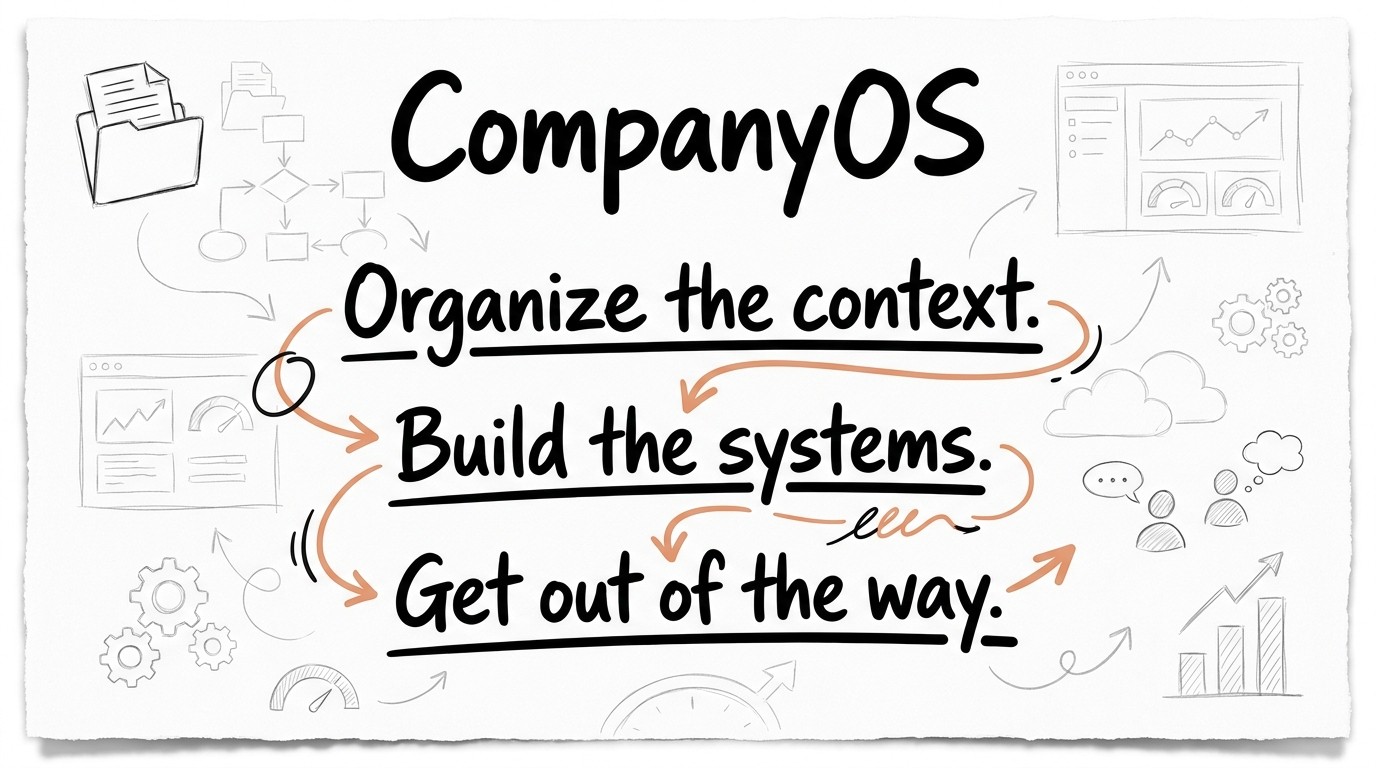
Organize the context. Build the systems. Get out of the way.
Final Thoughts
The businesses that win this decade won't be the ones with the most tools.
They'll be the ones that engineered their context deliberately -- and built systems that can carry it forward without the founder in every room, on every call, approving every decision.
We spent seven years learning that lesson the hard way. Inside our own ventures, long before Modern Operators existed.
Now we build it for founders who don't want to wait that long.
This is Issue 50 of Modern Operators. We help founder-led businesses install the operating infrastructure that turns their knowledge into a system their team -- and their AI -- can actually run.
See you next week,
Damon & Mark
Co-Founders, Modern Operators
How to get unstuck fast
Subscribe to our free newsletter that helps businesses go from working in the business to on the business.






Stay Updated with Us
Join the free weekly newsletter to see how smart founders operate modern companies.

Frameworks
Operational Models
Alignment


No Spam, Unsubscribe Any TIme