

Systems
Choosing What AI Your Company Runs On
Most founders I talk to are not short on actions they could take.
They already know the business runs through them. They already feel the market pulling away, a little faster every quarter…while their company moves at the same speed it did two years ago.
They have lots of choices about direction and most believe AI could really help them.
So why do so many founders wait to make a real change?
From my experience, it’s because choosing a direction feels dangerous. Pick the wrong approach and you have sunk money and a year into a foundation you might have to tear out.
So let's answer the real question.
Every founder is choosing an approach to AI right now, whether they know it or not.
Which one are you choosing?
Get that choice right and everything downstream gets easier.
Get it wrong and you are a year older…still the bottleneck and working a business that is getting harder to run and making less and less in revenue.
Let's get into it…
Why This Matters Now
Let’s look at an interesting number...
76% of small businesses now use AI in some form. But only 14% say it is fully embedded in their core operations (Goldman Sachs, 2026).
The companies that have AI embedded in their core are getting 5x-20x returns.
So, the real question is why aren’t more founders moving their companies to fully integrate AI?
Based on my conversations with business owners, it’s because most don’t know where to begin or how to think about the decision.
I am part of a mastermind of about 35 business owners, all running companies between $1.5M and $35M in revenue. Fewer than one in ten are actively building AI across their business, and those few are getting real returns for it. They are also the loudest voices in the room...deep into the transformation that is happening.
Here’s what I realized… they’ve already chosen an approach. They are now rapidly building on the decision they made.
The other 85% or so are pretty quiet. They have a clear vision for the company but no idea where to start, so they never take action. And here is the hard part.
Sitting in on those conversations feels like progress when it is usually the opposite...those founders are burning real mental energy chasing someone else's results.
Every time we meet, I watch the gap between the ten percent building and everyone else get wider and wider.
And that is what we’re going to talk about in this issue.
Not which AI “tool” to use...but the approach you choose for running your entire company on AI.
What Do You Really Need?
After installing AI operational engines in multiple growing companies, I’ve come to see the pattern that produces durable and sustainable results across an entire company over time.
Remember you are not choosing an AI “tool”. You are choosing the foundation your whole company will run on for the next decade.
Once you see it that way, the decision gets simpler…because a foundation has requirements and can be judged on whether it can carry the weight of your entire business.
Here are the six things a real operational engine has to do to be durable and sustainable over the long term.
🔹 One core brain. A single source of truth the whole company works from like the hub to a wheel, not information scattered across multiple tools (or in your head)
🔹 AI at the core…for everyone. Agentic AI that every staff member can use on shared company context, not a copilot bolted onto one seat for one power user.
🔹 Governance, permissioning, and audit. Control over who can see and change what, and a record of what the AI did, so "available to everyone" never means "everyone sees everything."
🔹 You own your data, and it’s model-agnostic. Your information stays yours and exportable, and you can swap the underlying AI model as the frontier moves instead of being locked to one vendor's features.
🔹 It scales and it gets adopted. The structure holds from five people to fifty, and your non-technical staff will actually use it.
🔹 It gets smarter over time. Feedback loops and memory, so the system compounds learning instead of resetting every week.
Keep that list. It is the same one I use when a client asks which approach to take.
The Five Approaches to Running Your Company on AI
When you set out to get AI running across your whole company, almost every path leads to one of these five approaches. Here is what each one is genuinely good at, and where each one stops short.
Let’s start with the first approach…
🔹 1. The personal agent. This is where almost everyone starts: ChatGPT and Claude, including their Projects where you load a knowledge base and custom instructions. Add the single-operator agents like Hermes Agent and OpenClaw, and coding assistants like Codex and Cursor.
This is exactly what the 10% in my mastermind are winning with.
One honest caveat, because it matters: ChatGPT and Claude Projects can now be shared with your team, so this is not strictly one-person anymore. But shared or not, it is a chat-and-docs layer sitting next to your business…not the system your company runs on.
The knowledge base is a snapshot you feed by hand, locked to one vendor's model, with little control over who sees what.
Unbeatable for personal leverage. It still fails "one brain for everyone" as the place the actual work happens.
🔹 2. The methodology. EOS, the operating model behind Traction, and its cousins. This one is not software at all. It is a framework for how your leadership team sets vision, structures the org, and holds people accountable.
Plenty of good companies run on it, and for the human side of the business it genuinely works.
But a methodology is a way to run your people and your meetings, not a place your data and your AI can live. It tells you how to think, not where to build.
There is no engine underneath it. The moment you want AI working across your company, you still have to pick one of the other four approaches to actually run it on.
Good for alignment. It was never meant to be the system your company operates in.
🔹 3. The suite copilot. AI built into the platform you already pay for: Think Salesforce Agentforce…Microsoft 365 Copilot…Google Gemini for Workspace.
This is the key difference from approach one. The AI lives inside the suite your team already works in, not in a separate app beside it. That means real capability, and on the enterprise tiers, real governance out of the box.
The catch is that you end up standing on a suite of tools vs a truly unified platform. This is because the vendor has been building individual tools for decades to do one thing really well.
Good if you want to stay in one ecosystem. The risk is your staff still accessing different tools at different times to get their job done…but they have integrated AI to make each tool's experience more intelligent.
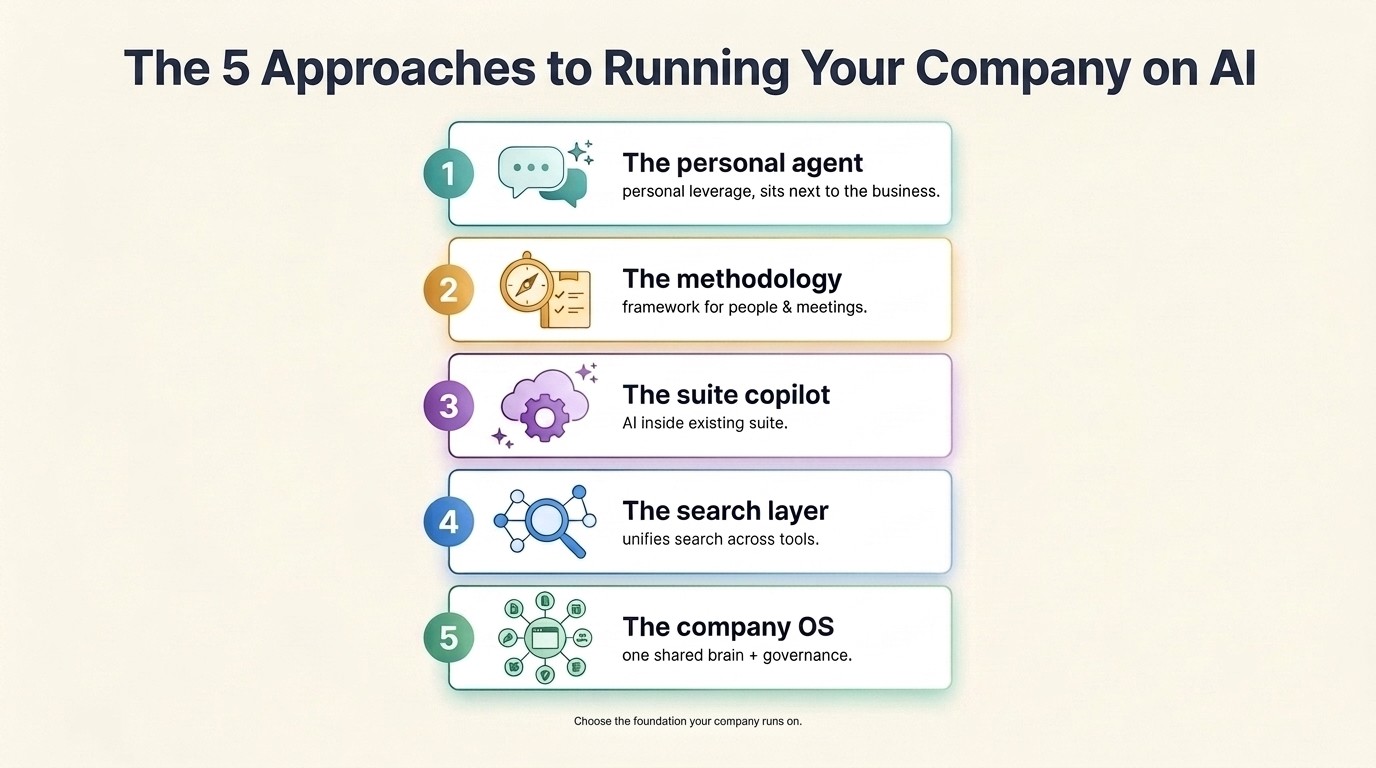
🔹 4. The search layer. Glean and tools like it. They sit on top of everything you already own and make it searchable and askable, connecting to a hundred-plus apps at once.
When your knowledge is scattered across a dozen systems, this feels like magic. You finally get one search box for the whole mess.
But look closely at what it actually does. It makes the sprawl easier to live with but continues to perpetuate staff time switching between multiple disconnected environments. The underlying chaos is still there, you have just laid a smart layer over the top of it.
You still own sixteen disconnected tools underneath, still pay for all of them, and still have no single place the work truly lives.
Excellent as a bridge. It is a better way to search your problem, not a way to solve it.
🔹 5. The company OS. One workspace where the whole company, its data, and its agents all live together, with permissions and model choice built in. This is the hub-and-spoke approach, and platforms like Notion are built for it.
Instead of AI sitting beside your business or trapped inside one vendor's suite, your company's actual work, its docs, projects, and data, becomes the shared brain the AI runs on.
Everyone works from the same source of truth, the AI has real context to act on, and you still own your data and can swap models as the frontier moves.
It is the only approach on this list that can clear the whole scorecard.
The honest catch is that it asks the most of you up front. More on that in a moment.
Here is the same thing as a scorecard you can screenshot.
Approach | One brain | AI for all | Governance & audit | Own data + model-agnostic | Scales & adopts | Gets smarter |
|---|---|---|---|---|---|---|
1. Personal agent (ChatGPT/Claude Projects, Hermes, Codex, Cursor) | ❌ | 🟡 | ❌ | 🟡 | ❌ | 🟡 |
2. Methodology (EOS / Traction) | 🟡 | ❌ | 🟡 | ❌ | 🟡 | ❌ |
3. Suite copilot (Agentforce, M365 Copilot, Gemini) | 🟡 | 🟡 | ✅ | 🟡 | 🟡 | 🟡 |
4. Search layer (Glean) | 🟡 | ✅ | ✅ | 🟡 | 🟡 | 🟡 |
5. Company OS (Notion, hub-and-spoke) | ✅ | ✅ | ✅ | ✅ | ✅ | 🟡 |
Ratings are directional and depend on how you set each one up. ✅ built for it. 🟡 partial, or depends on configuration. ❌ not what it is for.
I want to be straight with you…I run Modern Operators on the fifth approach. And, I’ve been building, scaling, and exiting businesses built on Notion since 2020.
Notion does not do that on its own... Drop your chaos into it with no structure and you get a prettier pile.
The platform makes the win possible. The organization and discipline is what makes it real.
That tradeoff is true of Notion the same way it is true of everyone else on this list.
Final Thoughts
You already know you are the bottleneck. You already know the company needs to run without you in the middle of it. The only thing left is to choose the foundation that gets you there, and to choose it on purpose.
Score your options against those six requirements, and the fear of betting wrong mostly disappears. You stop guessing. You start measuring.
Next issue, I will take the step most founders skip right after this one. Once you know the approach, how do you choose who installs it, so the installation produces measurable results?
If you want help scoring your current setup against that checklist, this is what we do.
Reply and tell me one thing: which of the six requirements matters most to you right now?
See you next week,
Damon Flowers
Founder, Modern Operators
This is Issue 63 of Modern Operators. We help founder-led businesses install the operating infrastructure that lets their team run without the founder in the middle of everything.
How to get unstuck fast
Subscribe to our free newsletter that helps businesses go from working in the business to on the business.






Stay Updated with Us
Join the free weekly newsletter to see how smart founders operate modern companies.

Frameworks
Operational Models
Alignment


No Spam, Unsubscribe Any TIme