

Systems
Are you the AI in Your Company? (That's a Problem)
There's a pull that most founders have felt at some point in the last two years.
AI gets good enough that you can finally see it. The contracts that used to take a lawyer. The sales scripts your team keeps getting wrong. The fulfillment workflow that's been broken for eight months. The customer onboarding experience that's been "good enough" since you and your team worked on it 2 years ago.
Suddenly, you're fixing things. Fast.
You're rolling up your sleeves. You're using AI to do work that would have taken weeks and cost real money. And it feels good…really good sometimes. It feels like you’re unleashing progress and creating real momentum.
Sit with this for a second…
That pull is real. And it might be pulling you right back into the trap you've been trying to escape.
Why This Matters Now
This is what's happening across business right now.
Founders are adopting AI at a faster clip than ever before. That's the good news. The complication: the gap between how founders are using AI and how their teams are using it is widening, not closing.
According to Section AI's research, only 16% of workers at companies under 500 employees use AI every day. That same research identified a specific pattern driving this: leaders aren't rolling out AI organization-wide, so workers resort to what the researchers call "shadow AI" -- disconnected, private, invisible to anyone else on the team.
The JPMorgan Chase Institute tracked this same gap longitudinally. In January 2023, AI adoption at employer firms outpaced nonemployer firms by 5.6 percentage points. By December 2025, that gap had grown to 10.8 points. The businesses with teams are pulling away from those without structured adoption. And yet, even inside those employer firms, most of the AI still sits with one or two individuals, siloed from the operating layer of the business.
The founder who goes all-in on AI first tends to experience what I'd call…
The solo operator trap.
And it looks a lot like success... until it doesn't.
The Trap You Can't See Until You're In It
It starts the same way every time.
You try AI on a contract negotiation. It works. You try it on a sales script. It works again. You start running it on your fulfillment workflow, your onboarding experience, your client communication templates. Every experiment lands. And you're getting sharper at prompting, at structuring the work, at knowing what to feed the model and what to do with what comes back.
This feels like a competitive advantage. And, it is…for a short period.
Under the surface, though…something is building.
Every AI experiment you run lives in your session. Your context. Your account. Your conversation history. The institutional knowledge you're building with AI isn't compounding inside your company. It's compounding inside you. And that means your team is still running on the old rails while you're operating with a completely different set of tools and capabilities.
🔹 You start becoming the AI-powered answer to every problem. Your sales team still writes scripts the old way. You rewrite them. Your ops manager still runs the broken fulfillment process. You fix it. Your team has questions. You have answers, because you have AI chops and they don't -- not in any meaningful, connected way.
🔹 You take on more projects, because AI makes each one faster. The contracts. The workflow redesign. The script library. The onboarding deck. The competitor analysis. Each one is genuinely valuable. But you're now managing a growing stack of AI-driven initiatives that live entirely with you.
🔹 You stop leading the architecture and start driving the execution. This is the quiet shift that takes about six months to notice. You're not directing the company's AI future anymore. You are the company's AI implementation. You've traded one version of doing for a faster, smarter version of the same trap.
McKinsey's research on AI adoption is direct: functional silos that constrain end-to-end AI solutions are one of the most commonly cited barriers to AI delivering real value. The solo founder using AI in isolation has become the silo, not the solution.
Coveo named a version of this the "peanut butter problem" in 2026 -- spreading AI experiments too thin across too many isolated initiatives means no single one gets enough organizational weight to succeed. You mistake activity for progress.
And the entrepreneurial pull makes it worse, not better.
The instinct that made you a founder is the same instinct that tells you:
If I roll up my sleeves and us AI to do X, Y, Z in my company, that will enable us to grow faster…
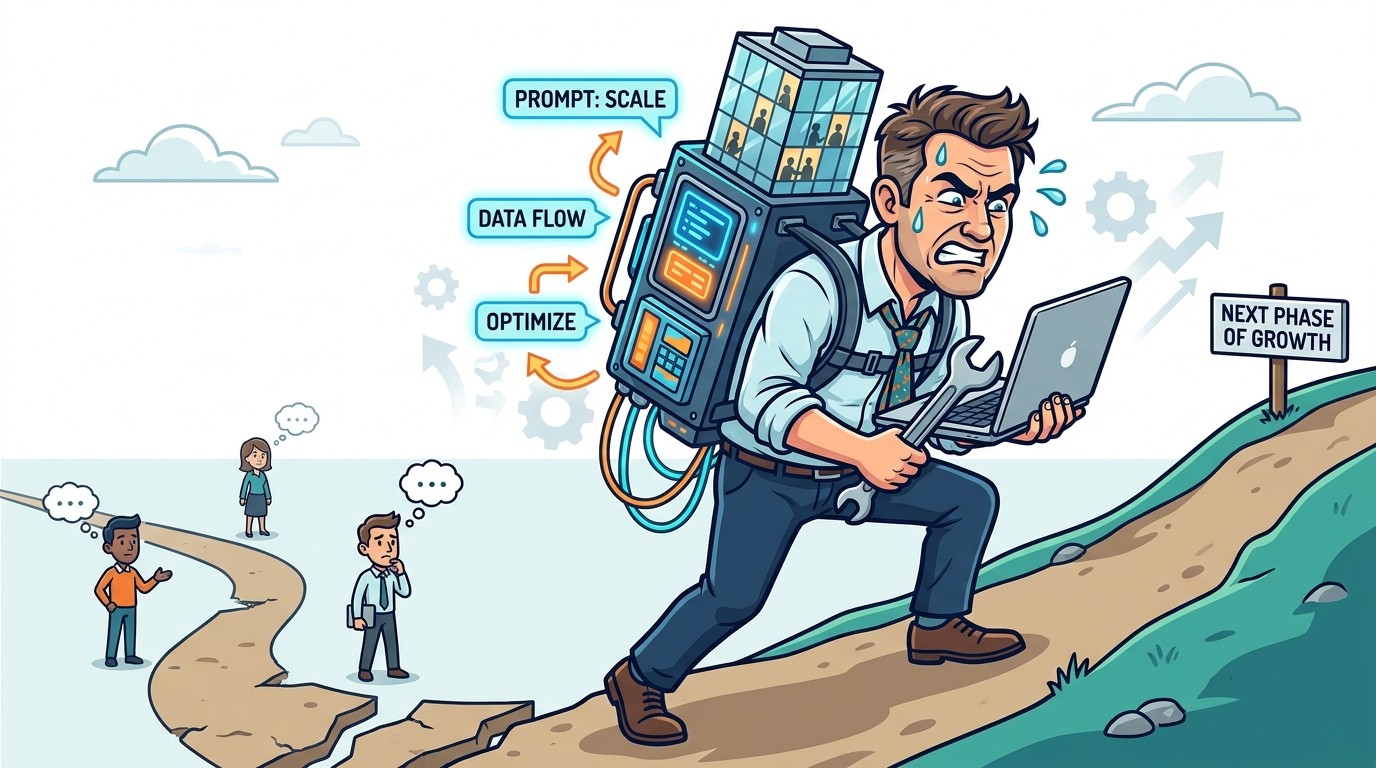
But this wave isn't one you can carry alone.
It's too fast and too broad to move through one founder's AI sessions.
The businesses pulling ahead ARE NOT the ones with the most AI-capable founder. They're the ones where AI has become part of the core operating system -- accessible to every team member, built into workflows, drawing on shared company context.
What a Harness Actually Is (And Why You Need One)
The term showing up across the AI infrastructure world right now is harness.
An AI agent harness is the software scaffolding around a language model, the tools, memory, sandboxes, and feedback loops, that turns a model into an agent.
In plain English for a founder: a harness is the operational engine that enables AI and gives it the context, coordination, and control it needs to be useful inside a real business.
Without a harness, AI is a very capable tool that only does what the person holding it knows to ask.
With a harness, it becomes something every person in your organization can use effectively, because the company's knowledge, workflows, and standards are baked in.
Your AI sessions are powerful. But they're not shared in a team context. A harness (CompanyOS) is shared and is accessible to your whole team. It stores institutional knowledge, not just your own. It has your workflows built in, so a team member can ask the same question you would ask and get a version of the same answer, without you in the room.

The harness for your business isn't a new AI model. It's the operating system behind it: the system that holds your company's context, makes it accessible, and lets AI act on it across your entire organization.
And right now, only roughly 15% of the market understands this distinction. The other 85% are still treating AI like a personal productivity tool, powerful for the individual but invisible to everyone else.
That gap is where the next wave of competitive separation happens.
Final Thoughts
The entrepreneurial spirit that carried you here is the same one that makes you want to pick up every AI tool and make it work. That instinct is an asset.
But this coming wave will ultimately reward teams…not founders. The businesses that come out of the next two years with real advantage won't be the ones with the best-prompting CEO. They'll be the ones that turned AI into company infrastructure: accessible to every team member, compounding across roles and workflows, still there whether the founder is in the office or not.
Stop building alone. The operating system isn't yours to carry.
If you want to see what a shared AI infrastructure looks like for a team your size, we built one. That's our CompanyOS: a fully installed modular system built specifically for founder-led businesses like yours. Compliance = Check, Privacy = Check, Ease of Use = Check, Runs $1M or $50M business = Check
Reply and tell me: what’s holding you back from taking this next step?
I read every one.
See you next week,
Damon Flowers
Founder, Modern Operators
This is Issue 57 of Modern Operators. We help founder-led businesses install the operating infrastructure that lets their team run without the founder in the middle of everything.
How to get unstuck fast
Subscribe to our free newsletter that helps businesses go from working in the business to on the business.






Stay Updated with Us
Join the free weekly newsletter to see how smart founders operate modern companies.

Frameworks
Operational Models
Alignment


No Spam, Unsubscribe Any TIme