

Thought Leadership
AI Doesn't Make You an Expert. It Just Makes You Sound Like One.
I had a conversation with a founder a few months ago that has stuck with me.
He was frustrated. His sales numbers weren't moving. He'd spent three weeks using AI to completely rewrite his sales scripts. The outputs were polished. Clean. Confident. Sounded like something a Fortune 500 sales team would use.
He was proud of them.
And……they weren't working.
When I asked him what sales methodology he used to structure the rewrite, he paused. "I just told the AI what I wanted and it gave me something really professional."
I’m shaking my head back and forth as I type this..
AI gave him exactly what he asked for. The problem is he didn't know what to ask for. And because the output looked “right”, he couldn't tell the difference between polished and effective.
This is one of the most dangerous AI mistake founders are making right now. And it's not because AI is bad. It's because AI makes everyone sound like an expert...when they're not.
Why This Matters Now
Lots of businesses are adopting AI and that looks good on the surface.
But…the success rate of those implementations is not keeping pace.
The businesses that ARE getting results are not the ones using the most tools or moving the fastest. According to the JPMorgan Chase Institute's longitudinal analysis of SMB AI use, the firms gaining the most from AI are not the ones spending the most. They're the ones that matched AI tools to specific operational tasks backed by clear domain expertise.
Expertise. That's the key point that keeps getting left out.
We hear a version of this story constantly. A founder decides to figure it out on their own. They come back to us months later...more burned out, deeper in technical debt, further behind the market than when they started, and with less bandwidth to make the change they now know they have to make.
The window to get this right is not going to stay open for ever.
The Confidence That Costs You
AI doesn't know when it's wrong. It knows how to sound right.
Harvard Business School researcher Kris Ferreira documented this directly:
AI often provides confident-sounding answers even when it lacks the information it needs to give reliable responses.
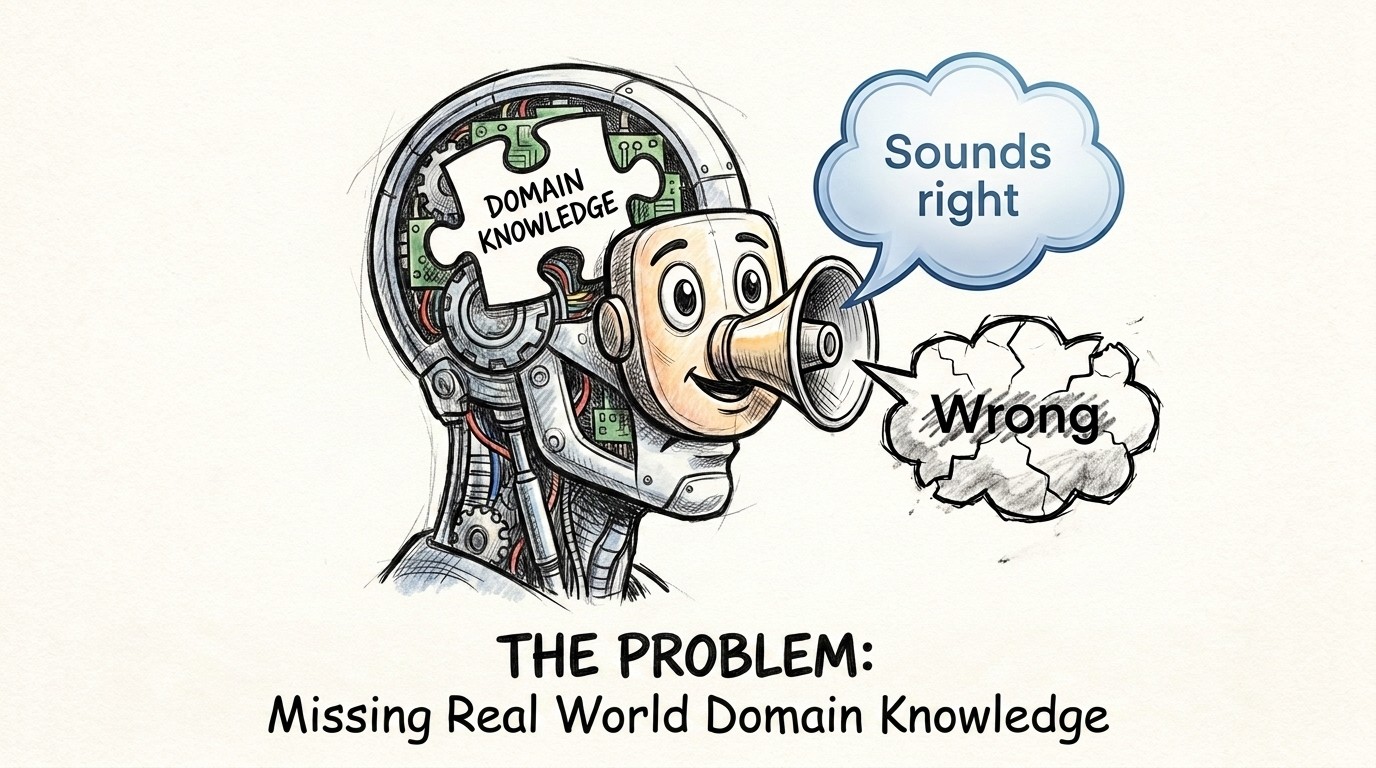
Her research concluded that users must know when to adhere to an AI recommendation and when to walk away from it.
The word for that judgment is expertise.
If you've spent ten years in sales, you know when a script sounds good but won't close. You feel it. You've heard the objections. You know the difference between language that builds trust and language that gets you deleted from the inbox.
If you haven't, you'll look at the AI output and see something polished and professional. You'll send it. And you'll blame the market when it doesn't convert.
This plays out the same way across every domain.
🔹 Sales: AI can polish a script in minutes. It cannot tell you whether the structure of your pitch is creating resistance, whether you're asking for the close too early, or whether your value proposition is landing on the right pain point. A non-expert won't know what's missing. The output will look finished. The pipeline will stay quiet.
🔹 Marketing: AI can write copy faster than any agency. It cannot tell you whether your angle is speaking to a desire your ICP doesn't actually have, whether your hook is landing in the right place in the buyer's journey, or whether your channel is reaching your audience at the wrong moment. A non-marketer will look at the output and see a professional campaign. The spend happens. And leads don’t come in.
🔹 Operations: AI can map a process in an afternoon. It cannot tell you whether the handoffs will break under real team conditions, whether the sequence matches how the work actually flows, or whether you're systematizing a broken workflow and making it fail faster. A non-operator will implement it. The chaos will return, dressed in a cleaner format.
The Journal of Small Business Strategy put it plainly in their research on SMB AI adoption:
Possessing a specific AI tool is less important than developing the capability to identify the right strategic use cases.
That capability comes from expertise, not from availability.
Here's the analogy that lands clearest for me.
AI is like a highly capable assistant who follows instructions without judgment. If you ask a great lawyer to draft a contract, they'll negotiate terms, flag risks, and protect you from language you wouldn't know to question. If you use AI to draft that same contract without legal expertise behind it, you'll get a document that looks right. The risks you don't know to look for will stay hidden...right up until it’s a problem you’re now paying for...
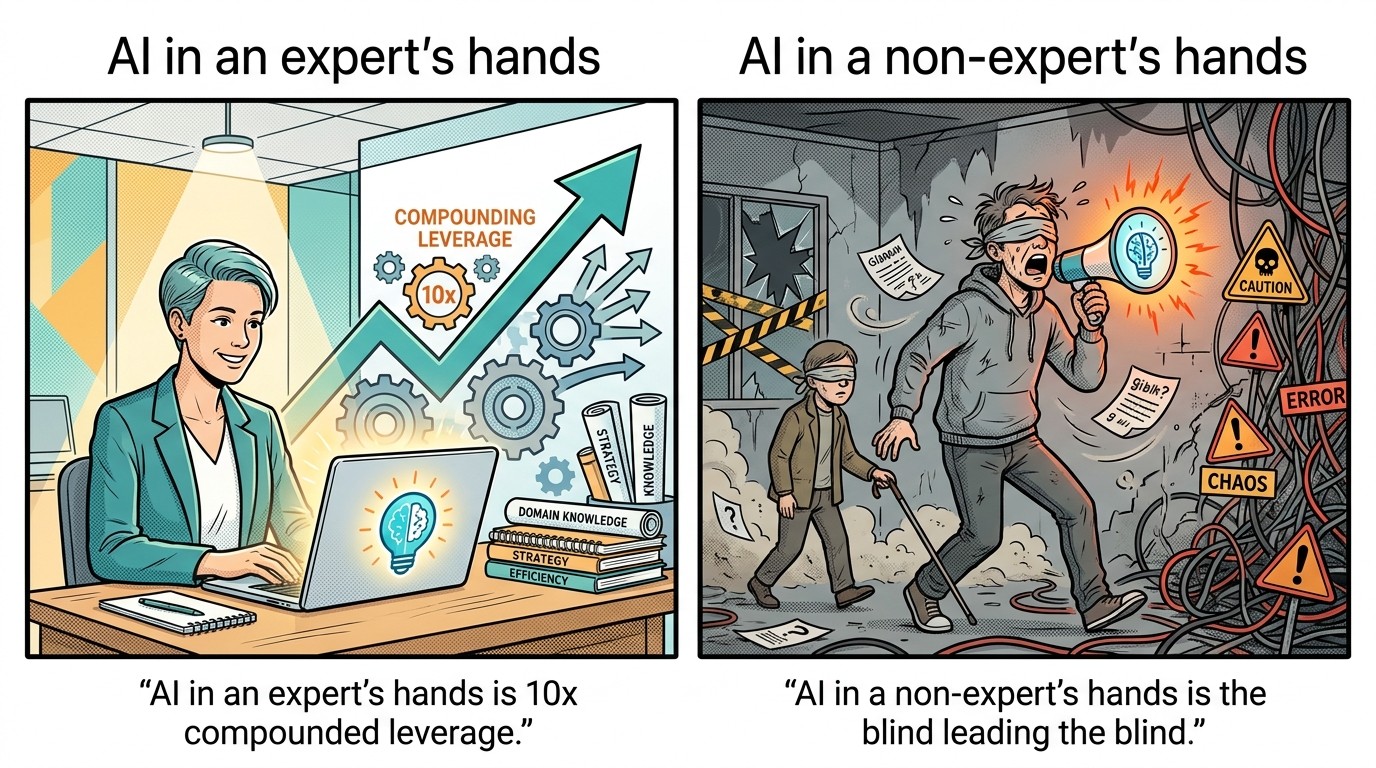
AI in an expert's hands is 10x compounded leverage.
AI in a non-expert's hands is the blind leading the blind.
The output quality is decided before you open the tool.
The "Figure It Out" Tax
There's a conversation we have more often than I expected.
A founder hears what we do. They're interested. The timing feels a little off, or the investment feels a little large, or they're feeling a burst of momentum and they decide to take a run at it themselves first.
Six months later, they come back.
They're more overwhelmed than before. The experiments they ran didn't compound. Some of them made things more complicated. The market kept moving while they were learning. Their team is confused about which direction they're heading. And the problem that was a nagging issue when we first spoke has calcified into something bigger and harder to unwind.
Technical debt. Momentum loss. Bandwidth burned.
And the part that stings most? They knew they needed help. They just thought AI would close the gap that expertise was supposed to fill.
Profile Tree, a digital agency that delivered AI training to over 1,000 businesses across the UK and Ireland, documented this exact pattern at scale. Their founder described it this way:
"Most businesses start with the technology and try to find problems it can solve. Successful businesses start with their actual problems and then determine whether AI offers the best solution. That sequence matters enormously."
The founders who came back to us didn't fail because they were careless. They failed because AI made the attempt look more viable than it was. The outputs were good enough to keep going. The results made them more confused about what was missing.
AI doesn't tell you what you don't know. It just keeps answering the question you asked.
This is the moment the market will separate the businesses building real AI leverage from the ones producing expensive noise. Well-intentioned, AI-polished, confidently delivered noise.
The businesses that pull away won't be the ones using the most tools.
They'll be the ones deploying expertise-backed AI.
People who spent years doing the thing...and now know how to use AI to do it faster, better, and at scale.
Right now, that combination is becoming more valuable than it's ever been.
Final Thoughts
Many have said that AI the great equalizer. They were wrong. It's the great amplifier.
In the hands of someone who knows what great looks like, it accelerates and scales real expertise. In the hands of someone who doesn't, it accelerates and scales the same mistakes...just faster and with better formatting (well sometimes better sometimes AI).
The most important AI question for your business right now is not "which tool should I use?" It's "do I have the expertise to evaluate what AI is giving me?"
If the answer is no, the highest-leverage move you can make is not another experiment. It's hiring an expert who does...and making sure they know how to use AI.
Expert knowledge plus AI leverage. That's the combination that wins right now. One without the other is either slow or blind.
If you're ready to stop experimenting and start building, book a call with us. We'll show you exactly where the gaps are and what it looks like to close them with real expertise behind it.
Reply and tell me: where are you currently using AI without the expertise to honestly evaluate what it's giving you?
I read every response.
See you next week,
Damon Flowers
Founder, Modern Operators
This is Issue 59 of Modern Operators. We help founder-led businesses install the operating infrastructure that lets their team run without the founder in the middle of everything.
How to get unstuck fast
Subscribe to our free newsletter that helps businesses go from working in the business to on the business.






Stay Updated with Us
Join the free weekly newsletter to see how smart founders operate modern companies.

Frameworks
Operational Models
Alignment


No Spam, Unsubscribe Any TIme