

Systems
Agentic AI Only Delivers on a Clean Foundation
Last week I promised you a number.
Issue 61 walked the ROI of an operational engine (our CompanyOS), layer by layer, in real dollars. At the end I told you an agentic OS stacks on top and drives another 3 to 5x across your company. This issue walks you though that next layer of return.
But there's a twist I owe you, because leaving it out would cost you money.
Agentic AI is the multiplier, not the foundation. And a multiplier only works on a clean base. Run it in the right order and it compounds across the whole company. Run it in the wrong order and you often get what many leaders see today: real wins in one corner that struggle to show up in the company's numbers, because speeding up one area can just move the bottleneck to the next.
Why This Matters Now
Lets’s start with the number nobody selling AI “tools” wants you to see.
95% of enterprise Gen AI pilots delivered no measurable P&L impact (MIT NANDA, 2025). Not 15%. Ninety-five. Companies spent real money, ran real pilots, and the company-level bottom line often barely moved.
And it usually wasn't because the model flopped. Most of those pilots did produce results... in one function, for one team, on one task. The problem is what happens next. Speed up a single area while everything around it stays the same, and the bottleneck just shifts downstream. The local number goes up, while the company number often barely moves. That's usually less a model failure than a systems one, and it's a common outcome when AI lands on scattered tools, undocumented process, and data trapped in one person's head.
Here's the pattern I've seen over and over. A founder buys the tool, hands it to one sharp person, and waits for the leverage. It shows up for that one person…but their speed can pile work onto the parts of the business that didn't change, so the company-wide gain often nets out close to flat. The tool was never the problem. The base underneath it was.
That's the whole reason we talk about your CompanyOS first (Issue 61). The operating system is the base. Agentic AI is what you run on top of it, once it's stable. Order matters.
What "Agentic OS Across the Whole Team" Actually Means
Let me kill the picture you probably have in your head.
"Agentic OS across the team" is not a chatbot per person. It's not everyone opening ChatGPT to write their emails a little faster. That's the dabbling most founders are already doing, and it's the thing that rarely produces meaningful company-wide ROI.
Agentic OS means autonomous, multi-step workers that run as experienced and trained roles inside your company with context they need to deliver high quality results. Not a person asking an assistant a question. A role, running on its own, with a human directing it (and sometimes not).
This is what it looks like in practice. It's how we run Modern Operators on VisionOS, our own agentic layer, right now:
🔹 An HR Director that scores new candidates, drafts the offer letters, builds compensation packages, launches customized new hire onboarding, and assists in performance reviews. 🔹 Brand Director that maintains guidelines, keeps asset on-voice, and monitors for the right media opportunities for our company 🔹 Copywriter that turns a rough idea into publish-ready content for any channel. 🔹 Sales Manager that qualifies leads, preps call notes, analyzes calls, and never lets a follow-up slip. 🔹 Account Managers that monitor client health, manage communication, answer questions, and schedule…along with pre and post meeting notes and tasks, and flags any account going quiet before it churns. 🔹 CTO Strategist that architects our technical roadmap, builds implementation plans, and pressure-tests the tech decisions we’re about to make. 🔹 Social Media Marketer that ships platform-native posts on a schedule. 🔹 Newsletter Publisher that oversees the development of the brief and produces the issue... like the one you're reading. 🔹 Just to name a few…
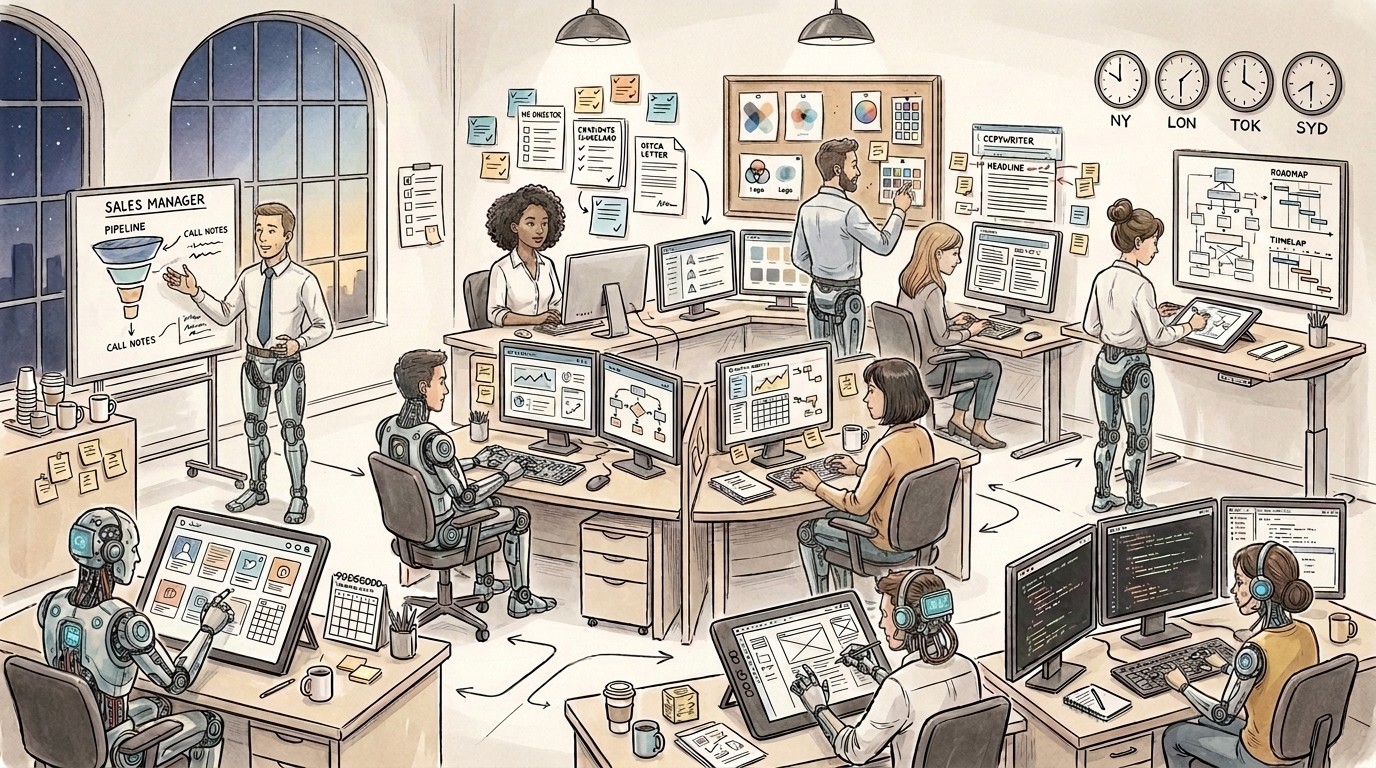
That's a full bench of roles that work 24/7. A full org chart of function…without the hiring.
Two things make it work…and both get missed.
First, it has to be nearly everyone, not one power user. The data is blunt here. AI "power users" send about 6x more AI messages than the median employee (OpenAI, 2025). Median users save around 6 hours a week. The ones who actually embed AI into their workflow save around 11 hours a week…more than a full day per staff member. (EY, 2025…this is increasing over time).
One champion with a chatbot rarely moves the company number.
Fifteen people each running a bench of agents is a different company.
Second, it only works once the base is clean. That's why so few have it. Only about 23% of larger organizations are scaling any agentic system at all, and inside any given function it's 10% or fewer (McKinsey, 2025). The winners aren't the ones with better AI. They're the ones who redesigned the workflow first. The documented 2 to 10x gains show up only with that redesign, not by dropping agents onto human-shaped processes (MIT HDSR, 2026, and BCG Platinion, 2025).
What it feels like to operate this way is the strange part. The work still gets done, but you're not the one grinding it out.
You review, you decide, you point. Your team of 15 feels like an army.
The Conservative ROI of an Agentic OS Across Your Team
Now the math. Same company as last week, on purpose: $2.0M revenue, 40% margins, $0.80M profit, 15 people.
Everything below is an illustrative projection, not reported data. Because I don’t want to report on the gains from our company, but rather our clients at the 6 month mark…which we’re still collecting (but it looks better than what you’ll see below).
I'm using deliberately conservative numbers so the floor is honest.
Rollout order: CompanyOS goes in at month 0. Agentic OS layers on around month 6, once the OS has 3 to 6 months of stability under it. That gap isn't a delay…it’s the precondition.
The role bench. Those eight-plus roles, hired as humans, run you roughly $500K a year in salary. Accessed as an agentic layer on top of your OS, you get that capability for around $60K a year.
Sit with that. Half a million dollars of function for the cost of one junior hire.
The productivity lift. Across your existing 15 people, the agentic layer adds roughly a 35% lift. Not by replacing anyone. By handing every one of them a bench, so their hours go to the work only a human can do.
We need to be clear on two assumptions before I show you the curve.
No double-counting. The role bench and the hires you avoid are the sources of the growth. The profit is the result. You never add them together. The $500K bench does not get stacked on top of the profit it helps produce. That's counting the same dollar twice.
Value unlocked is not cash returned. That $500K bench is capability you could never have afforded at this size. It's real, and it matters. But it's shown, not counted. The only figure that goes into ROI is profit actually produced, divided by what you spent. Income framing, not cost-savings theater.
So, with both engines running:
🔹 At Month 12 (12 months of CompanyOS, 6 months of Agentic). The OS has added about $0.30M in profit... roughly 6x ROI on the installation.
The agentic layer, only six months in and still ramping, has added about $0.19M... roughly an additional 3x ROI already.
🔹 At Month 18 (18 months of CompanyOS, 12 months of Agentic). The OS is now around +$0.50M in profit, about 10x ROI.
The agentic layer has matured to about +$0.46M, roughly an additional 7.7x on the installation.
Here's everything plotted together:
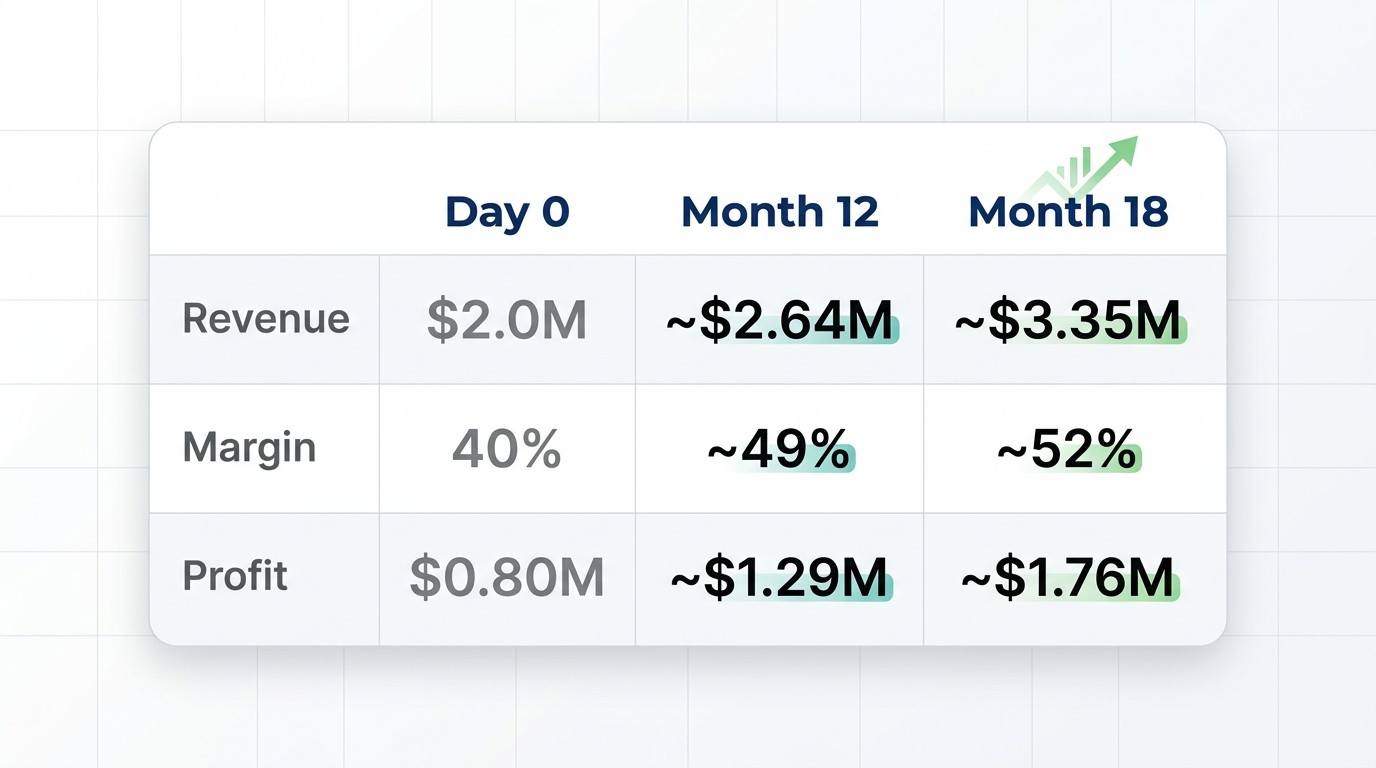
Read the profit line again. $0.80M to $1.76M in 18 months. Margins moved from 40% to 52%, because the same 15 people now access a full bench of experienced and trained agents without the payroll behind it.
Just to be super clear…
These figures are very conservative. We've seen results as high as 6,500% ROI, and that's achievable for teams with the right growth characteristics...which I'll break down in a future issue.
You don't have to take the ceiling on faith. The best SMB-scale proof in the wild is Ljusgårda, a food producer that put a single AI order agent on one workflow. It cut order-management cost by 83% and took that function from 6 people to 1 (Alice Labs, 2025). One workflow.
Now picture that type of ROI across your entire company.
Bringing It Together: CompanyOS + Agentic OS
Two engines. One order.
The CompanyOS is the base. It centralizes information, speeds decisions, ramps new hires, and gives the business distribution to run faster with more capacity and bandwidth. That was Issue 61.
The agentic layer is the 2nd multiplier. It hands all 15 people a bench of highly trained general and specialized agents that can do complex work 24/7, lifts output by another conservative third, and pushes margins meaningfully higher.
But it works because the foundation underneath it is solid. Reverse the order and you risk landing in the 95% of companies that saw little company-wide return despite the effort.
Picture it as a phased build:
🔹 Months 0 to 6. Install your operational engine (CompanyOS). Get information out of your head and into the foundation. Stabilize. 🔹 Months 6 to 12. Layer agentic roles onto the foundation. Start with one role, then widen to the whole team. 🔹 Months 12 to 18. Both engines compounding. Profit roughly doubles from where you started.
I'm not describing this from theory.
A previous company of mine went from $3.5M to $30M on about $400K invested. That's roughly 66x, about a 6,500% return on the growth spend.
Same engine, same order. The base first, then the multiplier.
Final Thoughts
Agentic AI is the multiplier, not a tool to start with.
On a clean operating system it turns 15 people into a company that runs like 40 and roughly doubles profit inside 18 months. Bolt it onto chaos instead and you risk landing closer to the 95%: real wins in one corner, but little movement company-wide... because order matters.
If you want this curve mapped against your actual numbers, that's what we install.
Reply and tell me one thing: which role would you hand to an agent first?
I read every response.
See you next week,
Damon Flowers
Founder, Modern Operators
How to get unstuck fast
Subscribe to our free newsletter that helps businesses go from working in the business to on the business.






Stay Updated with Us
Join the free weekly newsletter to see how smart founders operate modern companies.

Frameworks
Operational Models
Alignment


No Spam, Unsubscribe Any TIme