

Teams/Staff
How to Hire for Growth
The Hiring Mistake That Burns Founders Twice
You're stretched. You're overwhelmed. You've been the glue holding everything together for too long.
So you do what every growth-minded founder eventually does… you hire someone to fix it.
You bring in an Operations Director. You hand them the keys. You exhale.
And six months later? You're more in the weeds than before. Your new hire is frustrated. You're frustrated. And somehow, you're doing more work than when you started.
This is one of the most expensive mistakes we see founder-led businesses make.
Let's fix it.
Why This Matters Now
The stakes have never been higher. We've written before about how Operations has fundamentally changed. AI is evolving faster than any technology in history. Decision velocity is now a competitive moat. And the cost of operational drag… of having the wrong person in the wrong role with the wrong brief… compounds fast.
According to McKinsey (2024), companies with strong operational infrastructure make decisions 2.3x faster than their peers and adapt to disruption without losing momentum. But here's the part nobody talks about: that infrastructure has to be built before it can be *run.*
Most founders are hiring someone to run a system that doesn't exist yet. They're handing car keys to someone who has never built a performance car before.
Consider a prospect we'll call David. Seven-figure agency. Sharp founder. Burned out. He was in the process of hiring an Operations Director. The candidate looked great on paper… strong background in ops, managed teams before, solid references. But when we asked David a simple question… "What do you want this person to own, and how will you know they're succeeding?"… he had a hard time answering…beyond just “have things run smoothly”.
No documented vision. No defined outcomes. No clarity on what "good operations" even looked like for his business.
He wasn't hiring an Ops Director. He was hiring someone to figure out what he should have figured out himself first.
The Designer vs. The Executor
There are two fundamentally different hires. And most founders confuse them.
🔹 The Designer builds the strategy, architects the system, and creates the framework from scratch. They bring specialized expertise in building operational infrastructure. They've done it before, in environments similar to yours, and they know how to create a foundation that fits your specific business.
🔹 The Executor runs the strategy, improves the existing system, and drives performance within a defined framework. They're exceptional at optimization, accountability, and keeping a well-designed machine running at peak efficiency.
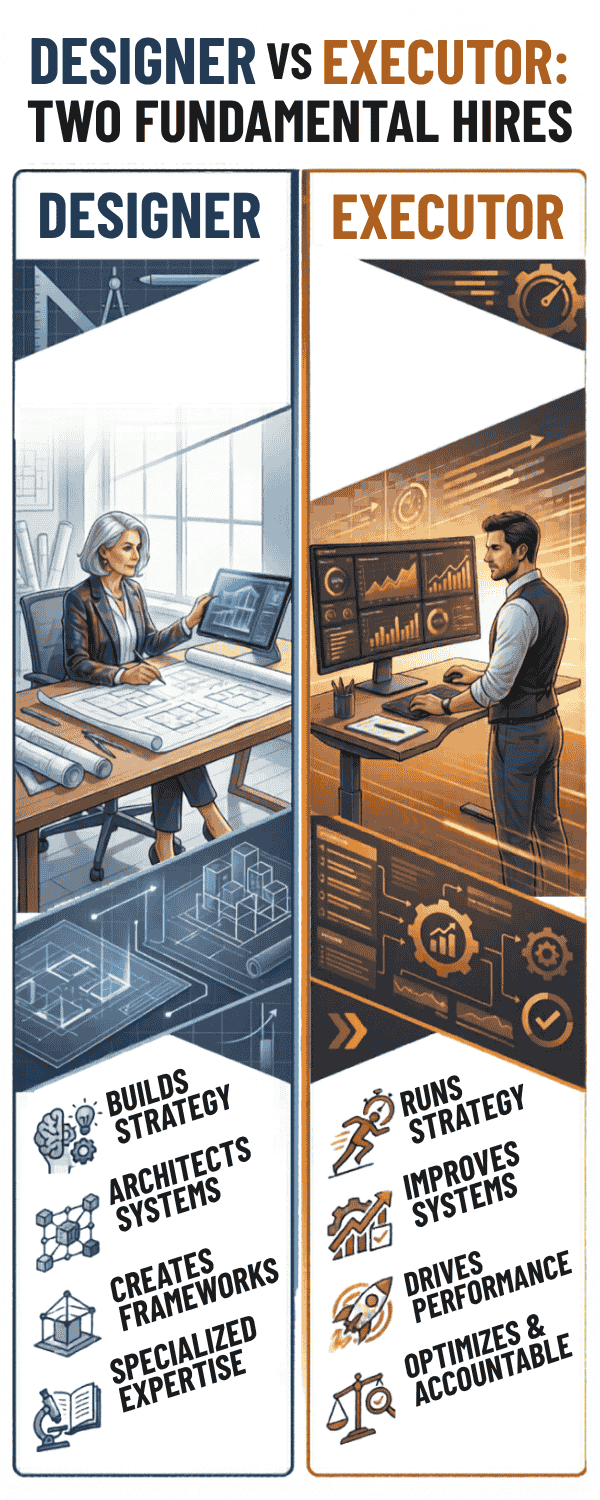
Both are valuable. Both are skilled. But they are not the same person. And they should not be hired the same way.
Think about sales. Most founders who have achieved product market fit don’t hire a salesperson and say: "Figure out our sales strategy, build the CRM process, design the pipeline, write the scripts, and then close deals." That almost always leads to failure. Smart founders who are following the executor path build the sales strategy (or brings in a specialist to design it), documents the process, and then hires a salesperson to execute and continuously refine it.
But in Operations? Founders make this exact mistake constantly.
They hire an Ops Manager and say: "Figure out our operations. Build the systems. Set up the tools. Improve the system and keep everything moving smoothly while you do it."
It sounds smart until we say it out loud.. Then we can all see…it’s a trap.
Why the Wrong Ops Hire Makes Everything Worse
How a well-intentioned hire ends up deepening the very problems you were trying to solve.
Here's what's actually happening when the wrong ops hire walks through your door.
The new hire doesn't know what you know. They don't know why certain decisions were made. They don't know your clients, your culture, your non-negotiables. They arrive with a blank canvas and a head full of "how we did it at my last company."
So they start building. And what they build reflects what worked somewhere else. Different industry. Different company stage. Different team dynamic. Different vision entirely.
Meanwhile, you (the founder) are watching them build the wrong thing… but you're not telling them clearly what the right thing looks like, because you haven't defined it yourself. You're frustrated they're not reading your mind. They're frustrated you keep jumping in and changing direction.
The result? A tug of war. You step back in. The ops hire feels undermined. Trust erodes. And tribal knowledge stays exactly where it always was: in your head and in the heads of your longest-tenured staff.
⚠️ Here's the real cost: siloed, disconnected tools only make the problem worse…not better
Every era of business since the 1970s added new tools to solve specific problems. By 2024, the average mid-sized business was running 25+ software applications. An ops hire who doesn't know your vision and isn't equipped with a modern systems framework doesn't consolidate that stack. They add to it. They bring tools that worked somewhere else. They build automations based on their mental model.
And the founder becomes more embedded as the integration layer, not less.
The tribal knowledge deepens. The bottleneck grows. The business stays founder-dependent. Every new hire that arrives spends their first 90 days asking questions that have already been answered a hundred times, but were never written down, because no one ever owned that either.
🧠 Think of it this way: you didn't hire someone to remove you from the system. You hired someone to build a version of the same system with you (and often other bottlenecks) still in the middle of it.
The Hidden Responsibilities Nobody Interviews For
Here's what makes this especially critical right now: the role of Operations is quickly being redefined completely.
Modern Operations isn't back-office administration. It's not just keeping the trains running. It is the connective tissue of your entire business. And the ops hire who doesn't understand this isn't just underperforming… they're actively pulling your company backward into patterns that no longer work.
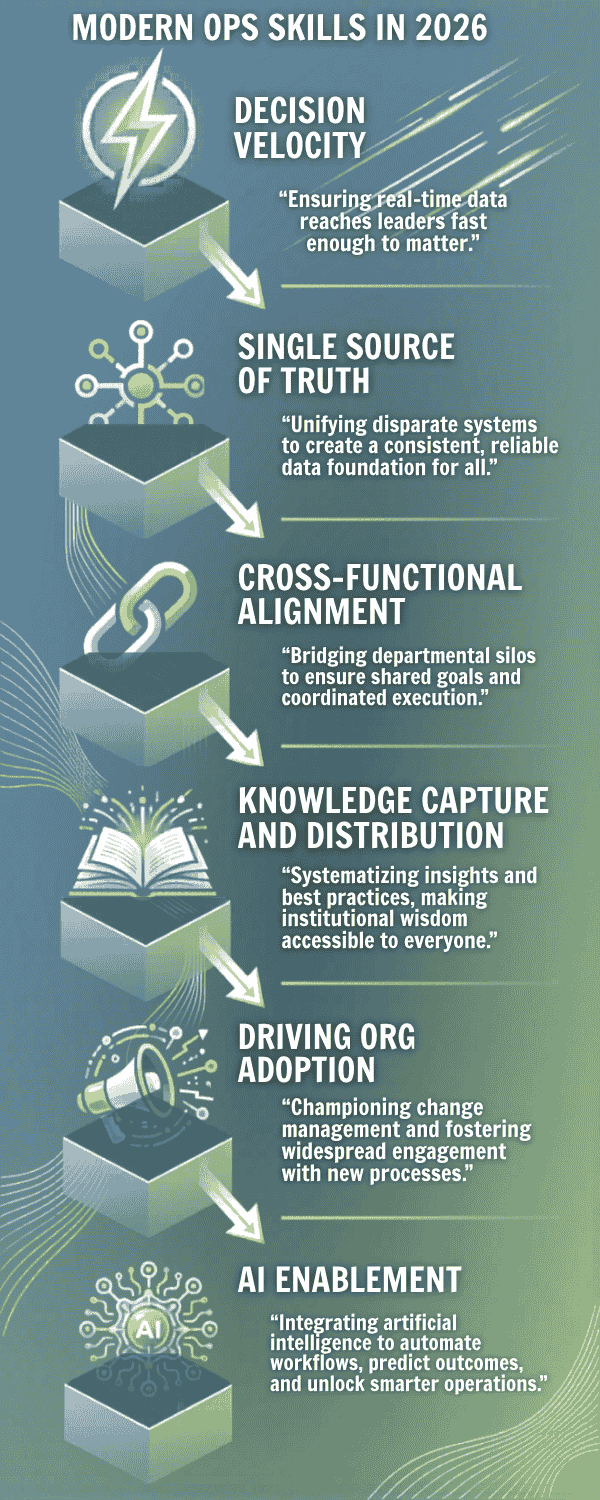
Here's what a Modern Ops hire needs to be responsible for in today’s business climate:
🔹 Decision velocity by ensuring real-time data reaches leaders fast enough to actually matter.
🔹 Single source of truth by creating and maintaining a centralized operating layer where strategy, processes, and knowledge live.
🔹 Cross-functional alignment by bridging marketing, sales, finance, and fulfillment so no team operates as an island.
🔹 Knowledge capture and distribution by converting tribal knowledge into documented, living systems your team can actually use.
🔹 Driving org adoption by rolling out new processes, tools, and frameworks in ways that stick, not just launching them and hoping for the best.
🔹 AI enablement by building the clean, structured data layer that makes intelligent automation actually work instead of amplifying your existing bottlenecks.
Most ops candidates being interviewed right now?
They're being evaluated on whether they're "organized," whether they've "managed teams," and whether they can "keep things on track."
Nobody is asking:
"Have you ever built an integrated Company OS from scratch?"
"How do you drive adoption when half the team resists new systems?"
"How do you apply AI in a growing organization that doesn't yet have clean data?"
Those questions aren't even on most founders' radar. And that's exactly how they end up six months in, staring at a business that hasn't changed.
According to BCG (2024), 74% of companies struggle to achieve and scale value from AI. The primary culprit? Operational infrastructure that isn't built to support it.
That infrastructure is what Modern Ops is supposed to design, own, and continuously improve.
How to Hire for Growth
Before you schedule that first interview or hire that candidate, do this work. Everything else comes after.
Define the purpose and ownership area. What does this role own? Not tasks. Outcomes. "Own our operations" is not a purpose. "Own the design, implementation, and continuous improvement of our Company OS, including systems, knowledge management, cross-functional alignment, and AI integration" is a purpose. One paragraph. Write it before you write anything else.
List 5 to 7 core functions. These are the categories of work that holistically support that purpose. Not every task, the domains of responsibility. Example: (1) Process design and documentation, (2) Tool stack management and integration, (3) Cross-functional alignment rhythms, (4) Knowledge capture and distribution, (5) AI and automation implementation, (6) New hire onboarding infrastructure, (7) Operational metrics and visibility.
Define the key metrics. This is how both you and the hire will know the role is succeeding. Examples: decision cycle time, process documentation coverage rate, new hire time-to-productivity, system adoption rate across the team, automation ROI. If you can't define what success looks like, you cannot hire for it. Full stop.
Map the knowledge flow. What processes, documentation, and institutional knowledge does this role need to receive to do the job well? What does it need to produce and distribute to the rest of the team? Who needs to be trained? Who needs to buy in? This is the part that makes everything compound over time. Skip it, and the knowledge stays in people's heads forever.
Interview for what you actually need. If you need a Designer, ask directly: "Walk me through a time you built an operational system from scratch. What was the starting state? What did you build? How did you drive adoption? What broke and how did you fix it?" If they can't answer with real specificity, they're an Executor. Nothing wrong with that. But don't hire an Executor to do a Designer's job.
✅ This week: Write a one-page role brief using all four elements: Purpose, Functions, Metrics, Knowledge Flow. Share it with your leadership team and get alignment before a single interview is scheduled. If you can't write it, that's your signal that you're not ready to hire yet. And that's okay… it means the next step isn't a job posting. It's clarity.
Final Thoughts
The most expensive hire isn't the one who fails outright. It's the one who spends six months building the wrong thing while the founder stays trapped as the operating system.
The world has changed. Operations has changed. The bar for what an ops hire needs to understand and be able to do has shifted dramatically in the last three years alone. Hiring someone because they're "good at ops" without defining what your ops actually needs to become is like hiring a contractor without blueprints and hoping the house turns out right.
Build the blueprint first. Define the role with precision. Then hire the right person to Design and/or execute it right
Clarity before hiring. Every time.
This is Issue 44 of Modern Operators. We help founder-led businesses scale smarter by turning clarity into their ultimate growth lever.
How to get unstuck fast
Subscribe to our free newsletter that helps businesses go from working in the business to on the business.






Stay Updated with Us
Join the free weekly newsletter to see how smart founders operate modern companies.

Frameworks
Operational Models
Alignment


No Spam, Unsubscribe Any TIme